

The mainnet launch is usually treated as the finish line. Code ships, tokens circulate, and the market decides what the project is worth. Everything before that is theory. Everything after is price discovery.
Midnight’s Kukolu launch doesn’t really fit that pattern.
The more I look at the structure around it, the less it feels like a clean starting point. It looks more like a transition that was already in motion before the first block even exists. Distribution is unfolding. Participants already hold NIGHT. And once the network goes live, usage doesn’t need to be bootstrapped from zero.
One detail that makes this clearer is how the genesis block is being handled. The network doesn’t start by minting a brand-new ownership structure. The genesis block mirrors the existing NIGHT distribution on Cardano. So when Midnight turns on, holders already exist. The asset isn’t introduced after launch. It’s carried into it.
That’s a very different starting condition.
Instead of users acquiring the token post-launch and then figuring out what to do with it, some participants effectively arrive at genesis already positioned. The distance between ownership and usage collapses. Once Kukolu goes live, the only thing that changes is that the network becomes usable.
It also changes how early activity should be interpreted. The first transactions aren’t speculative entries. They’re existing holders interacting with a system that suddenly became live. That creates a quieter, more organic opening phase compared to launches where everything starts simultaneously.
The bridge design reinforces that pacing. The initial protocol-level bridge from Cardano to Midnight is one-way. Assets can move into Midnight, but not immediately back through the same route. A two-way bridge is planned later, after mainnet stabilizes.
That creates a subtle early dynamic.
Moving NIGHT into Midnight isn’t just a quick test. It’s a directional decision. Participants entering the network are effectively choosing to interact within it, at least for a period of time. That reduces the likelihood of rapid in-and-out flows and shifts the early focus toward actual usage.
Even the timing of the genesis block contributes to this feeling. It’s created at the end of the Scavenger Mine period, not abruptly. The launch reads less like a switch being flipped and more like one phase rolling into another. Distribution, ownership, and activation overlap instead of happening sequentially.
Nothing really resets at mainnet.
It simply becomes usable.
That overlap changes what a mainnet launch represents.
Normally, participants wait for launch before forming opinions. They test, they transact, they measure friction. Here, some participants will arrive at Kukolu already holding NIGHT. Once the network opens, activity doesn’t depend on buying the token. It depends on whether holders decide to start using it.
The trigger shifts from speculation to activation.
I keep thinking about how that affects early behavior. On many launches, the first wave is chaotic. People rush in, test throughput, push transactions, and disappear. Activity spikes artificially. It’s hard to tell what real demand looks like.
With Midnight, the first interactions might unfold more gradually. Holders already exist. Some will engage immediately. Others will wait. Some will move assets through the one-way bridge and explore. Others will observe. The launch environment becomes layered instead of synchronized.
That makes early signals easier to read.
Another piece that stands out is how this interacts with the dual-token model. As soon as NIGHT is held within the live network environment, DUST generation begins. That means the ability to transact doesn’t depend on immediate market activity. Operational capacity accumulates naturally.
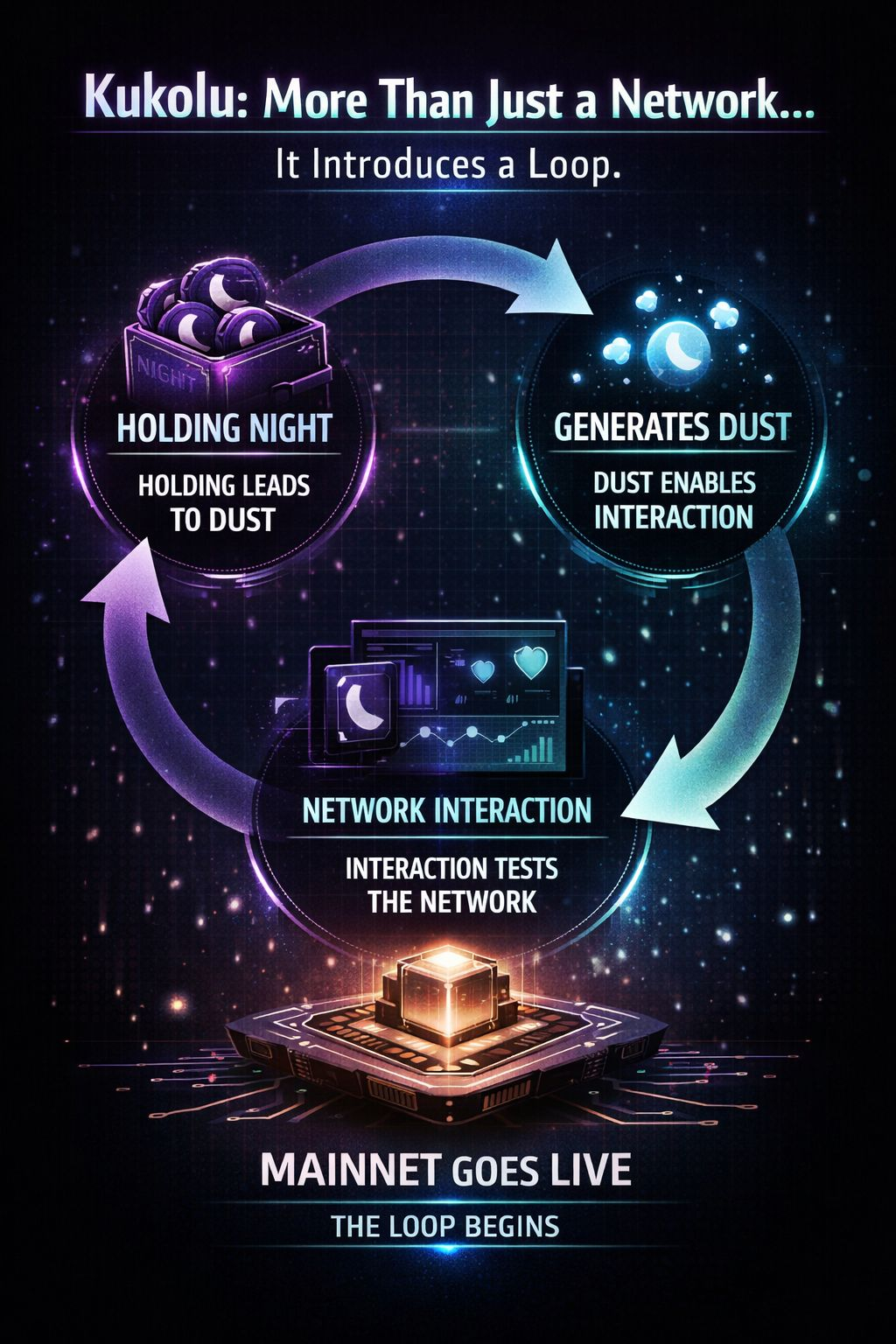
So Kukolu doesn’t just introduce a network. It introduces a loop.
Holding leads to DUST.
DUST enables interaction.
Interaction tests the network.
And all of that starts the moment mainnet goes live.
That could soften the typical launch spike. Instead of everyone needing to acquire gas immediately, some participants already have the means to interact. Usage can spread across time rather than clustering in the first few hours.
It makes Kukolu feel less like an event and more like a transition.
The federated structure of the launch also matters here. Kukolu isn’t attempting instant full decentralization. It begins with a defined set of operators, allowing the environment to stabilize before expanding. Combined with gradual participation, this creates a contained phase where real behavior can be observed without extreme volatility.
Early activity becomes meaningful data instead of noise.
If holders begin interacting steadily, it suggests confidence. If assets move into Midnight through the one-way bridge but interaction remains limited, that suggests caution. The network doesn’t just measure throughput. It measures willingness to engage.
That’s a more useful signal than raw transaction counts.
I also keep coming back to how this affects builders. Deploying on a fresh mainnet usually means uncertainty. Users may not arrive. Fees may fluctuate. Liquidity may not exist yet. But with Midnight, some of that uncertainty is reduced. Holders exist at genesis. Capacity begins accumulating immediately.
Builders aren’t launching into an empty environment.
They’re launching into one where participation is already forming quietly. That doesn’t guarantee adoption, but it creates a different starting point. Instead of waiting for users to arrive, applications can appear while users are already present.
The ecosystem builds alongside the launch.
Governance timing adds another layer. NIGHT holders who begin interacting during Kukolu are also the ones who will influence future protocol decisions. That ties early feedback directly to participants who are economically aligned with the network’s direction.
It tightens the loop between usage and evolution.
Instead of external observers testing the system, holders experience friction themselves. Their feedback reflects actual participation. Kukolu becomes less about proving the technology and more about calibrating it under real conditions.
The more I think about it, the more Kukolu looks like a soft ignition rather than a spark. Ownership exists before launch. Bridges allow directional movement into the network. Capacity begins accumulating immediately. And interaction unfolds gradually.
Nothing starts from zero.
That’s probably the most unusual part. Midnight isn’t launching into silence. It’s launching into a system that’s already slowly turning. The first block doesn’t create activity. It reveals it.

And that changes how the mainnet launch should be interpreted.
Instead of watching for a sudden spike, it makes more sense to watch consistency. Are holders moving into Midnight through the bridge? Are they interacting once capacity accumulates? Does activity grow as more participants enter the live environment?
Kukolu isn’t trying to prove everything in a day.
It’s trying to show whether the loop actually holds once the network becomes real.
