

When people hear “privacy chain,” they usually think of hidden transactions and black-box ledgers.
That was my first instinct too.
But after hearing Midnight’s team speak, somewhere between the noise of the conference floor and those spontaneous hallway conversations at Consensus Toronto, I started to see the project differently.
They are not pitching a privacy coin. They keep describing Midnight as a programmable privacy layer, and that distinction matters.
Because the real problem is not whether blockchains should be transparent. They have to be. That is part of what makes them trustworthy. The problem is what happens when that same transparency runs into real-world use cases like finance, identity, or healthcare. In those settings, full exposure does not work. But total secrecy does not work either. Regulators will not accept it, and users should not have to trust something they cannot verify.
That is the gap Midnight is trying to fill.
Not with all-or-nothing privacy, but with rational privacy: selective disclosure.
That sounds simple, but it is not.
Take identity as an example. Instead of revealing who you are, you prove that you are allowed to do something. In an auction, you might prove that you have enough funds without revealing the exact amount. In theory, that sounds elegant. In practice, it is hard, because once you disclose some information, that information itself can become part of the strategy. People will try to game whatever is visible.
So the system has to be designed for real behavior, not ideal behavior.
That is where Midnight gets interesting.
At the contract level, it does not force everything into one mode. Smart contracts can mix public and private states. Some variables remain visible. Others are shielded with zero-knowledge proofs. That means you can build applications where sensitive information stays hidden, but the result is still verifiable. Auditors do not need to see the raw data. They just need confidence that the rules were followed.
That is the real value: proving correctness without exposing everything behind it.
The token model is also more practical than it first appears.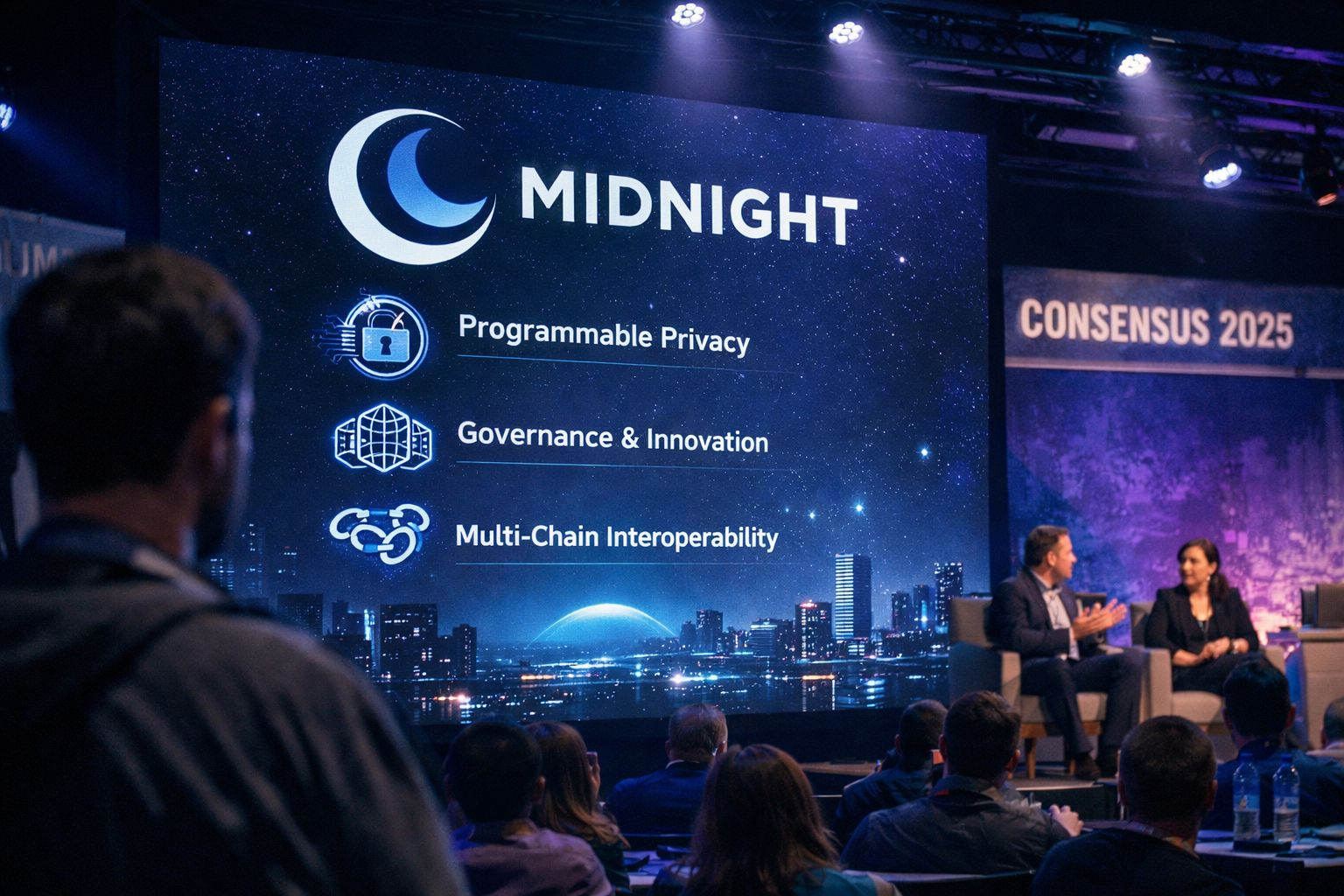
NIGHT handles the usual network functions like security and governance.
DUST is where the system becomes usable.
It pays for shielded computation, and unlike a tradable token, it is generated in a predictable way. That matters more than people think. Volatile fees are one of the biggest problems in privacy-focused systems. If you are a business trying to run private logic at scale, cost predictability is not a nice-to-have. It is essential.
The cross-chain angle is another part worth paying attention to.
Midnight does not require everything to move over. You can keep parts of your application on Ethereum, Cardano, or elsewhere, and only use Midnight where privacy is needed. Users can even interact with their native assets. That avoids duplication and reduces fragmentation across identity and liquidity.
At least, that is the promise. Execution will decide how real that promise is.
What stands out most is that Midnight seems to be aiming for something more grounded than the usual privacy narrative.
Not perfect secrecy. Not maximum transparency. Just enough disclosure to satisfy both usability and trust.
That is a much harder problem than it sounds.
Full privacy is easy to talk about. Real systems are not built that way.
I am still not fully convinced they have solved the balance, because the trade-off between transparency and compliance is brutal. Most projects underestimate that. But this approach feels more realistic than the usual extremes.
It is not about hiding everything.
It is about proving just enough, and keeping the rest protected.
@MidnightNetwork
#night
$NIGHT
