Every time you prove who you are, you overshare. Show a passport to confirm your age and the person on the other side sees your full name, birthdate, nationality, passport number. Submit bank statements to prove income and the entire transaction history goes with it. The system wasn't built for privacy. It was built for paper and we just scanned the paper.
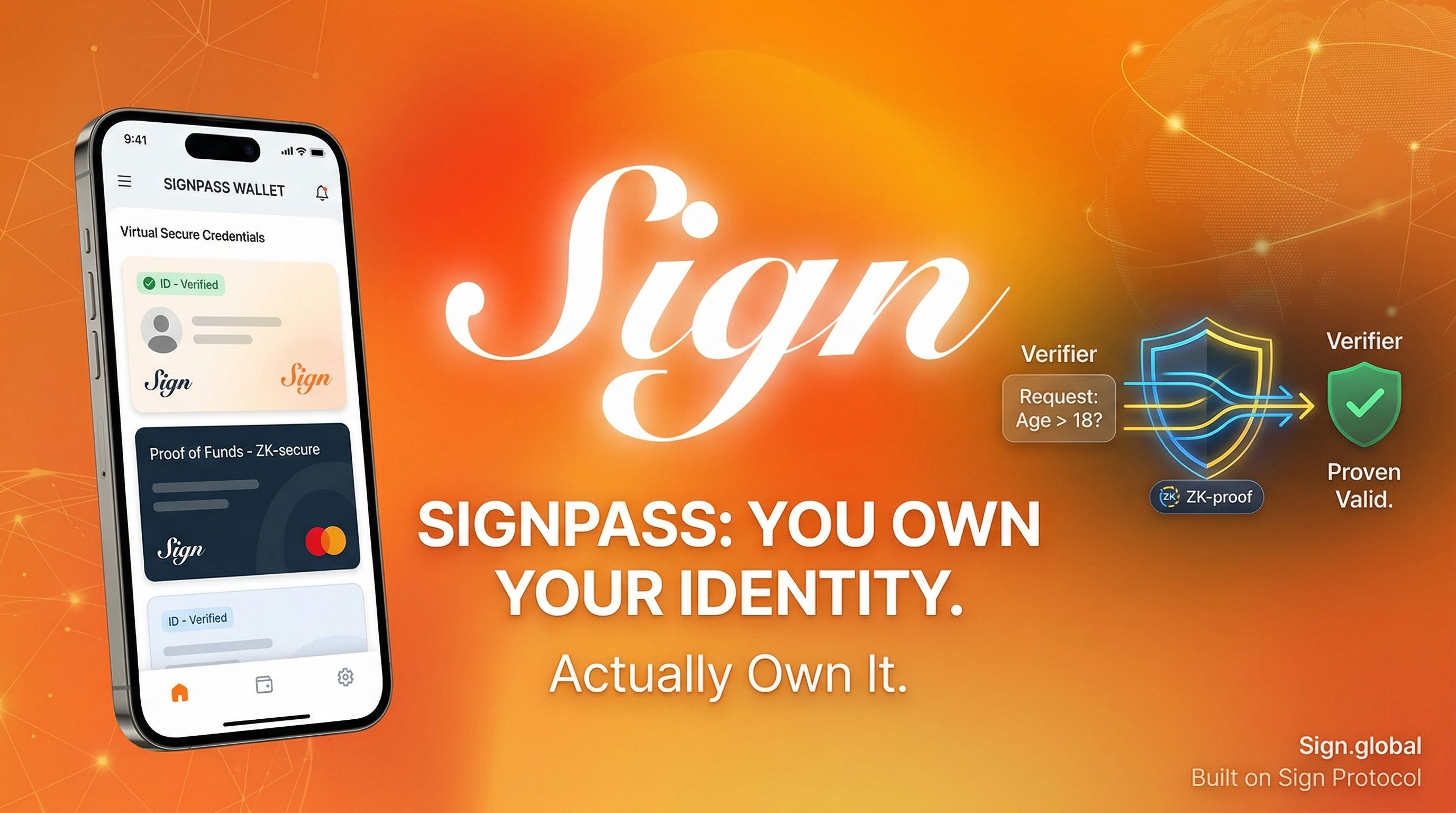
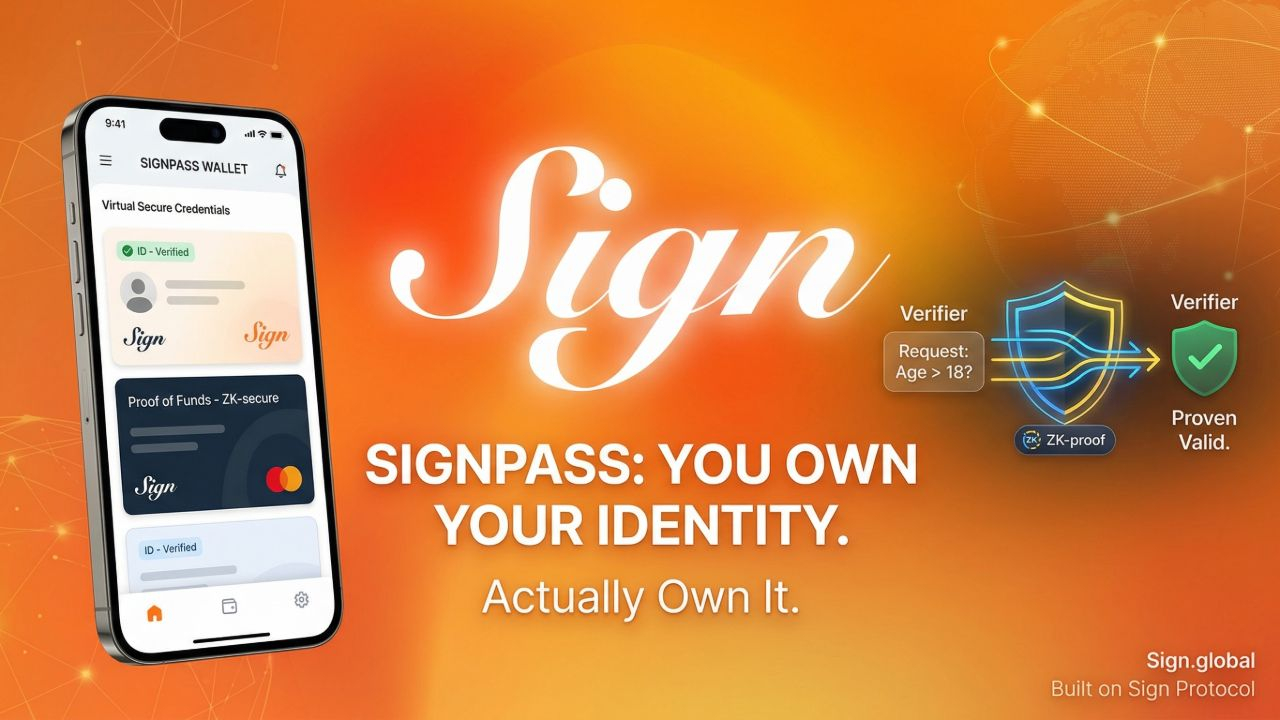
SignPass is Sign.global's answer to that problem. And the way it works is worth understanding properly.
The core mechanic is simple. When an issuer, a government agency, university, or bank, creates a credential through Sign Protocol, that credential doesn't sit on a central server. The hash and cryptographic proof go on-chain. The actual data lives in your wallet. Your wallet. Not Sign's servers. Not the issuer's database. Yours. If the issuer shuts down tomorrow, your credential still exists. If you lose your phone, you recover with a seed phrase and everything is still there.
That's a fundamentally different architecture from every existing digital ID system. Your passport data lives in a government database. Your bank's KYC records live on their servers. Your LinkedIn profile lives on LinkedIn's infrastructure. SignPass flips that. The credential belongs to the holder, not the institution that issued it.
The selective disclosure piece is where Sign's technical depth shows. When a verifier requests proof, say a bank asking you to confirm income above a threshold, SignPass doesn't send your full financial history. It generates a presentation containing exactly the two claims requested. You confirm with PIN or biometrics. The verifier gets a cryptographic proof that the claims are true. They never see your actual income number, your birthdate, or anything else. Just a valid yes to the specific question they asked.
Combined with ZK-proofs, you can prove you're over 18 without revealing your age. Prove your income exceeds a threshold without showing the number. The whole verification takes 0.03 seconds via QR or NFC. No gas fee for standard verification. No central log of who checked what.
The revocation system works both ways. Issuers can invalidate a credential instantly through Sign Protocol. The revocation status updates on-chain immediately, so any verifier checking it gets the current state in real time. No calls to a central authority. No waiting. On the holder side, you can hide, pause, or delete a presentation without touching the underlying credential. You can also see exactly who verified which credential and when. Full audit trail, fully under your control.
In the SIGN Stack, SignPass functions as the identity layer that everything else plugs into. Digital SOM CBDC uses it for citizen verification. Sierra Leone's national ID program runs through it. The same wallet that holds your credentials can handle programmable money and tokenized assets. One self-sovereign wallet for identity, payments, and capital.
Now the honest part. SignPass works beautifully as infrastructure. But infrastructure only matters if institutions actually accept it. Right now, the verifier network is thin. Kyrgyzstan and Sierra Leone are live deployments, but for the average person, finding a bank or government service that accepts a SignPass credential outside those countries is still a question mark.
The W3C Verifiable Credentials standard is open and Sign Protocol runs omni-chain, which means the interoperability foundation is solid. But adoption on the verifier side moves at government speed. And government speed is not crypto speed.
The privacy architecture is genuinely better than anything in traditional ID systems. The question is how long the gap stays between "technically superior" and "universally accepted."
That's the thing worth watching.
@SignOfficial #SignDigitalSovereignInfra $SIGN