
This is not a neutral setup.
April unlock is coming. The market is already leaning short. Everyone is running the same trade. Here is what they are missing.
The Narrative Everyone Is Running Is Wrong
Low float. Big unlock. Sell the news.
Clean setup. Simple logic. And honestly it will probably work for a day or two.
But that entire framework is built on one assumption: that supply is the only variable that matters right now. It ignores something more important how demand is actually behaving inside this structure. And those two things are no longer telling the same story.
That is the misread.
What The Numbers Are Actually Saying
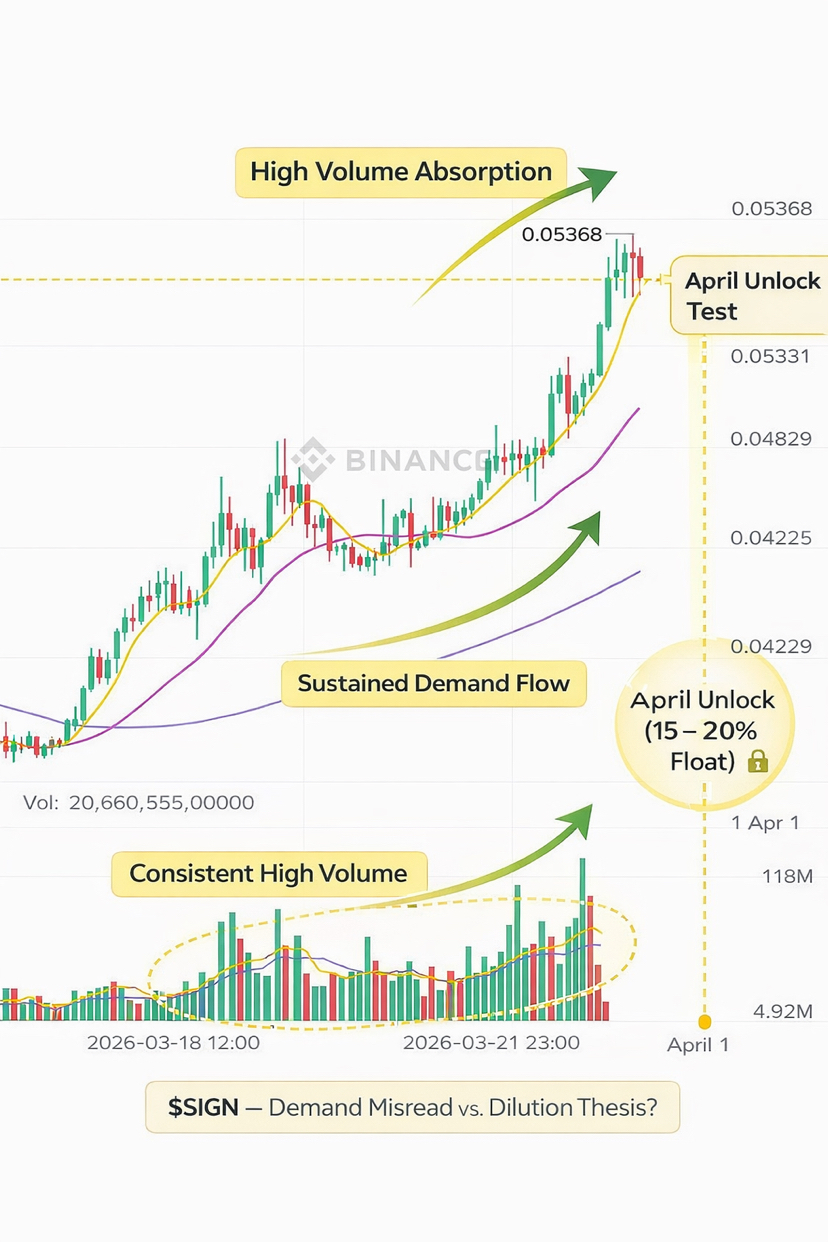
$SIGN is trading around $0.053. Market cap sits near $85–87M. FDV is above $520M. Only 16.4% of supply is circulating.
Standard read? Dilution incoming. Exit before the unlock hits.
But that reading skips the most interesting part of this setup.
Daily volume has been consistently running between $50–60M somewhere between 60 and 70% of total market cap rotating every single day. At that level of turnover, price should be fragile. Reactive. All over the place. It is not.
There is only one clean explanation for that.
A portion of that volume is not coming back to the order book. It is being absorbed into the system and staying there. The float is not behaving like fully liquid inventory. Something is removing supply from active circulation on a consistent basis.
I have been tracking wallet movement over the last several days. Exchange outflows on the Ethereum side have been quiet not explosive, not headline-grabbing just steady and directional. Tokens leaving exchange custody without triggering any disorderly price action. That is what real accumulation looks like. It does not announce itself.
The Holder Structure Is Being Read Backwards
Total holders across platforms are sitting above 16,000. Direct on-chain Ethereum holders are still in the low hundreds.
Most people look at that gap and immediately call it weak distribution. Retail has not shown up. Conviction is thin. Move on.
That reading misses the phase this asset is actually in.
sign is still staging. Users are entering through Binance and through incentive layers and not all of them are immediately rotating out. A portion of that demand is quietly converting into real positioning before it ever shows up clearly in on-chain metrics. It is not visible yet. That does not mean it is not happening.
The Binance concentration makes this more interesting, not less. Around 60 to 65% of all volume is moving through one venue with significantly thinner books everywhere else. In most situations that would be a concern. Here it is compressing demand into a tighter space. Inflows hit harder. Spreads stay tighter than the underlying liquidity should allow. Absorbed volume leaves a more visible impact on structure than it normally would.
This is not permanent. But right now it is reinforcing stability rather than creating fragility.
The Incentive Layer Is Not What You Think
Campaign-driven volume gets dismissed almost automatically. Tourists chasing rewards, dumping the moment the campaign wraps up. That assumption is correct often enough that it becomes the default.
Look more carefully at where this particular flow is actually going.
A meaningful segment is not just collecting rewards and exiting. It is being redirected into genuine ecosystem usage attestations, credentials, ongoing interactions that have utility beyond the initial incentive. Tokens connected to those functions carry a different behavioral profile. The person holding them has a reason to keep holding that exists independently of the price chart.
That is the inflection point most people are not pricing in. Short-term participation quietly becoming retained demand. Not all of it converts. But enough of it is moving in that direction to change the character of the float.
April Unlock This Is Where Everything Gets Tested
Somewhere between 290 and 400 million tokens are scheduled to enter circulation. That is roughly 15 to 20% of the current float arriving at once.
This is real supply pressure. I am not arguing otherwise.
But the emission schedule runs linearly through 2030 with no aggressive front-loaded cliff. No single massive dump point engineered into the structure. That pacing matters because it gives the current demand behavior actual room to prove itself rather than getting immediately overwhelmed before it can.
The next 30 days will answer the question directly.
If post-unlock volume holds above 25 to 30% of market cap without collapsing, if holder count continues expanding, and if on-chain activity reflects actual usage rather than pure exchange rotation the structure is real. Demand is not just arriving. It is staying.
If volume falls below 15% of market cap outside of specific catalyst windows, if larger wallets begin visibly distributing, if new supply simply sits there without being absorbed then the current stability was always conditional. The demand was incentive-driven noise, not structural conviction. And the unlock confirms the dilution thesis.
One of those two outcomes is going to become obvious fairly quickly after the unlock hits.
Where This Either Breaks or Gets Validated
The market has made its decision. $SIGN is a dilution story. Supply wins. Get out before the unlock.
There is a different read available if you are willing to look at the demand side with the same attention most people are giving the supply side.
Demand persistence is being underestimated here. The structure is already adapting before full supply has arrived. The float is not behaving like an asset waiting to be sold down. It is behaving like an asset where a portion of the available supply has already been quietly removed from the equation.
The unlock is going to resolve the argument one way or the other.
Until it does this is not a low-float token sitting passively while dilution approaches.
It is a system actively testing whether the demand that has arrived is real enough to hold when the pressure finally comes.
If that demand holds, the market did not misprice the supply.
It misread the demand entirely.
Watching closely. Positioned accordingly.