

#SignDigitalSovereignInfra @SignOfficial
I spent a long time thinking digital identity was basically solved. Not perfectly, but solved enough. You log in with Google, bank verifies you, government issues a passport. Infrastructure exists. Felt like a problem with rough edges, not a real gap.
Then I started looking at how cross-border identity actually works in the Middle East. Turns out the rough edges were the whole story.
UAE has UAE Pass. Eleven million users, fifteen thousand connected services. Works brilliantly inside the country. But step outside — bring in a foreign contractor, verify credentials across Gulf free zones that each operate as separate jurisdictions — and suddenly you're back to paper, PDFs, and third party verification. The system that works at home doesn't travel.
Thats the gap Sign is trying to fill. And its a specific gap, not a vague one.
Sign Protocol started as EthSign, a blockchain document signing app. Five iterations later it became the number one contract signing app in Web3, built interfaces in Telegram and LINE, reached 300,000 users. Then the team made a different bet. Instead of staying an application, they decided to become infrastructure. The attestation layer underneath everything else.
An attestation in Sign's model is a cryptographically verified statement about anything. A credential, a qualification, a government ID. Once issued on-chain, any application on any chain can verify it without calling back to a central authority. Not just creating identity — making identity usable everywhere it travels.
The system is already running in three countries. UAE, Thailand, Sierra Leone. Each deployment is different and that difference is worth understanding.
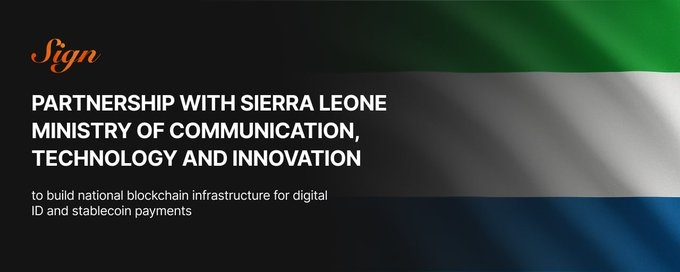
Sierra Leone is the most documented and the numbers are striking. Two thirds of citizens financially excluded despite digital infrastructure existing. 73% have identity numbers but only 5% hold actual identity cards. Without the card you cant open a bank account, cant receive government services, agricultural payments, pensions. The chain breaks at the first link.
Sign's MOU with Sierra Leone's Ministry of Communications, signed November 2025, targets exactly that. Blockchain-based digital ID that lets someone with a verified on-chain credential access financial services, receive payments, participate in government programs. The identity doesnt disappear when a bureaucratic record gets lost. It lives on-chain, portable, verifiable.
Sierra Leone matters for the Middle East argument not because the problems are the same — they're not. But it shows the model actually works in a real government context. Thats further than most Web3 identity projects ever get.
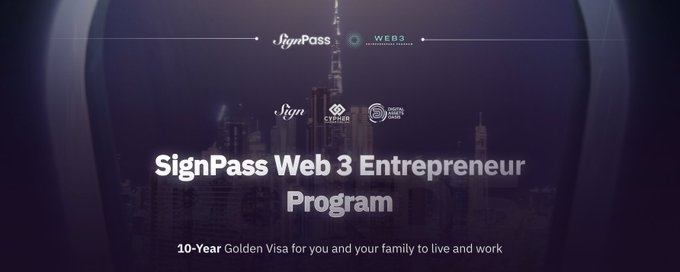
Now apply that to the Gulf.
The Middle East has a different problem than Sierra Leone. Not exclusion, fragmentation. Millions of expat workers whose credentials — medical, professional, educational — need reverification every time they cross a border, change employers, move between DIFC, ADGM, and mainland jurisdictions with different regulatory frameworks. Saudi Arabia building NEOM from scratch. Qatar running a World Cup on a temporary workforce needing rapid credential verification at scale.
UAE Pass works domestically. It doesnt create interoperable credentials that a contractor in Riyadh can verify about a worker from Karachi. Sign's attestation layer is specifically built for that cross-chain, cross-border problem.
Dubai has committed to moving all government transactions onchain by 2030, projecting 5.5 billion dirham in annual savings. That's not a whitepaper claim, it's a budget commitment. The infrastructure needed for that transition has to handle identity at the sovereign level. Verifiable, auditable, not dependent on any single company's servers.
TokenTable adds another layer that's easy to overlook. Over four billion dollars distributed to forty million wallet addresses across two hundred projects. That's not a lab test. That's the distribution infrastructure that handled real money at real scale. When a Gulf government needs to distribute subsidies or pension payments to millions of verified citizens, that engine needs to already exist. TokenTable already does.
Revenue matters here, too. Fifteen million dollars annually. Most Web3 infrastructure projects have no revenue model. Sign has one. That changes the risk calculation for any government considering a long-term partnership.

The honest caveat though — UAE deployment details are still vague publicly. Sierra Leone MOU is documented and timestamped. UAE integration is confirmed but not broken down in any granular way. Which services, how many users, what's live versus planned. That clarity isn't public yet and for a project making sovereign claims, that gap is worth watching.
There's also a deeper tension the sovereignty framing glosses over.
If the UAE government issues your credential on Sign Protocol, it can also revoke it. The blockchain makes it portable and verifiable. But the issuer still controls legitimacy. Sovereignty for the citizen and sovereignty for the state are not the same thing. Sign is building the latter and calling it the former. Worth being clear about that.
What I keep coming back to is the practical question. In five years when Dubai's on-chain target comes due, when Gulf free zones need interoperable identity infrastructure, when cross-border labor flows need a verification layer that doesn't route through a server in California — what does that system look like?
Sign is one of the few projects with real government contracts, real revenue, real distribution infrastructure, explicitly positioned for that exact use case. Whether the sovereign framing holds up or not, the problem it's solving is real.
The market is still pricing this at an early stage. Maybe that's right. Or maybe it's one confirmed government deployment away from becoming something nobody can ignore.
Watching attestation usage and whether UAE specifics ever go public. That's the signal, not the price.
