
I work with a small fintech startup, and last week they asked me a very practical question: is there a blockchain that can store transaction logic and compliance proofs without pushing customer data onto a public ledger?
I paused for a moment because, honestly, I did not have an answer I felt fully confident about. Then I went back to Midnight’s docs and spent quite a while reading. The more I read, the more it felt like this is not just another privacy chain. Midnight is trying to solve a contradiction that most blockchains today have almost accepted as normal: if you want consensus, everything has to be public, and once everything is public, it becomes very hard to fit real-world data protection needs.
From the way I see it, this is the most important part of Midnight’s thesis.
The original problem with blockchains was never that they forgot to add privacy. Public by default was a deliberate architectural choice. Nodes need to see enough information to verify that a transaction is valid without trusting a central party. That is what makes consensus work. But that same design runs directly into the real world, where financial data, user data, or medical data cannot be exposed forever on a public ledger. This is not just a privacy issue in the usual sense. It is a legal, compliance, and data control problem.
What makes Midnight interesting to me is that they are not trying to patch this by adding another layer that simply hides some information on top of a public blockchain. They start from a deeper question instead: does a blockchain really need everything to be public for consensus to work?
Their answer is no, and Midnight’s entire architecture seems to be built around that idea.
The first thing that stood out to me is the dual-state model. Put simply, Midnight separates the state that the network needs to see in order to verify transactions from the sensitive data that the network does not necessarily need to see. Public state holds what validators need to confirm that a transaction is valid. Private state keeps sensitive data on the user side. The bridge between the two is formed by zero-knowledge proofs, where users can prove that a transaction is correct without revealing the underlying inputs.
To me, that is no longer privacy as a feature. It feels more like a redesign of the relationship between consensus and data.
If you follow that logic, Midnight is not just hiding transaction content. It is trying to define exactly which data needs to be revealed, which data does not, and what is sufficient for the network to keep functioning properly. That is a very different approach from how the market tends to group everything together under the label of privacy chain.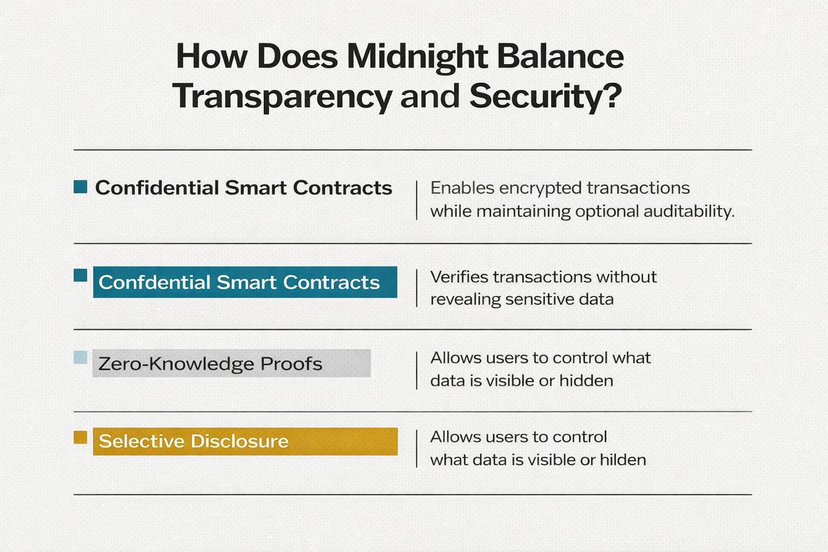
I also think selective disclosure is the part that gives Midnight’s thesis a chance to go further than older privacy narratives. In the real world, businesses do not need to hide everything from everyone. They need the ability to share the right piece of data with the right party in the right context. A regulator may need to see one part. An auditor may need to verify another. A counterparty should only see the minimum information relevant to them. If privacy is just an on-or-off switch, it becomes very difficult to use in environments with real compliance requirements.
Midnight seems to be taking a different path. Privacy is the default, while disclosure becomes a deliberate action. That may sound like a small distinction, but to me it is exactly what separates Midnight from how the market usually understands privacy blockchains. They are not telling a story about hiding everything to become more private. They are telling a story about controlling what data is revealed, to whom, and under what circumstances.
That is why I think the way they describe themselves as a data protection blockchain carries far more meaning than simply calling themselves a privacy chain.
Another point I appreciate is that Midnight is not only trying to solve this at the theoretical level, but also pushing it into the developer experience. Compact appears to be designed so that developers must explicitly define which parts are private and which parts can be disclosed. This matters because many real-world data leaks do not come from malicious intent. They happen because the system does not force developers to think carefully enough about disclosure. If privacy is only a best practice, sooner or later someone will get it wrong. If privacy is embedded into the logic of the language and the compiler, the chances of more consistent implementation become much higher.
From where I stand, this is one of the areas where Midnight is doing better than many projects that talk about privacy but do not really solve the experience of building actual products.
That said, I also want to be direct about the uncertain part, because this is where many infrastructure discussions become too generous.
Getting the architecture right does not mean the problem has already been solved in the real world.
A fintech startup will not integrate Midnight just because the dual-state model sounds elegant. They need to know whether their legal team is comfortable with that model. They need to know whether regulators will see selective disclosure and viewing keys as a strong enough audit trail. They need to know whether the proving system can hold up in production under real transaction volume. And more importantly, they need to know how many developers are actually building applications around this logic instead of just reading the docs and saying it sounds promising.
To me, this is Midnight’s biggest gap right now. The thesis is strong. The positioning is genuinely different. But infrastructure is only proven through adoption, not through a well-written whitepaper.
So if you ask me what Midnight is, I would not call it a better privacy chain. I would say Midnight is trying to become the data protection layer that Web3 still lacks. Privacy is only one part of the story. The larger idea is programmable confidentiality, selective disclosure, and the ability to bring blockchain closer to industries that cannot live with a public-by-default model.
I am not in a NIGHT position yet because I am still waiting for clearer signals from adoption. What I want to see is not just narrative or partnership announcements, but real apps, real users, and real use cases where businesses choose Midnight not because the privacy story sounds compelling, but because its architecture solves a problem that current blockchains still cannot solve.
That fintech startup’s question last week sounded simple, but it actually touched one of the deepest pain points in the industry. Midnight is one of the very few projects that, in my view, is trying to answer that question from the architectural level rather than just through marketing.
That is why I think this project deserves to be read much more carefully than the market currently gives it credit for.
Are you looking at Midnight as a privacy chain, or as a data protection layer for Web3? Drop your view below. I would genuinely like to hear how others are interpreting this thesis. @MidnightNetwork #Night $NIGHT
