something in the $Sign whitepaper doesnt sit right with me...
everyone talking about Sign focuses on attestations, ZK proofs, MiCA compliance. but theres a specific component sitting inside the protocol architecture that raises a control question nobody seems to be asking.
so what actually happens here:
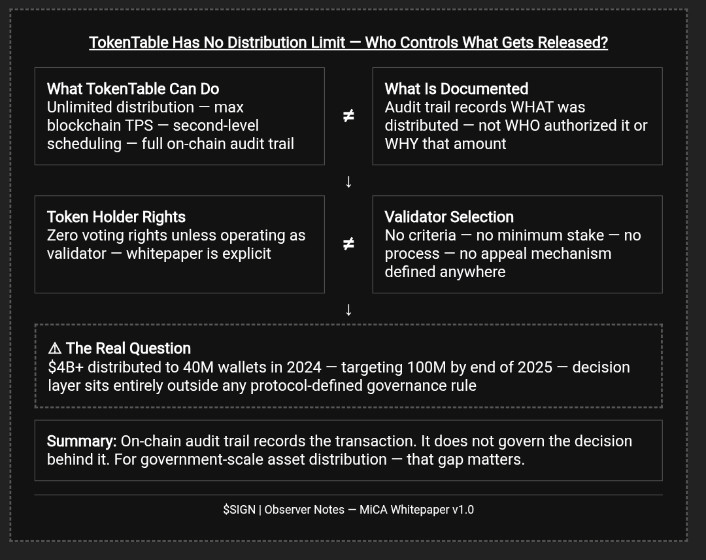
TokenTable — $SIGN's digital asset distribution engine — has no maximum distribution size. unlimited. processes at maximum blockchain TPS. scheduling works at second-level granularity. audit trail stored fully on-chain.
on paper this sounds like pure infrastructure efficiency. a government deploys it, programs the rules, assets flow automatically to citizens. clean, fast, auditable.
but the whitepaper never explains who programs those rules. or who can change them.
the part that doesnt add up:
the SIGN stack lets governments and institutions deploy Sovereign Chains independently. they control the validator set. they control access logic. they control block production. they control upgrade and shutdown decisions.
but SIGN token holders? whitepaper is explicit — no voting rights unless they operate as network validators. and nowhere does the whitepaper define who qualifies as a validator or how selection happens.
so you have a system capable of distributing unlimited digital assets to unlimited wallets — with second-level precision — where the control layer sits entirely with whoever deployed the Sovereign Chain. not with token holders. not with a defined governance body. not with any protocol-level constraint.
in 2024 alone, $SIGN distributed more than $4 billion in tokens to upwards of 40 million wallets. target is 100 million wallets by end of 2025.
what they built right:
the on-chain audit trail is genuinely strong design. every distribution event recorded on-chain. transparent, immutable, verifiable by anyone. for government use cases — subsidies, benefits, public sector payouts — this is exactly the kind of accountability infrastructure that makes blockchain useful beyond speculation.
where it gets complicated:
the audit trail tells you WHAT was distributed. it doesnt tell you WHO decided it, WHY that amount, or WHETHER the decision followed any predefined governance rule. those decisions sit with whoever controls the Sovereign Chain — and that entity answers to no protocol-level constraint the whitepaper defines.
theres a meaningful gap between "on-chain transparency" and "on-chain accountability." one records the transaction. the other governs the decision behind it. for government-scale asset distribution — benefits, subsidies, public funds — that gap matters.
the question nobody answered:
if a Sovereign Chain deployment controls unlimited distribution to millions of wallets — and validator selection is undefined — what stops a single deploying entity from reprogramming distribution rules without any token holder awareness or protocol-level check?
whitepaper doesnt answer this. tbh i dont think its been asked yet 🤔
watching: which governments deploy Sovereign Chains first, whether validator selection criteria ever gets published, how the 100 million wallet distribution target gets authorized and by whom.
what's your take — on-chain audit trail without defined decision governance is real accountability, or just transparency without control?? 🤔
#SignDigitalSovereignInfra @SignOfficial $SIGN