
I didn’t start paying attention to SIGN because I was impressed by it.
I started paying attention because I had seen the same problem too many times, in too many different forms, and I was honestly tired of watching people pretend it wasn’t a real problem. Online, people contribute, help, build, show up early, stay consistent, and carry communities on their backs for months. But when it comes time to recognize that effort, verify that history, or distribute something fairly, everything suddenly becomes fragile. Someone pulls out a spreadsheet. Someone else shares an old wallet list. A few names are missing. A few names shouldn’t be there at all. People argue. Trust slips. And the worst part is that none of this feels unusual anymore.
That’s what stayed with me before I really understood SIGN: how normal unfairness had become.
Not dramatic unfairness. Not the kind people make threads about. I mean the smaller kind that accumulates quietly. The contributor who gets forgotten because their work wasn’t formally recorded. The early supporter who gets left out because the system has no memory. The team that wants to be fair but doesn’t have the structure to prove anything cleanly. I’ve seen that kind of mess enough times to know that most communities are not failing because they don’t care. They’re failing because their tools are weak where it matters most.
That’s why SIGN felt different to me, but not in some flashy way.
It didn’t feel like one of those projects trying to sound bigger than it is. It felt more like a response to repeated frustration. Like something shaped by people who had already lived through the mess and had stopped romanticizing quick solutions. I could feel that restraint in it. There was no sense of “we’re here to reinvent everything.” It felt more like: this part is broken, it keeps hurting real coordination, and somebody needs to fix it properly.
I think that difference matters.
Because when a system is built from frustration instead of performance, it usually ends up asking better questions. Not “How do we get attention?” but “What keeps breaking in practice?” Not “How do we make this look innovative?” but “What keeps causing avoidable damage?” And once I started looking at SIGN through that lens, I stopped seeing it as just another protocol story. I started seeing it as an attempt to solve a very old internet problem: how do you carry proof, trust, and legitimacy from one place to another without rebuilding them every single time?
That sounds abstract until you’ve watched how often people suffer from its absence.
I’ve seen contributors spend months earning credibility inside one ecosystem, only to become invisible the moment they move elsewhere. I’ve seen communities try to reward loyalty but end up rewarding whoever filled out the right form at the right time. I’ve seen teams talk about transparency while relying on backchannel lists no one else can inspect. At some point, you realize this isn’t just an operations issue. It changes how people behave. When systems don’t remember contribution properly, people stop trusting contribution itself. They start optimizing for visibility instead of value.
That’s one of the more important things I noticed while thinking about SIGN: good infrastructure changes behavior long before people consciously acknowledge it.
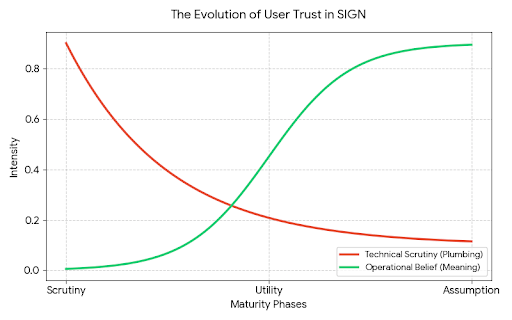
Early on, people approached it carefully. Almost suspiciously. They weren’t warm toward it. They weren’t emotionally invested. They tested it the way people test anything that might embarrass them later. They checked whether credentials would actually verify cleanly. They tried to understand whether the outputs could be manipulated, copied without meaning, or stripped from context. There was no romance in that stage. It was just scrutiny. And honestly, I think that was healthy. Systems that deal with trust should be questioned hard before they’re accepted softly.
Later, the tone of user behavior changed, and that shift told me more than any announcement could.
People stopped asking whether the system could technically issue or verify something. They started asking what was worth attesting to in the first place. That may sound like a small difference, but it isn’t. It means the plumbing had become reliable enough that attention could move upward, from mechanics to meaning. That’s where these systems actually become difficult. Because recording a claim is one thing. Deciding what deserves to become a meaningful claim is something else entirely.
That’s where SIGN feels serious to me.
It sits in a very uncomfortable space, one that a lot of people underestimate. If you make credentialing too loose, everything starts to count, and when everything counts, nothing really does. But if you make it too restrictive, you recreate the same power structures people were trying to get away from in the first place. So the challenge isn’t simply openness or control. The challenge is how to create a system where claims can exist flexibly, while trust still emerges selectively. That’s hard. That takes time. And more than anything, it requires social patience.
I don’t think enough people appreciate how much patience matters in systems like this.
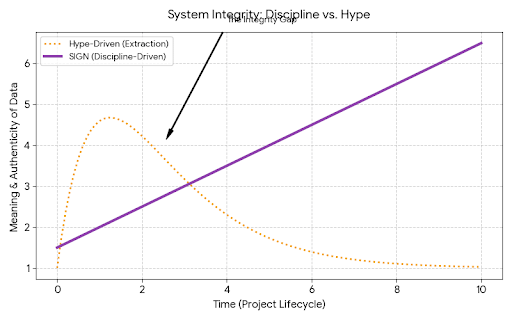
In crypto especially, there’s always pressure to move faster than reality deserves. Ship the new feature. Launch the incentive layer. Create momentum before understanding whether the foundations are actually stable. But what I found quietly encouraging about SIGN was that it didn’t seem eager to turn every capability into a growth mechanism. Some things felt intentionally delayed. And I think that was wise. Because the moment you introduce rewards too early, behavior becomes distorted. You stop learning how people would use the system naturally, and start learning how they behave when they want something from it.
That distinction is everything.
If the earliest usage of a protocol is shaped mostly by extraction, then a lot of the data it generates becomes misleading. Activity rises, but meaning weakens. Participation increases, but sincerity drops. People learn the surface of the system before they understand its purpose. And once that happens, it becomes much harder to recover the original integrity of the network. So when I looked at how SIGN evolved, I didn’t read its slower parts as hesitation. I read them as discipline.
The token, in that context, makes more sense to me as a long-term coordination layer than as an object of excitement.
I know that sounds less glamorous, but it feels truer. For something like SIGN, a token only matters if it helps bind people to the health of the system over time. Not just as users, but as stewards. Not just as participants, but as people with some responsibility toward the credibility of what’s being built. If the verification layer becomes meaningful, then the token’s role is not to distract from that with spectacle. Its role is to align people with the slow work of protecting that meaning.
That kind of alignment is harder than it sounds.
Because governance in a system like this is not really about dramatic public decisions. It’s about small judgment calls that compound quietly. What should be standardized? What should remain flexible? Which use cases genuinely strengthen the protocol, and which ones add volume without adding trust? When do you expand, and when do you deliberately hold back? These are not glamorous questions. But they are the questions that decide whether a protocol matures into infrastructure or dissolves into noise.
And infrastructure, I’ve learned, is usually built by people who are comfortable being misunderstood for a while.
From the outside, restraint can look like slowness. Care can look like lack of ambition. Saying “not yet” can look like weakness in a culture that celebrates speed. But when I watch systems that last, they are almost always shaped by people who understand the cost of premature scale. SIGN gives me some of that feeling. Not perfection. Not certainty. Just the sense that parts of it were built by people who know that trust, once diluted, is very hard to restore.
Community trust around a project like this also forms differently than people assume.
It doesn’t come from branding. It doesn’t come from big language. And it definitely doesn’t come from asking people to believe harder. It comes from repeated observation. People watch. They compare. They notice how the system behaves when something goes wrong. They notice whether mistakes are acknowledged quickly or explained away. They notice whether credentials remain useful outside the environment where they were issued. Over time, those observations harden into belief—not emotional belief, but operational belief. The kind that says: I may not talk about this much, but I trust it enough to use it when it matters.
That kind of trust is much more valuable than excitement.
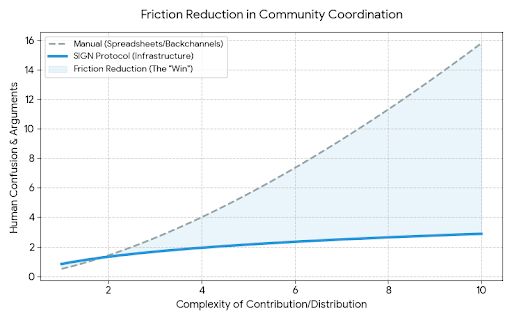
Excitement is loud, but it doesn’t last. Observed reliability is quiet, but it compounds. And I think that’s what SIGN has been building, slowly: not fandom, but credibility. The kind of credibility that only emerges when people keep seeing the same thing happen correctly across different contexts. A credential here. A verification there. A distribution that feels cleaner than it would have otherwise. A reduction in arguments. A reduction in manual chaos. A reduction in the number of places where trust can break for stupid reasons.
That last part matters more than people think.
A lot of important infrastructure doesn’t win by creating new forms of visible activity. It wins by removing recurring forms of friction. It takes something that used to require explanation, negotiation, and cleanup—and turns it into a process people no longer have to think about. That is a very unglamorous kind of success. But it is usually the real one. And when I look at SIGN through that lens, I don’t find myself asking whether it feels exciting enough. I find myself asking whether it is reducing the amount of human confusion around verification and distribution. Increasingly, I think it is.
The usage patterns tell a more honest story than the narrative ever could.
What matters to me is not how many credentials were issued in some burst of activity. That can be manufactured. What matters is whether those credentials are reused, referenced, or relied upon later in a way that saves people work and preserves context. A system starts to become real when outputs created in one place continue to carry meaning in another. Not because someone forced interoperability as a slogan, but because people found it practical. That kind of reuse is where infrastructure begins to show itself.
Retention looks different here too, and I think that’s a good sign.
People don’t need to engage with a system like SIGN every day for it to matter deeply. In fact, daily engagement would probably be the wrong metric to obsess over. This is the kind of infrastructure people return to when something important is on the line—when they need to prove contribution, verify eligibility, or distribute something fairly without opening the door to avoidable disputes. The interaction may be occasional, but the reliance can still be profound. I trust that pattern more than constant attention.
By that point, the protocol stops feeling like an experiment people are trying out and starts feeling like a layer people quietly depend on.
That transition is never dramatic. There’s no ceremony for it. It just happens over time. People stop explaining why they’re using it. Integrations stop feeling performative and start feeling necessary. What once looked optional begins to look like basic hygiene. That, to me, is one of the strongest signals any project can produce: when its value becomes less conversational and more assumed.
I think that’s the stage SIGN is slowly moving toward.
Not something perfect. Not something beyond criticism. But something more substantial than an idea. Something increasingly shaped by real-world usage, real user caution, real distribution problems, real questions around legitimacy, and real attempts to preserve meaning as the network grows. That is a much harder path than simply becoming visible. But it is also the only path that gives a project like this a chance to matter for longer than one cycle.
What keeps me interested, honestly, is not the ambition of the category. It’s the emotional truth sitting underneath it.
People want to know their effort will still count later. Communities want to know fairness doesn’t depend on private memory. Builders want systems that don’t force them to choose between scale and legitimacy. These are not abstract desires. They’re emotional ones. They come from disappointment, exclusion, and fatigue. They come from seeing good work disappear into weak record-keeping and temporary coordination tools. A project like SIGN only becomes important if it understands that underneath every credential is a very human fear: that contribution can be forgotten.
That’s why this matters.
Not because verification sounds sophisticated. Not because token distribution sounds innovative. But because people are tired of losing trust for preventable reasons. Tired of messy recognition. Tired of systems that remember noise better than they remember real effort. And if SIGN continues to be built with discipline—quietly, carefully, without rushing past the hard parts—I think it could become one of those rare pieces of infrastructure that people rely on without needing to constantly talk about it.
And honestly, that would be enough.
Because the most important systems are not always the ones people praise the loudest.
$SIGN @SignOfficial #SignDigitalSovereignInfra