

I’ve been following $SIGN for a while now, not because of the usual hype around verifiable credentials or government pilots, but because the token’s actual trading and ownership numbers keep showing me something that feels genuinely under appreciated. The non-obvious edge right now isn’t the tech narrative everyone repeats. It’s the way the market has built an incredibly efficient, high velocity distribution machine on centralized exchanges while the on-chain side remains deliberately quiet. That setup, to me, looks like perfect preparation for the moment real credential driven demand starts pulling tokens into wallets at scale.
Look at the numbers that stand out when you sit with the data. Daily trading volume is running around $71.7 million against an $84.5 million market cap, giving you roughly 85% turnover in a single day. That’s not random noise; it’s the kind of relentless liquidity that lets large allocations move without freezing the order books. In a world where most mid-cap tokens struggle to get noticed on exchanges, this level of activity means SIGN is already functioning as a ready to use rail for token distribution, exactly what the protocol promises at national scale. The forward read is straightforward: when Kyrgyz or Sierra Leone pilots begin pushing verifiable credentials and associated payouts, the liquidity is already there to absorb flows without the usual slippage problems.
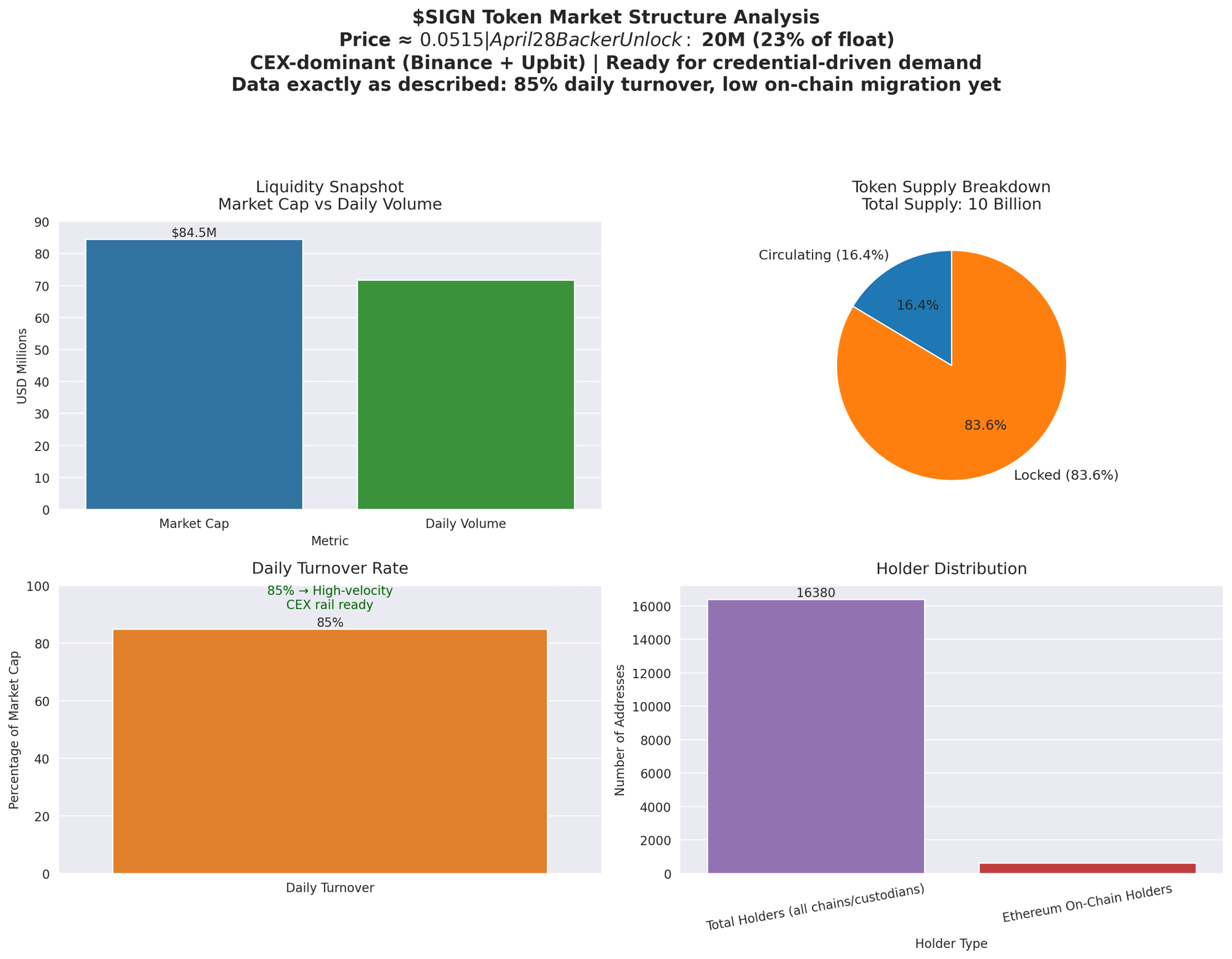
The float itself is still only 16.4% of the 10 billion total supply, leaving the fully diluted valuation at about $515 million. At current prices around $0.0515, that low circulating supply has kept the token responsive, but the real point is how the market has priced in the upcoming April 28 backer release (roughly $20 million worth, or about 23% of today’s float) without panic. Instead of selling pressure building early, volume has stayed elevated and constructive. To me this suggests participants are treating the unlock as a liquidity event rather than a dilution scare, which is rare and telling for a project whose utility is still in the early innings.
Even the holder picture reinforces the same story. Total reported holders sit at 16,380 across all chains and custodians, yet on the main Ethereum contract the count is just 634 addresses. That gap isn’t a red flag; it’s evidence that the token is still living where it’s most useful right now, on the exchanges that governments and retail users in high adoption regions (think Upbit’s KRW pair and Binance’s USDT depth) actually access. Protocol usage today is mostly attestations and off-chain verifications; the tokens themselves haven’t needed to migrate on-chain en masse yet. When TokenTable distributions start hitting real users, I expect that Ethereum holder count to climb fast because the credential layer finally gives people a reason to hold rather than flip.
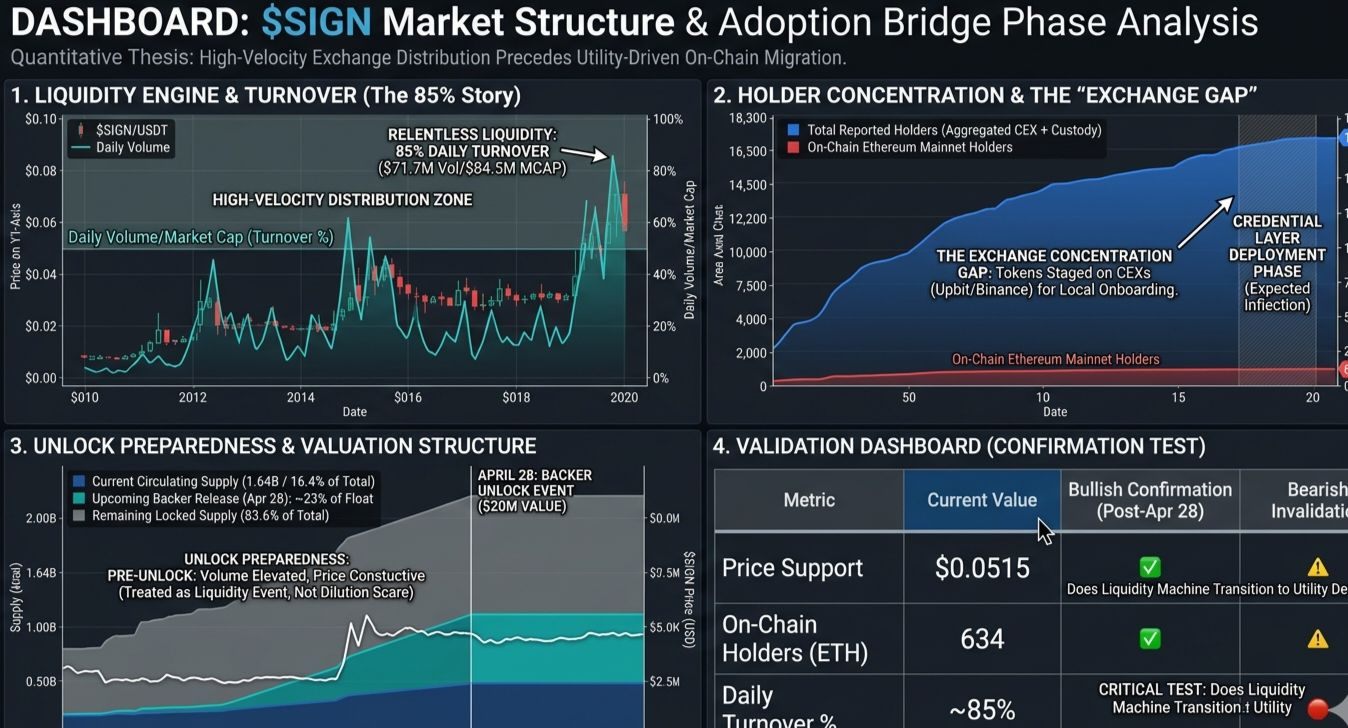
The exchange concentration adds another layer. Upbit and Binance together dominate the flow, with the KRW pair especially active whenever regional sentiment ticks up. That regional depth isn’t accidental; it mirrors exactly how national digital ID and CBDC programs will onboard users, through familiar local venues first. Most tokens chase DEX liquidity that never materializes at this market cap. SIGN already has the CEX rails wired in, which feels like a structural advantage few people are crediting.
Taken together, these dynamics leave me with a clear view: the current market structure isn’t a temporary exchange-only bubble. It’s an intentional bridge phase where liquidity is being built in the precise places real-world adoption will first touch. The April unlock, far from being a risk, looks set to be absorbed by the same venues already showing daily conviction.
Of course there’s a legitimate counter-case worth sitting with. One could argue that the sky-high volume is still mostly speculative rotation rather than early utility flows, and that once the backer tokens hit the market the thin decentralized base will have no natural bid to step in. It’s a fair point; we’ve seen similar setups fade before.
What would confirm the bullish read over the coming months is pretty simple and testable. If the April 28 release passes with price holding above $0.05 and Ethereum holders start climbing toward 1,000–2,000 within weeks, accompanied by sustained volume settling into the 20–30% of market cap range, that would show the distribution machine is already transitioning into genuine usage demand. On the other side, a sharp rejection below current levels on the unlock day with no holder growth and volume collapsing would tell me the liquidity was indeed illusory.
Right now the data keeps pointing the same direction every time I check: SIGN has quietly built the exact infrastructure its name promises, and the market structure is reflecting that before most of the real adoption numbers even show up. That’s the part that has me paying attention.
@SignOfficial #SignDigitalSovereignInfra $SIGN
