

I have been in crypto long enough to notice one simple pattern. Many projects fail not because their code is weak, but because nobody actually uses them. Strong technology means nothing if people are not involved. That is the real problem I keep seeing again and again. And this is exactly where Sign started to feel different to me.
Instead of focusing only on building technology, Sign seems to focus on people first. The best example of this is something called the Orange Dynasty. At first it looks like just another marketing idea, but when I looked deeper, it felt more like a Web3 game. There are clans, leaderboards, daily rewards, and constant activity. Within just two weeks of launch in 2025, it reached more than 400,000 members and over 100,000 verified users. That kind of growth usually does not come from hype alone. It shows real participation.
What makes this more interesting is how activity is measured. Sign uses something called attestations. In simple words, users must prove real actions on-chain. It is not about clicking buttons or farming rewards without effort. You actually have to do something that can be verified. This removes fake engagement and creates a system based on real contribution.
Then I looked at the token side, because that is where most projects break. SIGN has a total supply of 10 billion tokens, which sounds large at first. But what matters more is how those tokens are distributed. A big portion is reserved for the community and ecosystem, and tokens are released slowly over time. At launch, only around 12% of supply was in the market, which helped avoid heavy selling pressure.
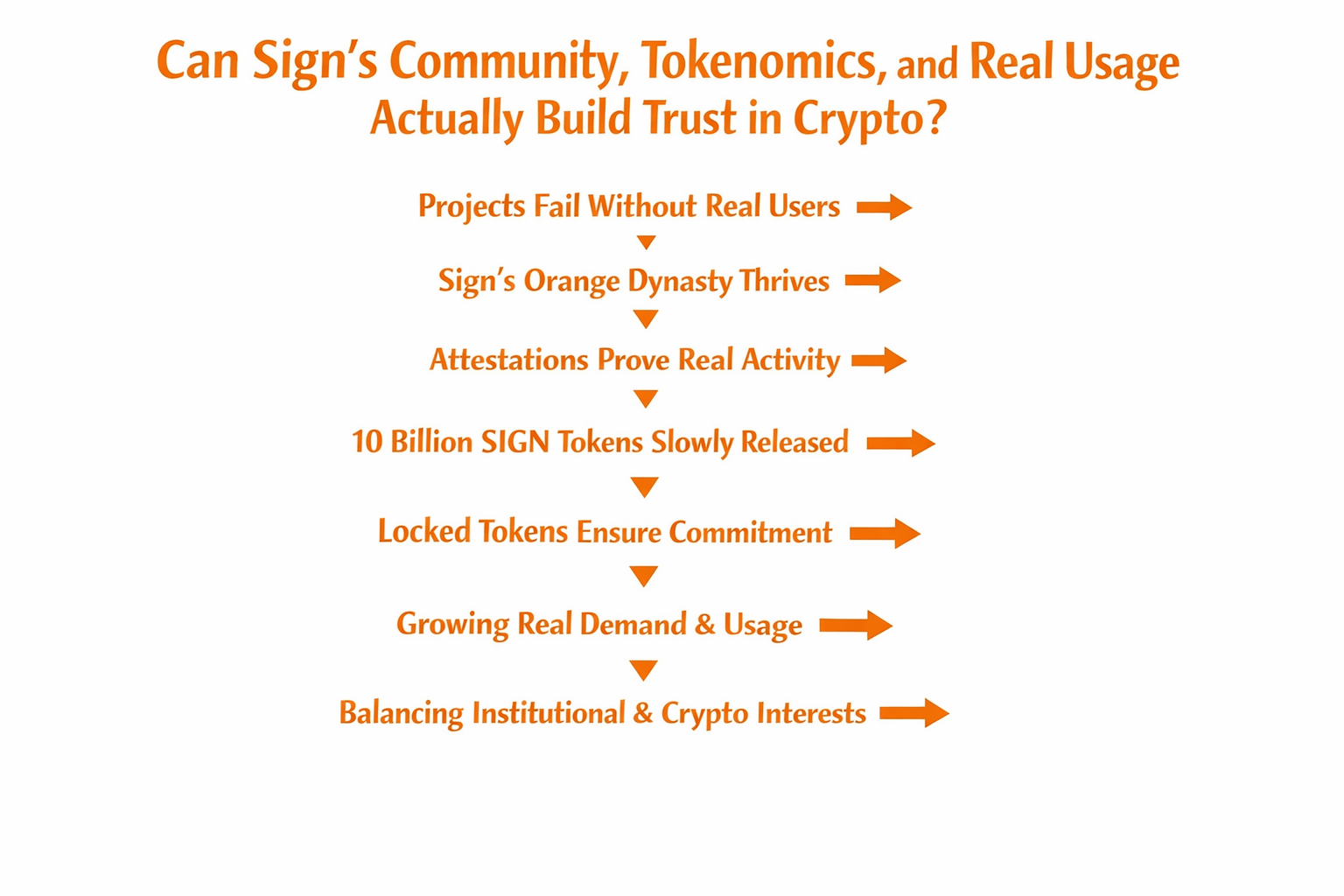
The part I personally pay attention to is lockups. Investors cannot sell their tokens for two years, and team tokens are locked even longer, around four years with a one-year delay before anything unlocks. This means the people closest to the project cannot just exit early. They are forced to stay and build. For me, this reduces one of the biggest risks in crypto.
The token is also not just for holding. SIGN is used as gas on the network, for governance, staking, and rewards. It also connects with real products like TokenTable. In 2024 alone, Sign processed around 6 million attestations and distributed tokens to about 40 million wallets across different blockchains. That level of activity shows actual usage, not just speculation.
To understand the demand side, imagine this as an example. When projects distribute tokens or run campaigns, they use Sign’s system, and users interact through SIGN. This creates real demand because people need the token to use the network, not just to trade it.
Looking forward, the growth potential depends on whether this usage continues. If the network reaches something like 100 million wallets and keeps increasing attestations, demand for the token could grow naturally. At the same time, Sign is not only targeting retail users. It is also moving toward government and institutional partnerships. This creates a second layer of stability, because institutional demand is usually more consistent than retail hype.
But this also creates tension. Governments prefer control, while crypto is built on freedom. This balance is not easy, and it could become a challenge in the future. Still, I do not see it as a red flag right now. It looks more like a planned strategy to survive in both worlds.
In the end, what stands out to me is that Sign is not relying only on speculation. It combines community engagement, real usage, and structured tokenomics. It is not perfect, and it is not fully decentralized yet, but it feels like a project trying to build something that lasts.
For me, this is not a short-term trade idea. It looks more like a long-term bet on whether real usage and real communities can outperform hype in crypto. And honestly, in today’s market, that might be the smartest approach.