When I think about blockchain, I do not think about speed first. I do not think about hype, charts, or the loud promise that every new system is going to change everything overnight. I think about pressure. I think about what happens when technology grows up and has to face a more serious question. Not how much attention it can attract, but how much responsibility it can carry.
That is why a project like @undefined feels interesting to me.
A blockchain built around zero knowledge proof technology says something deeper than just “we have advanced tools.” To me, it says that the next stage of digital systems may not be about exposing more. It may be about proving more while revealing less. That difference matters. It changes the mood of the whole conversation.
For a long time, a lot of people in this space seemed to accept a strange trade. If you wanted transparency, you had to sacrifice privacy. If you wanted utility, you had to surrender control. If you wanted to participate, you had to leave pieces of yourself visible in places where they might never fully disappear. That always felt like an unfinished idea to me. Functional, maybe. Revolutionary, perhaps. But still unfinished.
Because ownership should feel like ownership.
It may work technically, but it does not feel mature. Real progress should not force people to choose between usefulness and dignity. It should not require exposure as the price of entry.
This is where the idea behind Midnight starts to feel important in a more human way.
I do not see it simply as a chain using ZK proofs. I see it as a shift in attitude. A sign that blockchain is learning restraint. A sign that the industry is beginning to understand that trust is not built only by making everything public. Sometimes trust is built by designing systems that know exactly what needs to be proven and exactly what should remain private.
That is a very different kind of intelligence.
It is easy to build loud systems. Loud systems attract attention quickly. They make noise, generate momentum, and give people something obvious to point at. But the strongest systems are often quieter than that. They are built with discipline. They focus less on spectacle and more on structure. Less on showing everything and more on doing the right things in the right order.
That is how I imagine Midnight.
Not as something trying to impress the room with volume, but as something carefully designing a better relationship between people and digital infrastructure.
In my mind, the real value of this approach is not aesthetic. It is practical. If privacy and utility can live together, then the range of meaningful use cases becomes much wider. Identity can become more intelligent. Transactions can become more respectful. Participation can become more selective and intentional. A system can confirm what matters without collecting what it does not need.
That sounds simple, but it is actually a major philosophical improvement.
Too much technology has been built with the assumption that more data automatically means better outcomes. More tracking, more visibility, more collection, more exposure. But people are starting to question that model, and rightly so. Just because something can be made visible does not mean it should be. Just because data can be extracted does not mean ownership has been respected.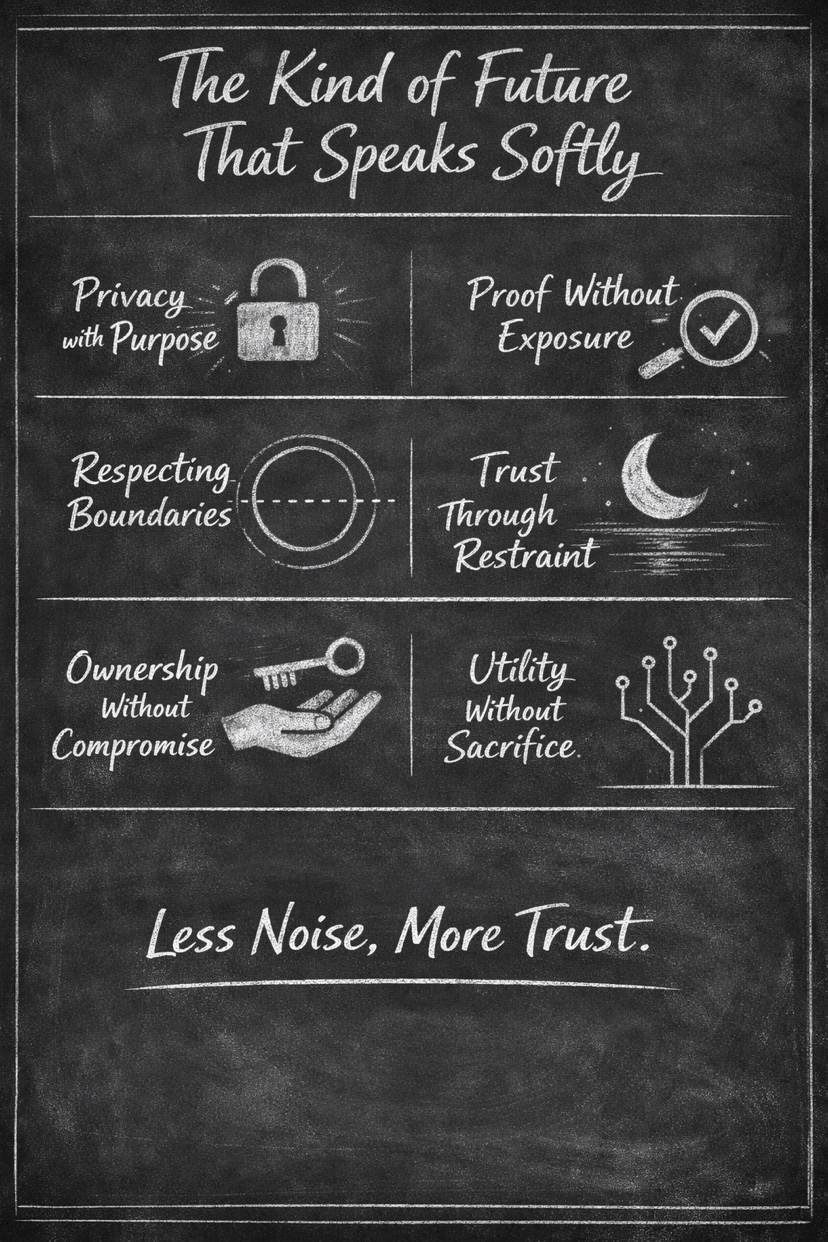
A blockchain like Midnight feels aligned with that changing mindset.
It suggests that digital systems can still coordinate, verify, and create value without turning privacy into collateral damage. It suggests that ownership can remain personal even inside shared networks. It suggests that data protection is not an obstacle to utility, but part of what makes utility worth having in the first place.
That is the part I keep coming back to.
I think the future of blockchain will belong less to the chains that shout the most and more to the ones that understand boundaries. Because boundaries are not weakness. Boundaries are design. They are a way of saying this system knows where its power should stop. And in an era where so many platforms seem to benefit from knowing too much, that kind of restraint feels rare.
Midnight, at least in spirit, feels like a response to that problem.
It feels like the kind of project that is not asking users to become fully transparent in order to be fully included. It feels like a system built with the assumption that privacy is not a feature for edge cases, but a condition of real digital freedom. That makes it more than a technical narrative to me. It becomes a cultural one.
Because people do not only want better tools. They want better terms.
They want systems that do not quietly demand more than they give. They want participation without unnecessary exposure. They want ownership that still feels intact after they use it. They want utility that does not come with a hidden cost attached to their identity or their data.
When I look at Midnight through that lens, I do not just see a blockchain. I see a correction.
A correction to the early logic of the internet, where convenience often won by taking too much. A correction to digital environments that normalized surveillance in exchange for access. A correction to the idea that efficiency alone is enough to call something progress.
Real progress should know how to protect people while serving them.
That is why I think zero knowledge, in this context, is more than a technology. It is a design principle. It reflects a more thoughtful understanding of what digital trust could look like. Not trust built from total exposure, but trust built from precise proof. Not ownership reduced to a slogan, but ownership respected through architecture.
That makes @MidnightNetwork midnightnetwork feel less like a trend and more like a direction.
And direction matters more than noise.
A lot of projects can generate attention for a season. Fewer can represent a meaningful step toward a better model. Midnight feels like one of those ideas that may grow in importance as the broader digital world becomes more aware of what it has been giving up for the sake of convenience. The more people begin to value protection, control, and selective disclosure, the more relevant this kind of infrastructure becomes.
So when I think about Midnight, I do not think of it as flashy. I think of it as disciplined. I do not think of it as trying to reveal everything. I think of it as proving only what matters. I do not think of it as a chain chasing noise. I think of it as part of a quieter future, one where utility no longer demands unnecessary surrender.
And honestly, that feels like a future worth building toward.
$NIGHT
#night 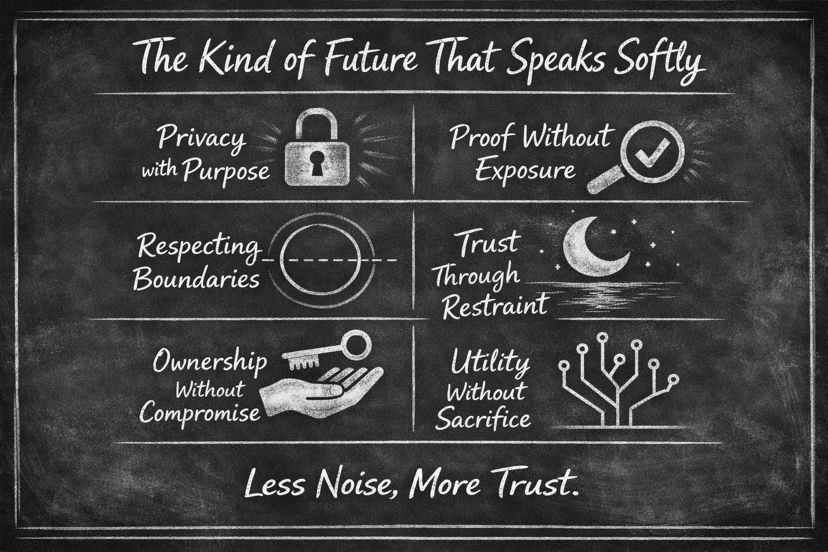

Artigo
The Kind of Future That Speaks Softly
Aviso Legal: inclui opiniões de terceiros. Não se trata de aconselhamento financeiro. Poderá incluir conteúdos patrocinados. Consulta os Termos e Condições.
0
8
278
Fica a saber as últimas notícias sobre criptomoedas
⚡️ Participa nas mais recentes discussões sobre criptomoedas
💬 Interage com os teus criadores preferidos
👍 Desfruta de conteúdos que sejam do teu interesse
E-mail/Número de telefone