


I was working through a Compact contract interaction earlier when something about the output stopped me.
The condition was true.
I was sure of it.
But the circuit wouldn’t produce a proof.
I checked the inputs.
All valid.
Checked the schema again.
Nothing off there either.
Ran it again.
Same result.
Still no proof.
At that point I figured I was missing something small.
Some constraint I hadn’t noticed yet.
So I slowed it down.
Traced how the inputs were actually landing inside the circuit.
What the schema was really encoding.
Where the private state stopped fitting.
That’s where it shifted.
The condition I was trying to prove wasn’t false.
It just… wasn’t there.
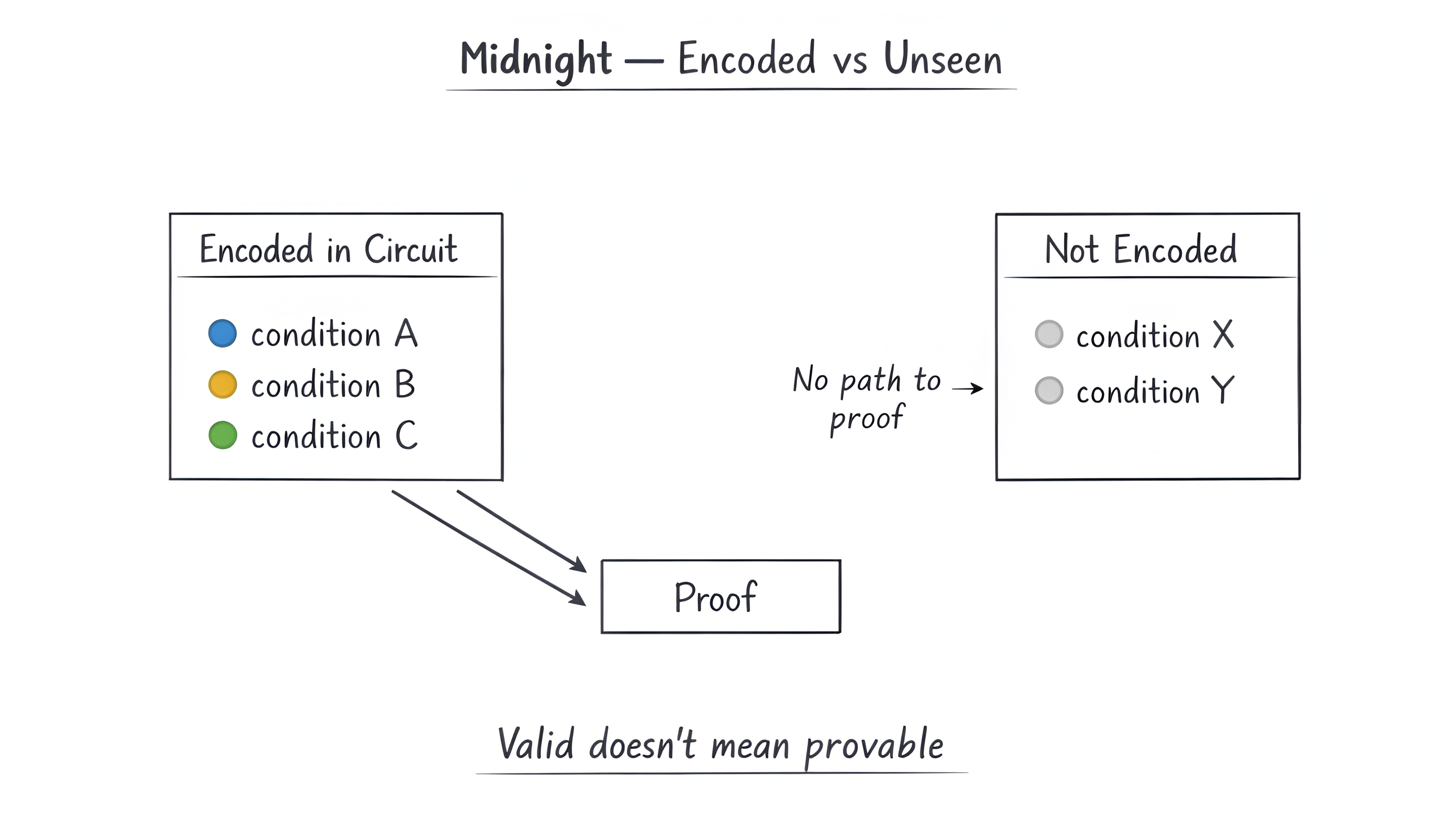
Not wrong.
Just unreachable.
I sat with that longer than I expected.
Because nothing had failed.
There was no error.
No rejection.
The system just didn’t have a way to see what I was asking.
That’s when it clicked.
This wasn’t a proof failing.
It never had a path to form in the first place.
That’s a different kind of limit.
Not a break.
More like a boundary you don’t notice until you hit it.
The circuit was fixed earlier.
Before this interaction.
Before this edge case.
Before this condition even showed up.
Which means everything it can prove was already decided.
Anything outside that…
just never appears.
No signal.
No trace.
Just absence.
The contract keeps running.
Proofs keep forming.
Everything inside that boundary behaves perfectly.
But outside it, nothing even registers.
I keep coming back to this as a provability horizon.
Not something you can point to directly.
Something you only discover when you run into it.
And by then, the circuit is already live.
Already handling real interactions.
Already defining what exists and what doesn’t.
Compact’s rigidity is the point.
No shifting rules.
No expansion after the fact.
What was compiled is what holds.
But that also means every circuit carries a snapshot of assumptions.
Taken at one moment.
And the world doesn’t stay there.
New conditions show up.
Edge cases build quietly.
And the horizon doesn’t move with them.
It just stays where it was.
Silent.
$NIGHT only matters here if Compact circuits can evolve fast enough that this provability horizon doesn’t drift away from what the network actually needs to verify.
Because the gap doesn’t show up all at once.
It builds slowly.
Outside the system.
Until something that should be provable…
just isn’t.
So the real question becomes this.
If a Compact circuit can only prove what it was built to understand, what happens to everything the system never learned to see?
