
I have a specific discomfort I carry into every new blockchain project that talks about decentralization while simultaneously operating in a phase where a small group of people controls meaningful capital allocation decisions. That discomfort is not ideological. It is practical. When I cannot identify who makes the spending decisions, what criteria they use, and what accountability mechanisms exist if those decisions go wrong, I treat the governance layer as an unpriced risk sitting beneath whatever technical story the project is telling. With Midnight, that unpriced risk sits in a structure called the Treasury, and I think it deserves far more scrutiny than it is currently receiving from anyone watching the NIGHT price and waiting for mainnet.
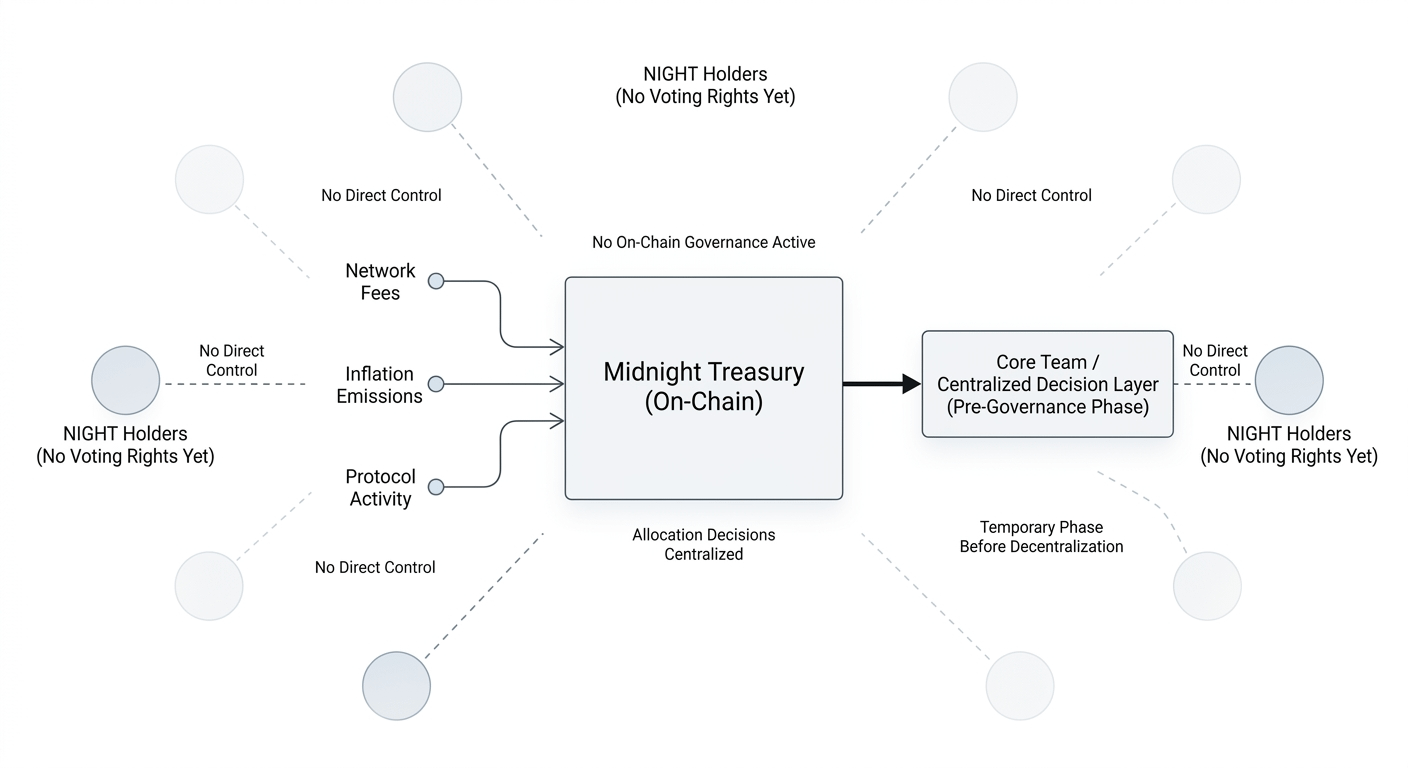
Midnight's protocol design includes an on-chain Treasury that accumulates resources over time and is intended to fund ecosystem development, grants, infrastructure, and the broader growth of the network. The concept is not unusual. Many serious blockchain protocols have treasury mechanisms, and the argument for them is straightforward — a well-funded, protocol-native treasury gives a network the ability to fund its own growth without depending entirely on external venture capital or the core team's personal runway. In theory, a treasury aligned with the protocol's long-term health and governed by its token holders is one of the more sound financing structures a decentralized network can have. In theory.
The complication with Midnight's Treasury right now is the same complication that applies to every governance mechanism in a protocol that has not yet completed its decentralization roadmap. NIGHT token holders do not currently have on-chain governance voting rights. The governance infrastructure that would allow NIGHT holders to propose, debate, and vote on Treasury allocations is a feature of the fully decentralized network that Midnight is building toward, not a feature of the federated mainnet launching at the end of this month. During the period between now and full governance activation, the decisions about how Midnight's Treasury resources are allocated are being made by a much smaller group of people than the token's twenty-four billion unit supply and its eight million airdrop recipients would suggest.
The price today is $0.04271 on Binance, down 0.65 percent in a session where volume reached 11.72 billion NIGHT and $502.91 million in USDT — the highest single-session volume recorded since listing. The 24-hour range ran from $0.04196 to $0.04562. The EMA(20) sits at $0.04423 and EMA(50) at $0.04650, both well above current price. The MACD is holding positive at plus 0.00003, a razor-thin margin that suggests yesterday's attempted reversal is fighting to survive rather than accelerating. RSI has pulled back to 37.45, approaching oversold again after briefly recovering. The volume story is the most striking data point today. Over half a billion dollars of NIGHT changed hands in a single session while price moved less than one percent. That kind of volume-to-price ratio tells you that large buyers and large sellers are meeting at this level and neither side is winning decisively.
The governance question I keep returning to is not whether Midnight's team has bad intentions. I have no reason to believe they do, and the project's no-VC-allocation, full-public-distribution approach to the Glacier Drop suggests a genuine orientation toward broad ownership rather than insider capture. The question is structural, not personal. Between now and the point where NIGHT token holders have functional on-chain governance rights, every Treasury allocation decision is a centralized decision made by people who are accountable to the protocol's mission documents and their own judgment rather than to a live governance mechanism with transparent voting records and on-chain enforceability. That is a meaningful power concentration regardless of the intentions behind it, and meaningful power concentrations deserve explicit acknowledgment and explicit mitigation plans.
The risk that sits inside that concentration is specific. Treasury resources allocated during the pre-governance window cannot be recalled or reversed by token holders even after governance rights activate, because the spending will have already occurred. If those allocations go to genuinely productive ecosystem development, the pre-governance spending period looks like efficient early-stage capital deployment. If those allocations go to partners, projects, or infrastructure that does not serve the broader token holder base, there is no recourse mechanism available to NIGHT holders until governance activates, and by then the capital is gone. That asymmetry is not unique to Midnight. It is a common feature of protocols in transition between centralized and decentralized governance. But common does not mean unimportant, and I have seen enough treasury misalignment events in blockchain history to treat the pre-governance window as a period that warrants attention rather than trust.
The counterargument worth taking seriously is that premature governance activation carries its own serious risks. A fully permissionless governance mechanism active on a network with eight million airdrop recipients, many of whom have no long-term interest in the protocol, is a governance attack surface rather than a decentralization achievement. Governance decisions made by a large population of disengaged, zero-cost-basis token holders tend to be low-quality decisions susceptible to coordination attacks, proposal spam, and capture by whoever is willing to organize voting blocs most aggressively. Midnight's approach of building toward governance rather than launching with it from day one is defensible precisely because good governance requires an engaged, informed stakeholder base that takes time to develop. The federated and controlled early phases are arguably protecting the Treasury from governance failure rather than hoarding it from legitimate participants.
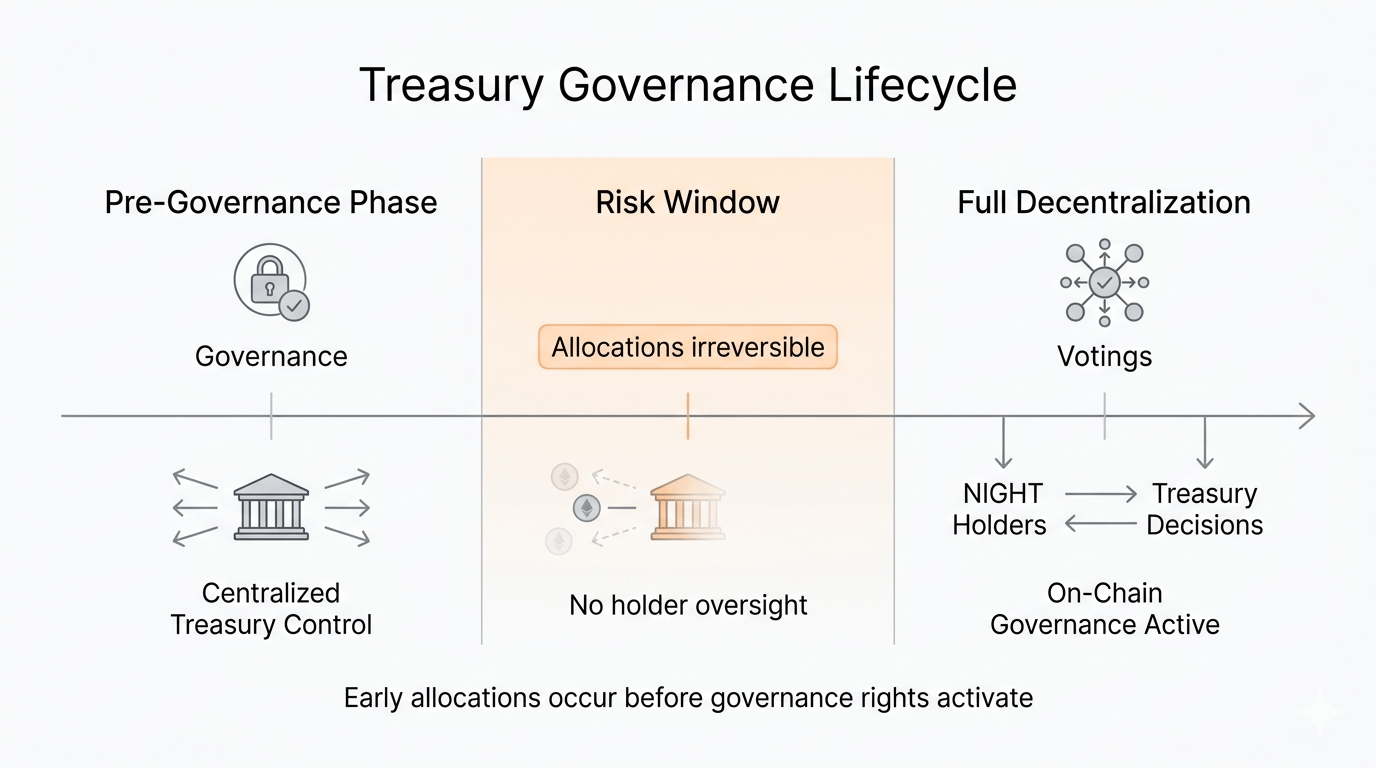
What would make me more constructive on Midnight's governance trajectory is specific. I want to see the team publish a clear, dated roadmap for governance activation that includes the specific conditions triggering NIGHT holder voting rights and the specific categories of Treasury decisions that will be subject to on-chain governance when it activates. I want to see any Treasury allocations made during the pre-governance window disclosed publicly with clear rationale, so the community can evaluate those decisions retrospectively when governance does activate. And I want to see the governance design itself published for community feedback before it goes live, not after, because governance mechanisms that arrive fully formed without input from the people they govern tend to reflect the preferences of designers rather than the needs of participants.
Midnight is building something technically serious. The Treasury and governance layer is where the technical seriousness needs to extend into institutional seriousness. A network that proves hidden computations are correct but cannot prove its own resource allocation decisions are legitimate has a credibility gap that no zero-knowledge proof can close.
Watch what Midnight says about its Treasury between now and full governance activation. Transparency during that window is the first test of whether the decentralization commitment is structural or decorative.
@MidnightNetwork #night $NIGHT
