

Midnight Network is one of those names I didn’t expect to linger in my head, but it did. Not because it sounded revolutionary, not because it came in loud, but because I couldn’t dismiss it as quickly as I usually do. I’ve been around this space long enough to recognize when something is just rearranging old promises. Most of it is. New words, same pitch, slightly different timing. So I’ve gotten used to tuning things out. This one made me slow down a bit, which is already unusual.
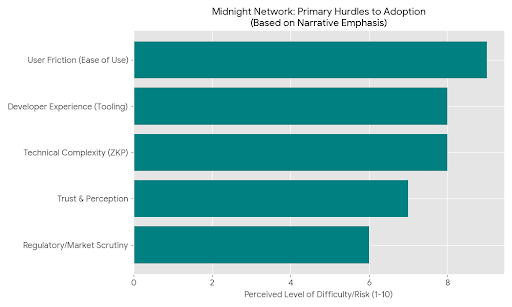
I’m watching how it frames itself—privacy, zero-knowledge proofs, data ownership—and I can already feel the instinct to roll my eyes. Those words have been stretched thin over the years. Everyone claims them. Very few actually carry them through in a way that survives real use. Still, there’s something slightly different here. Not better, just… more deliberate. Like it’s not trying to sell me a dream as much as it’s trying to fix something that’s been quietly broken for a while.
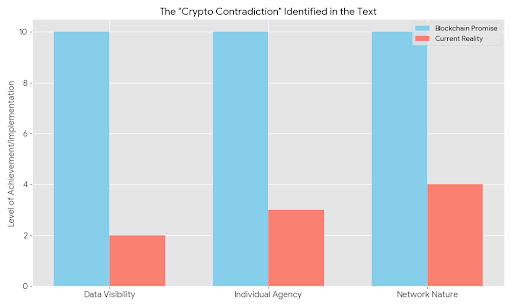
Crypto has always had this contradiction baked into it. It talks about control, but exposes everything. It promises independence, but leaves trails everywhere. You can call it transparency, but for most people, it just feels like overexposure. That’s fine for traders who don’t care, or for people deep enough in the system that they’ve accepted it. But for anyone outside that bubble, it’s uncomfortable. And that discomfort doesn’t go away just because the tech is “working.”
That’s the gap Midnight is trying to sit in.
Not by adding privacy as a toggle, but by building around it from the start. That sounds clean when you say it like that, but I’ve seen how messy it gets when you try to actually implement it. Zero-knowledge tech isn’t new anymore, but it’s still not simple. It’s still something that asks a lot—from developers, from infrastructure, from users who don’t even realize they’re being asked. That’s usually where the friction creeps in. Not in the idea, but in the interaction.
Because people don’t adopt systems for being correct. They adopt what feels easy enough to not think about. Privacy systems rarely feel like that at first. They feel like an extra step, an extra layer, something you have to trust without really seeing. And trust, in this space, is already fragile.
So I keep circling the same question in my head: does this actually get used, or does it just make sense on paper?
Midnight seems aware of that tension, at least more than most projects I’ve seen trying to play in the same space. It’s not pretending privacy is just a nice feature to have. It’s treating it like a structural requirement. That’s a stronger position, but also a riskier one. Because now everything depends on whether that structure holds up under pressure.
And pressure comes from places people don’t like to talk about. Privacy always attracts scrutiny. Not just from regulators, but from the market itself. There’s always that underlying suspicion—who benefits from this, and how? Even if the intention is completely reasonable, the perception can shift quickly. That shift alone has killed momentum for projects that were technically solid but socially uncomfortable.
Then there’s the developer side of it. Builders go where things are clear, where tooling is mature, where they don’t have to fight the system to get basic things done. If Midnight ends up feeling like a maze, it won’t matter how good the idea is. People will just go somewhere else. That’s the quiet reality most whitepapers don’t account for.
What keeps me from brushing this off completely is that the problem it’s pointing at hasn’t been solved yet. Not properly. Data exposure is still the default. Ownership still feels incomplete. And the more the space grows, the more noticeable those cracks become. You can ignore them for a while, but they don’t disappear. They just get harder to justify.
That doesn’t mean Midnight wins. It just means it’s looking in a direction that still matters.
I’ve seen good ideas fail here for simpler reasons than this. Timing, incentives, complexity, attention—any one of those can quietly shut something down before it has a chance to prove itself. And this doesn’t look like a project that will get carried by hype alone. If anything, it might struggle because it’s not loud enough, not simple enough to explain in a single sentence that people instantly latch onto.
So I’m not convinced. I’m just paying attention.
It’s a different kind of attention than excitement. More like I’m waiting to see if it holds together when people start using it in ways that aren’t controlled or ideal. That’s where things usually fall apart. Or, rarely, where they start to matter.
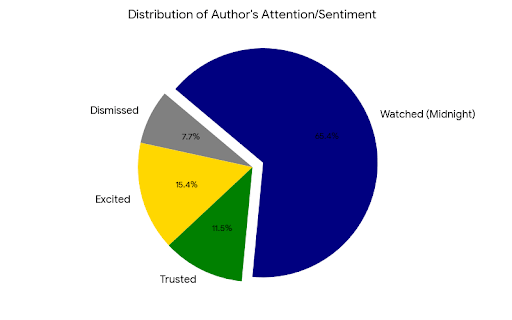
Right now, it’s still in that uncertain space. Not dismissed, not trusted, just… watched. And honestly, that’s probably the most honest place anything in this market can be.