
At first, I thought most digital systems struggled because they didn’t store enough information.
So the solution always seemed obvious.
Track more activity.
Collect more signals.
Record everything.
But the more systems grow, the more a different problem starts to appear.
They don’t lose data.
They lose context.
A user interacts with a platform, completes an action, contributes to something meaningful. The system records that event. It exists somewhere—on-chain, off-chain, inside a database.
But as time passes and that information moves across different systems, the original meaning begins to fade.
Another application sees the signal but not the context.
A new workflow references the data but not the intent behind it.
A decision is made, but the reasoning behind it is no longer visible.
What remains is a fragment of information that must be interpreted again.
This is where inefficiency quietly builds.
Every system ends up reconstructing context.
It tries to understand what the signal represents, why it mattered, and whether it should influence a new outcome. Even when the same data is used, the interpretation can differ because the original meaning was never preserved in a reusable way.
SIGN appears to focus on exactly this point of loss.
Instead of treating signals as isolated records, it introduces a way to attach structured meaning to them—so that context does not disappear as the information moves.
That structure turns signals into something more durable.
When a signal becomes a credential, it carries not just the fact that something happened, but what that event represents within a system. The meaning is no longer implied or reconstructed later. It is embedded from the start.
This changes how systems interact over time.
In most environments today, time increases fragmentation. The further a signal travels from its origin, the more interpretation it requires. Different systems apply different logic, and eventually the same event leads to different conclusions depending on where it is used.
With structured context, that drift begins to narrow.
A system can reference a credential and understand its meaning without rebuilding it. The interpretation becomes consistent because it is anchored to the original definition rather than recreated each time.
That consistency is what allows coordination to scale.
As ecosystems grow, the number of interactions between systems increases. Without shared context, each interaction introduces friction. Systems must negotiate meaning repeatedly, and alignment becomes harder to maintain.
SIGN introduces a direction where that negotiation becomes less necessary.
Instead of passing around raw signals, systems can exchange structured representations that already carry meaning. The focus shifts from interpreting data to acting on it.
This also changes how systems evolve.
In fragmented environments, every new application adds another layer of interpretation. The same data gets processed in slightly different ways, and over time those differences accumulate.
With shared context, new systems can build on existing meaning rather than redefining it.
The ecosystem becomes more coherent because its components operate on aligned definitions.
Of course, preserving context in this way is not simple.
The system must define credentials carefully so that they remain useful across different use cases. It must ensure that meaning is neither too rigid nor too ambiguous. And it must maintain trust in the verification process so that other systems can rely on these representations confidently.
Infrastructure at this level is rarely visible.
Users do not think about context layers or structured signals. They simply expect systems to behave consistently, to recognize their participation, and to produce predictable outcomes.
If SIGN reaches that point, the complexity remains underneath.
But the experience above becomes smoother.
And that leads to a broader realization.
The problem in digital coordination is not that systems forget what happened.
It’s that they forget what it meant.
SIGN is essentially working to preserve that meaning.
So that as information moves across systems and time, it doesn’t need to be rediscovered again and again.
And when context stops disappearing, coordination starts to feel less like reconstruction…
…and more like continuity.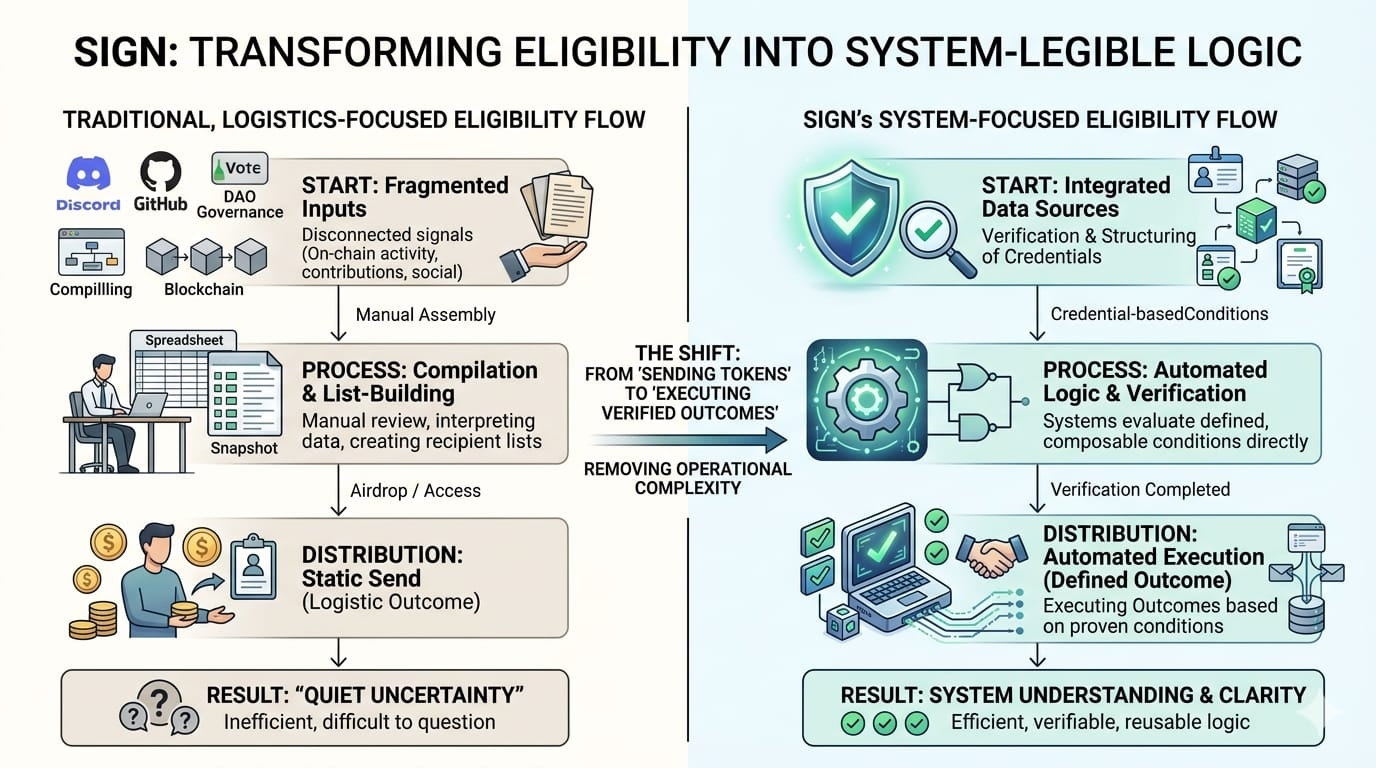
@SignOfficial #signdigitalsovereigninfra $SIGN #TrumpConsidersEndingIranConflict #iOSSecurityUpdate #OpenAIPlansDesktopSuperapp #AnimocaBrandsInvestsinAVAX