At first, it feels like digital systems are very good at memory.
They record everything.
Transactions, interactions, contributions, ownership—every action leaves a trace somewhere. Nothing really disappears. If you look hard enough, you can always find the data again.
But over time, another pattern starts to appear.
Systems remember what happened.
They don’t always remember why it mattered.
A user completes an action. A contribution is made. An interaction occurs at a specific moment for a specific reason. The system captures the event, stores it, and moves forward.
Later, another system encounters that same signal.
It sees the action, but not the intent.
It sees the record, but not the context.
So it asks the same questions again.
Does this qualify?
Does this count for anything here?
Should this influence an outcome?
That repetition becomes part of how systems operate.
Even when the data is available, the meaning behind it has to be reconstructed each time. And each reconstruction introduces variation. Slight differences in interpretation lead to slightly different outcomes.
Over time, that variation becomes fragmentation.
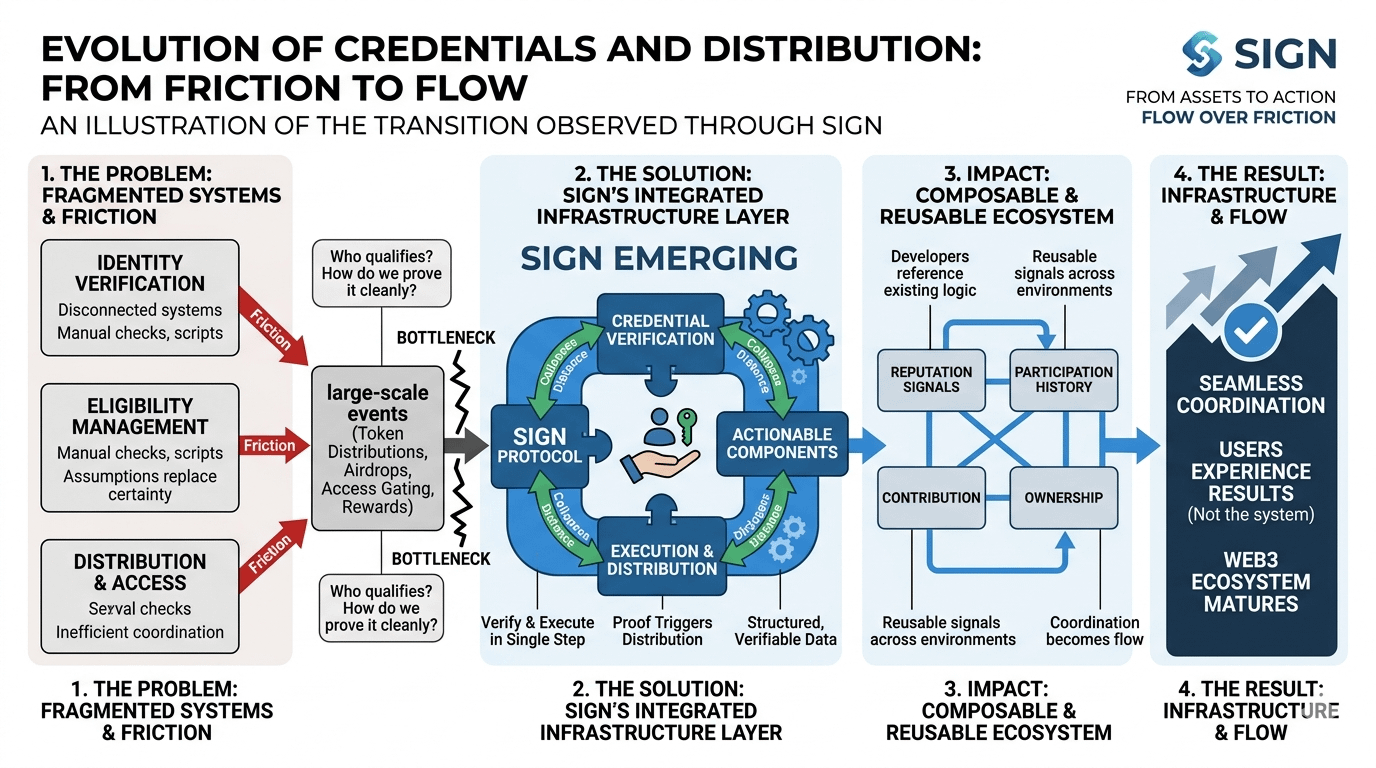
SIGN appears to focus on this exact point.
Instead of allowing systems to repeatedly reinterpret the same events, it introduces a structure where the meaning of those events can be preserved alongside the data itself.
That preservation changes the role of memory.
In most systems, memory is passive.
It stores events so they can be retrieved later. But retrieval is not the same as understanding. Each system still needs to interpret what it retrieves.
SIGN turns memory into something more active.
When an event becomes a credential, it carries a defined meaning. The system no longer sees just a record—it sees a structured representation of what that record signifies.
That distinction matters because it reduces the need for repeated interpretation.
A system doesn’t need to ask what an event means if that meaning is already embedded in how the event is represented. It can act on that representation directly.
This creates a different kind of continuity across systems.
Instead of each system forming its own understanding of the same event, they can share a common interpretation. The meaning travels with the signal rather than being recreated at every step.
That continuity reduces friction in subtle but important ways.
Developers no longer need to rebuild the same logic across different applications. Users no longer experience inconsistent outcomes for the same behavior. Systems no longer drift apart in how they evaluate participation.
Everything begins to align around shared definitions.
This alignment becomes more valuable as ecosystems grow.
The more systems interact, the more important it becomes that they interpret signals consistently. Without that consistency, coordination requires constant adjustment. Systems must reconcile differences, handle edge cases, and manage exceptions.
With shared meaning, that overhead decreases.
Systems can rely on the same representations without negotiating interpretation each time. The focus shifts from understanding data to using it.
Of course, preserving meaning in this way introduces its own challenges.
Meaning must be defined carefully. It must be precise enough to be useful, but flexible enough to apply across different contexts. Verification must ensure that credentials are trustworthy, otherwise the shared structure loses reliability.
These challenges are part of building infrastructure.
They are not always visible, but they determine whether a system becomes widely usable.
SIGN seems to be operating at that foundational level.
It is not trying to create new types of activity or new categories of data. Instead, it is organizing how existing activity is understood, so that meaning does not disappear as systems evolve.
That focus leads to a broader realization.
Digital systems do not struggle because they lack memory.
They struggle because memory alone is not enough.
Without preserved meaning, memory becomes something that must be interpreted again and again.
SIGN is working on the layer where memory and meaning stay connected.
So that when a system looks at the past, it doesn’t just see what happened.
It understands why it mattered.
And when that understanding remains intact, coordination stops feeling like repeated interpretation…
…and starts to feel like systems building on knowledge that already exists.
@SignOfficial #signdigitalsovereigninfra $SIGN