
I don’t get impressed by bold claims anymore. I watch how networks behave when reality tests them.
That’s where the difference shows. Not in the launch announcement. Not in flashy marketing. But when a system has to operate under pressure, with real users and real stakes. That’s when cracks appear.
Midnight Network didn’t capture my attention for what it promises. It stood out for the pressure it seems designed to handle. Crypto has long acted as if privacy and practicality could coexist effortlessly. That was convenient. It was never true.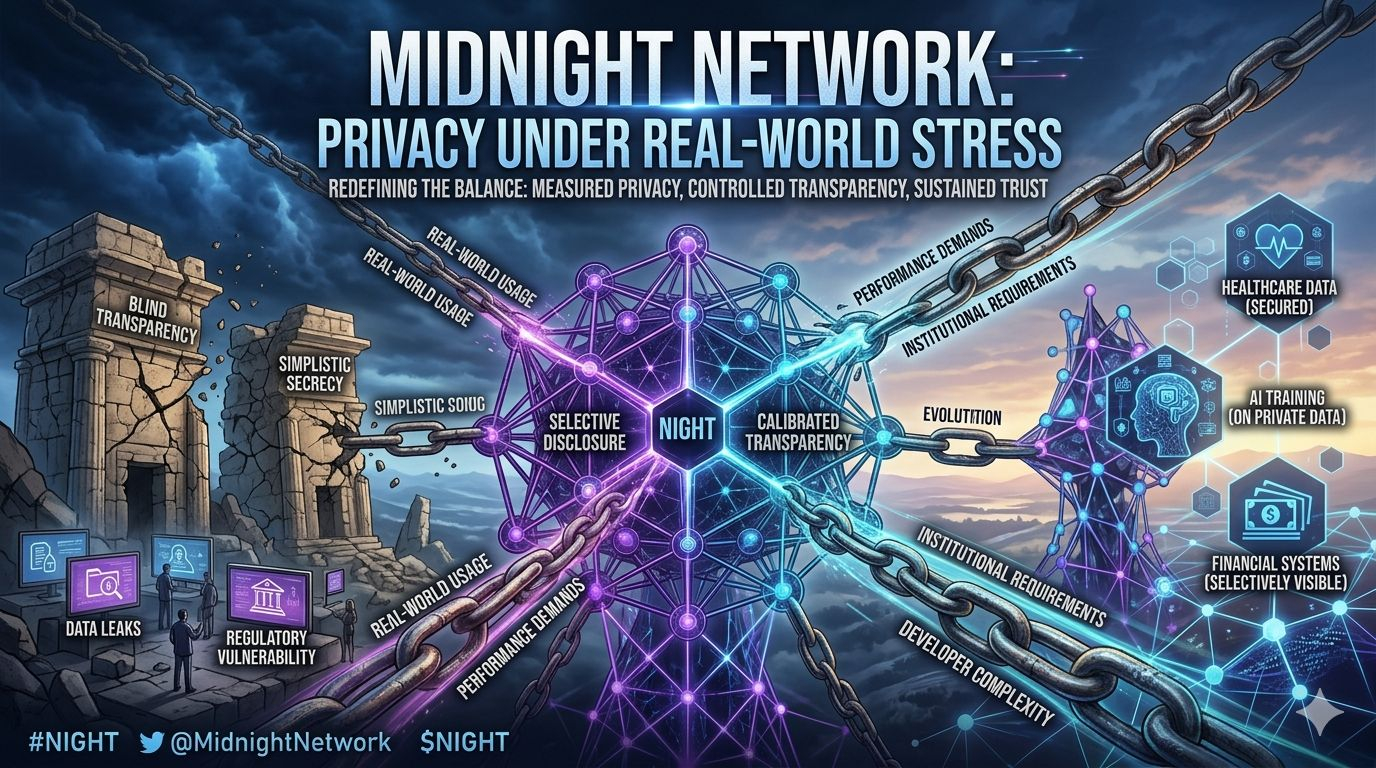
Because privacy is simple on paper. It’s easy to sell when no one is using it seriously.
Introduce actual usage, and everything changes. Performance slows. Complexity rises. Tradeoffs become unavoidable. The narrative of “perfect privacy” suddenly feels like a compromise waiting to be discovered.
This is the edge Midnight Network is exploring.
Not privacy in theory. Privacy under stress.
Most blockchain systems are built around transparency. That made sense early on—it built confidence where none existed. But as crypto tries to become functional, the same transparency can become a liability.
AI systems can’t run on fully exposed data. Healthcare fails on open ledgers. Financial behavior starts to break when every action is permanently visible. Transparency stops fostering trust and begins creating risk.
Crypto struggles to admit this. It still leans on the mantra: openness solves everything. Public data will regulate itself. That works until it doesn’t—and failures don’t scream; they fester quietly.
This is why Midnight Network is worth watching.
It doesn’t aim to reverse transparency. That would be too simplistic. Instead, it attempts to control how much exposure is needed to maintain trust.
That distinction is crucial.
You don’t need to reveal everything to prove validity. You reveal enough. Crypto has long ignored this subtle middle ground.
Extreme approaches dominate: full visibility or total secrecy. Both are simple to define. Neither scales well. Real systems operate in between, where selective disclosure and context matter. Midnight Network is designed for that space.
And that’s where complexity grows.
Selective disclosure raises heavy questions:
Where does sensitive computation actually occur?
Who decides what qualifies as “enough”?
How can users trust hidden elements?
Can concealed data subtly influence outcomes?
These aren’t abstract problems. They are structural vulnerabilities.
Crypto often solves the surface layer and assumes the foundation will hold. Rarely does it. Real usage exposes unresolved weaknesses gradually, silently.
This is why I resist early judgment.
I watch how Midnight Network scales. How developers build atop it. How users interact without full comprehension. How convenience competes with security.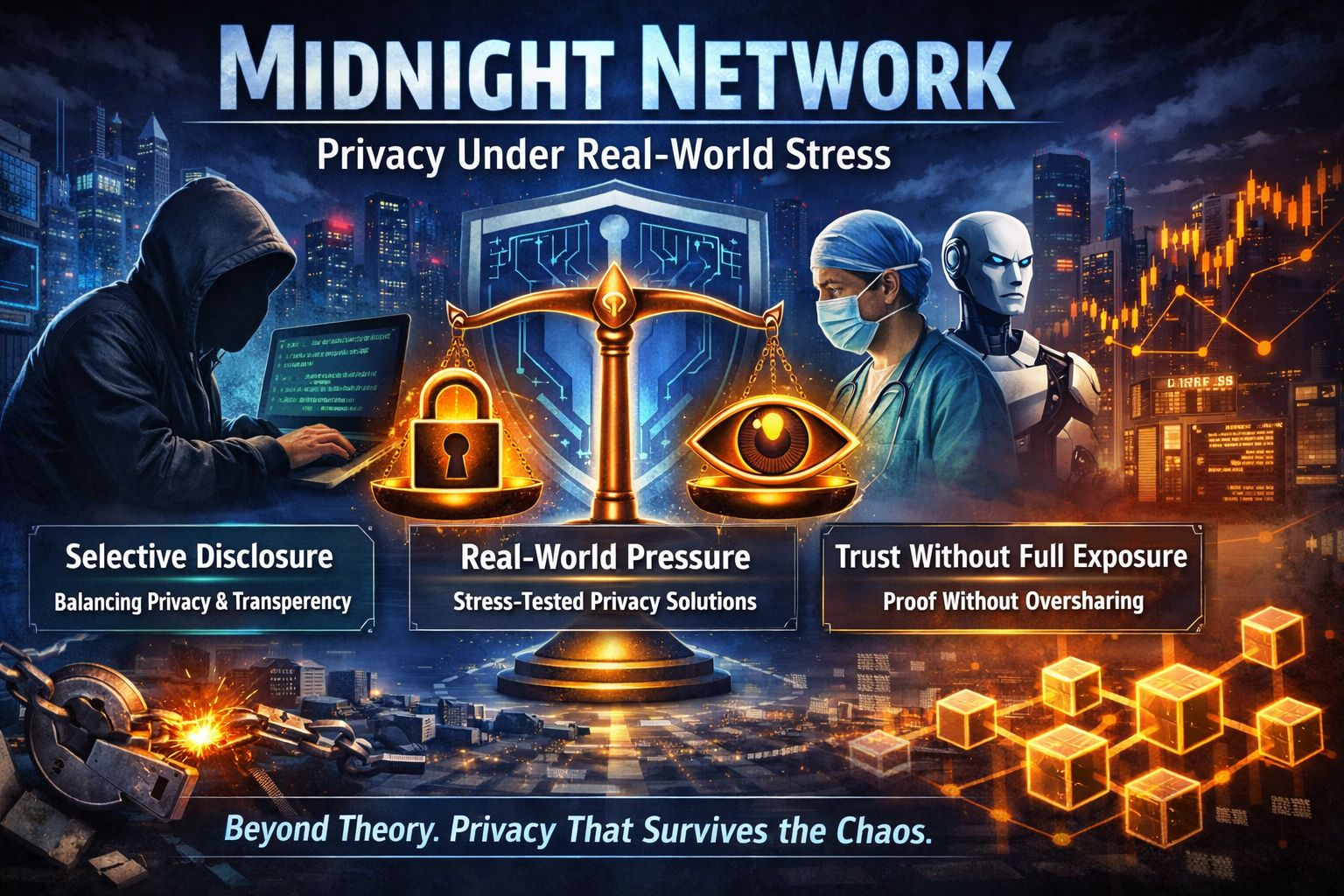
Good architecture doesn’t guarantee longevity—it only delays failure. I’ve seen too many networks crumble when subjected to real ecosystems. Crypto doesn’t reward elegant theory; it rewards systems that survive friction.
Midnight Network must prove it can:
Maintain privacy without overhead.
Ensure selective disclosure doesn’t create hidden flaws.
Handle conflicting demands while staying coherent.
This is no small challenge.
Builders want flexibility. Users demand simplicity. Institutions insist on guarantees. The system itself must remain consistent. Those pressures rarely align.
That’s why privacy solutions drift. Not from flawed ideas, but because reality reshapes them. Principles become compromises, often invisible from the outside.
Midnight Network seems aware of this risk. Awareness alone isn’t enough.
It must withstand practical pressures. Resist bending toward convenience. Protect clarity while enabling adoption. Remain meaningful even under evolving demands.
That’s where most systems quietly lose their intent. Not suddenly. Gradually. Silently. Until they are no longer what they promised.
Midnight Network might succeed. Or it might not.
If it does, it won’t be for narrative or hype. It will be for holding a delicate balance that most networks fail to maintain:
Privacy is measured, not absolute.
Transparency is controlled, not blind.
Trust exists without exposing everything.
In the future of crypto, that balance may matter more than any feature currently marketed.
The real question remains: can Midnight Network hold it?
#NIGHT #night @MidnightNetwork $NIGHT
