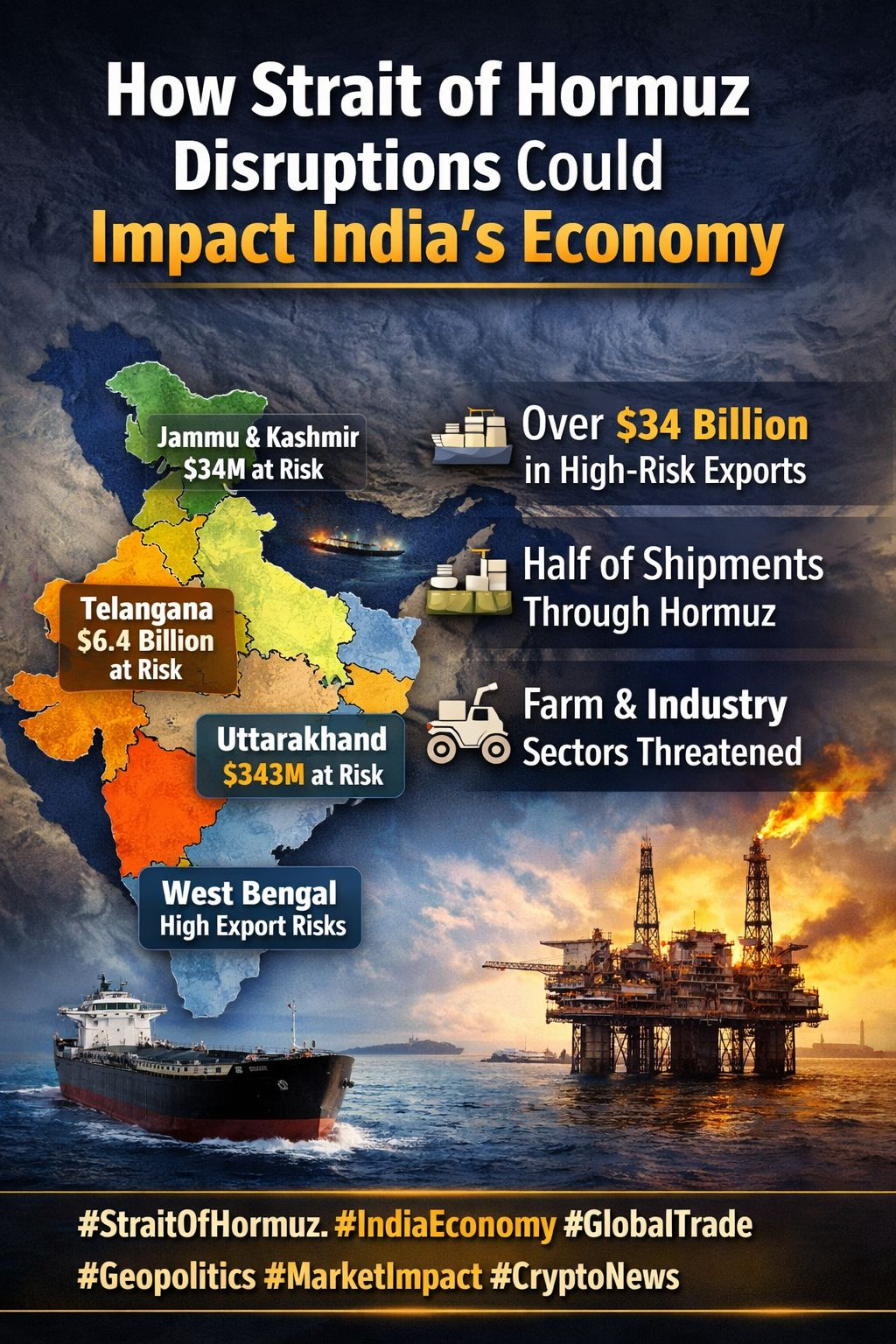
The ongoing geopolitical tensions around the Strait of Hormuz are not just a regional concern—they carry significant global economic implications. For India, the disruption of this critical trade route could have a disproportionate impact, especially on certain states that rely heavily on Gulf-linked markets.
According to recent analysis, states like Telangana, Uttarakhand, West Bengal, and the union territory of Jammu & Kashmir are among the most vulnerable. These regions depend significantly on exports routed through the Gulf, including aircraft components, industrial goods, agricultural produce, and meat products. Any disturbance in this trade corridor directly threatens their economic stability, particularly affecting farmers and small-scale exporters.
In 2024 alone, over $34 billion worth of India’s exports—approximately 8% of the country’s total exports—are considered high-risk due to their dependence on this route. More than half of these shipments typically pass through the Strait of Hormuz, making it a crucial lifeline for Indian trade.
Telangana stands out as the most exposed state, with nearly $6.4 billion in exports—almost one-third of its total outbound trade—reliant on this corridor. A major contributor to this is the state’s aircraft parts industry, accounting for around $6 billion, with a significant portion of shipments linked to the Hormuz route.
Although Uttarakhand and Jammu & Kashmir have smaller export volumes, their vulnerability is relatively higher. About $343 million of Uttarakhand’s exports and $34 million from J&K fall into high-risk categories, representing over 16% of their total exports. This highlights how even smaller economies can face severe consequences due to global trade disruptions.
As tensions continue and shipping activity slows in the region, the ripple effects could be felt across multiple sectors in India. From industrial supply chains to agricultural incomes, the economic risks are real and growing.
In conclusion, the Strait of Hormuz remains a critical artery for India’s trade. Any prolonged disruption could reshape export dynamics, impact regional economies, and underline the importance of diversifying trade routes and reducing dependency on geopolitically sensitive corridors.