

I keep finding that token design becomes easier to understand when I stop treating supply as a static number and start thinking about where that supply is actually allowed to act.
That shift changed the way I read Midnight network. What first looked like a simple multichain token setup started to feel more like a control system. The real issue is not only how many units exist, but how the protocol stops one unit from behaving as if it were live in two places at once.
That friction matters more than people usually admit. Once a token can exist on one chain and also be represented on another, the risk is no longer just an obvious exploit. It is accounting drift. One ledger may treat the asset as available while another has not yet reflected the matching lock, release, or status change.
If that gap is not handled as a protocol rule, then “same supply” starts sounding more like a narrative than a property.
It feels a bit like checking one coat under one numbered ticket so it cannot honestly be claimed from two counters at once.
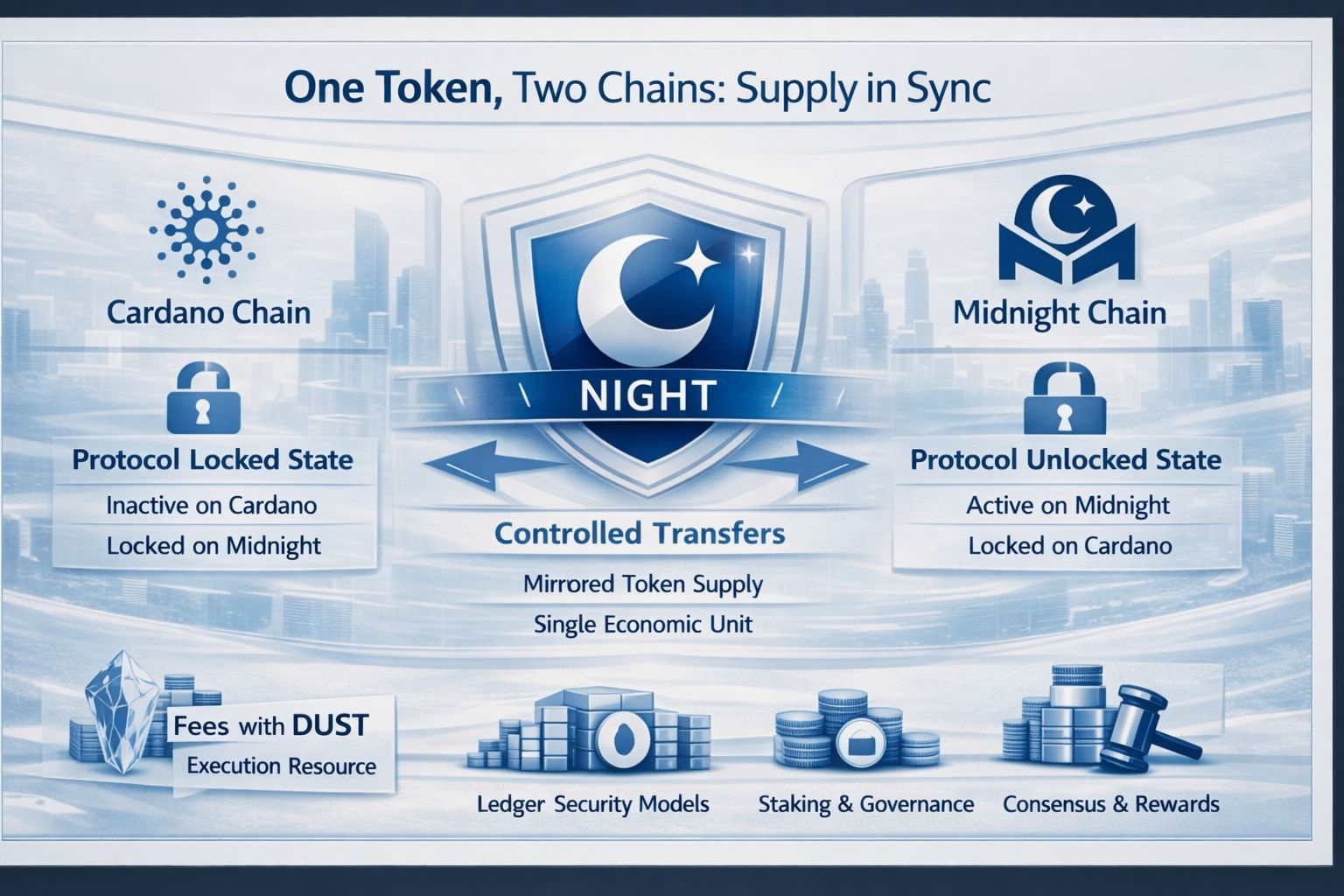
What I find more interesting here is that the network seems to treat consistency as a state problem, not just a bridge problem. The supply may be mirrored across Cardano and Midnight, but circulation is controlled through distinct conditions.
A unit can be protocol-locked or protocol-unlocked. That distinction does a lot of work. A locked unit is constrained by the system and does not carry the full rights of active participation. An unlocked unit does. The important part is the symmetry: if a token is active on one side, it must remain constrained on the other.
That is what keeps a single economic unit from becoming functionally duplicated across two environments.
I think the design becomes clearer when the state model is separated into layers. At the ledger level, native NIGHT on Midnight is handled through UTXOs rather than one loose account balance. Each output has a defined owner and value, and spending means consuming existing outputs and creating new ones.
That structure gives the chain a precise way to track what is actually spendable at any given moment. At the same time, the broader system is not forced into only one model. Native assets can follow UTXO discipline, while Compact contracts can support account-style logic when shared mutable state is the better fit.
That split feels deliberate to me. It is not trying to make one model do every job.
The cryptographic flow is where the control gets less visible but more serious. The network relies on commitments, nullifiers, Merkle membership checks, and zero-knowledge proofs so state transitions can remain private without becoming unverifiable. In practical terms, a transaction has to prove that it comes from valid prior state, that the balance conditions hold, and that the same spend path has not already been consumed before.
New commitments are inserted, nullifiers are recorded, and reused nullifiers are rejected. That sounds technical, but the underlying logic is simple: private does not mean ambiguous, and hidden does not mean unaccounted for.
Fees fit into that same design logic. NIGHT is not just treated as something to be spent directly every time activity happens. Execution is powered by DUST, a shielded and non-transferable resource generated from holding NIGHT.
I think that separation matters because it keeps capital and operational fuel from collapsing into the same function. DUST is used for transactions, regenerates over time from holdings, and decays when its backing output is spent. So the fee model is linked to the token, but not in a way that turns every network action into direct disposal of the core asset.
The security side also feels more integrated than it may appear at first glance. The chain leans on Cardano’s proof-of-stake base, with stake pool operators able to participate in block production for the network.
That means consensus selection is not floating outside the token system. It is tied to incentives, validation, and security participation.
Governance is intended to sit there as well, which gives the asset a third role beyond execution and security. In simple terms, utility breaks into three clear parts:
DUST supports fees, staking-linked participation supports block production and network security, and NIGHT anchors governance over rules and upgrades.
What keeps this design interesting to me is that it does not treat consistency as a hopeful byproduct of moving between chains. It tries to define, in protocol terms, when a token is active, when it must remain constrained, and which route preserves its canonical rights. That is a more disciplined answer to multichain supply than the usual bridge language gives.
What I still cannot judge from the documents alone is how much operational complexity users and operators will feel once this model is tested under routine, high-volume cross-chain movement.
@MidnightNetwork $NIGHT #night
