
I’ve been looking closely at how @MidnightNetwork is designed, and somewhere in the middle of reading through its documentation, I caught myself thinking about something I didn’t expect how projects like SIGN might slowly be moving away from hype and into something much more grounded: the quiet layer of compliance infrastructure.
At first, I didn’t connect the dots.
Privacy and compliance have always felt like opposites in crypto. One tries to hide information, the other tries to reveal it. But the more I sat with Midnight’s design, the more I realized that this way of thinking might be too simple.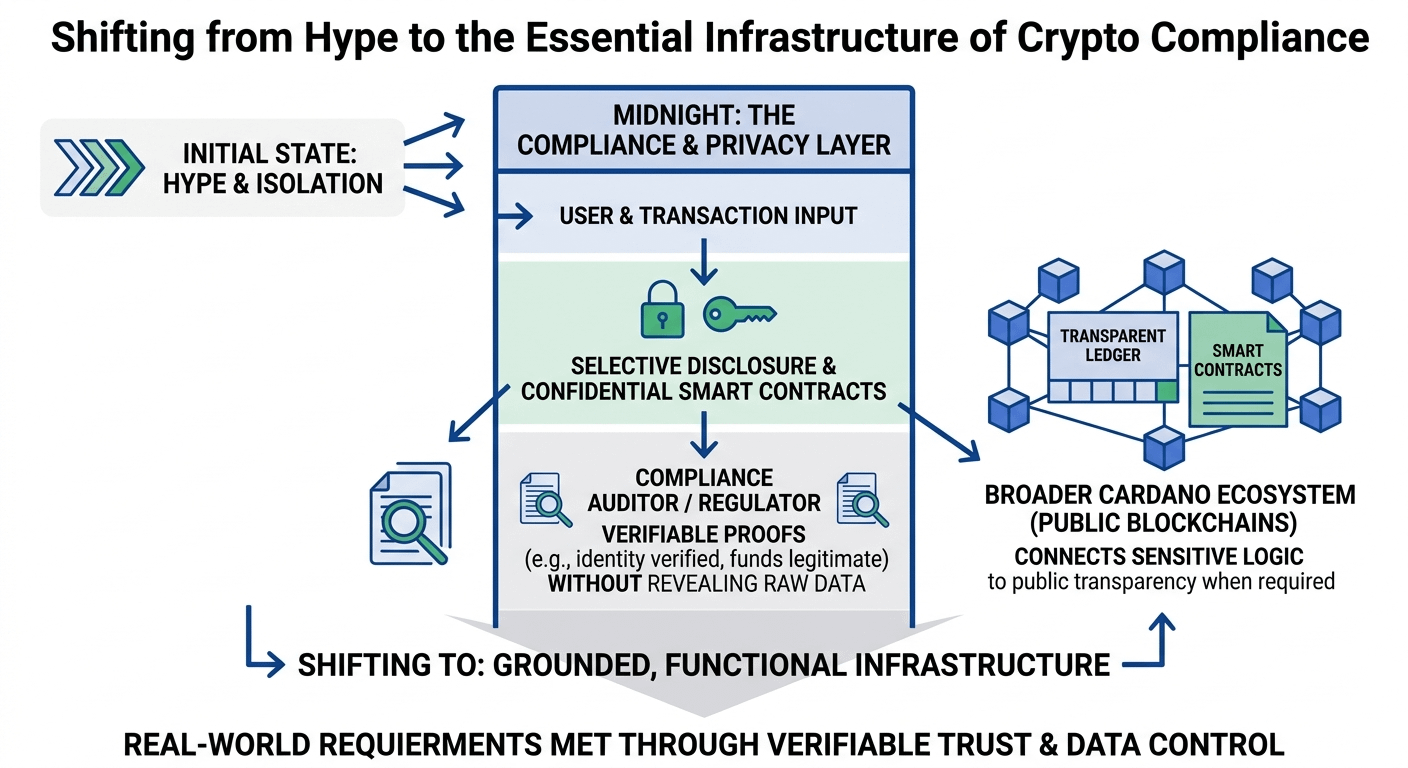
Because in the real world, compliance isn’t about showing everything.
It’s about showing enough.
What caught my attention while reading the documentation was how Midnight uses confidential smart contracts with selective disclosure. Data doesn’t have to be exposed to be useful. Instead, the system allows certain facts to be proven without revealing the full context behind them.
That idea stayed with me longer than I expected.
You don’t need to open the entire book sometimes you just need to prove that a specific page exists.
In my view, this is where the conversation around SIGN starts to feel different. If compliance can be reduced to verifiable proofs instead of raw data exposure, then the whole dynamic shifts. Suddenly, it’s not about choosing between privacy and regulation. It’s about designing systems where both can quietly coexist.
And Midnight seems to be exploring exactly that.
Another thing that stood out to me is how it fits into the broader Cardano ecosystem. It’s not trying to replace transparent blockchains. It sits alongside them as a privacy focused sidechain, almost like a parallel layer where sensitive logic can live safely, while still connecting back to public systems when transparency is required.
That separation feels… realistic.
Some interactions need visibility. Others need discretion. But both still need to be trusted.
While thinking about this, I kept coming back to incentives. For a long time, participating in crypto meant accepting a trade off you gain access to open systems, but you lose a degree of control over your data. Midnight’s model suggests a different path, where users and institutions can prove what matters without exposing everything.
That’s where infrastructure like SIGN begins to make more sense to me.
Not as hype. Not as narrative. But as something functional.
A layer that helps translate real world requirements compliance, identity, verification into blockchain logic without breaking privacy in the process.
But there’s also a quieter layer to all of this.
These systems don’t run on autopilot. The guarantees they offer depend heavily on how they’re designed and implemented. Developers decide what gets revealed, what stays hidden, and how proofs are structured. That means consistency isn’t automatic it’s something that has to be built carefully over time.
And maybe that’s the part we don’t talk about enough.
The technology is evolving. But so is the responsibility behind it.
My takeaway so far is that Midnight isn’t just building privacy tools. It’s helping reshape how we think about trust in systems where data actually matters. Instead of forcing full transparency or complete secrecy, it creates space for something in between something more aligned with how the real world already works.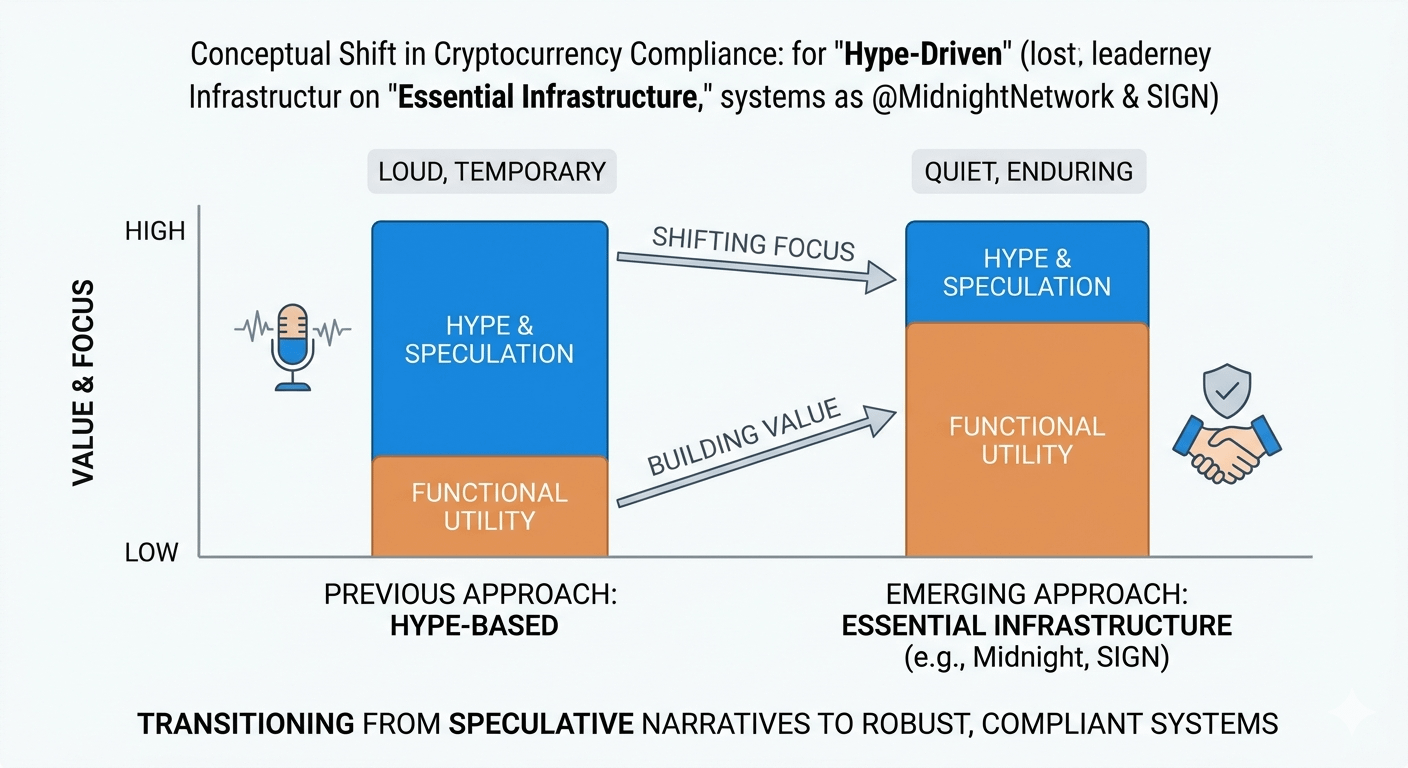
Not perfect. But practical.
As blockchain moves closer to handling identity, financial systems, and institutional processes, this balance between privacy and compliance will only become more important. Maybe the future isn’t about louder innovations, but quieter ones that simply work in the background.
Curious how others are interpreting this shift between privacy infrastructure and compliance within the Midnight ecosystem.