We’ve normalized something we should’ve questioned years ago.
Every time you go to a doctor, they don’t just check your blood pressure. They ask your full name, your address, your insurance, your entire history. Even when none of that is relevant to why you’re sitting in that chair.
Every time you prove your age at a bar, you hand over an ID that tells them where you live, what you look like, your exact date of birth when all they needed was a yes or no.
Every time you apply for a loan, you hand over every transaction you’ve ever made every coffee, every late-night purchase, every awkward transfer even though the bank only needs to know one thing: can you pay this back?
None of this feels strange anymore. That’s probably the strangest part.
We’ve been over-sharing for so long, we forgot it was ever a choice. We built systems around exposure and called it trust. We handed over more than was needed and called it verification. Somewhere along the way, the cost of participating in digital life became your entire story whether you meant to share it or not.
That’s the discomfort Midnight Network starts from. Not some grand vision. Not a whitepaper fantasy. Just a quiet observation: most systems take more than they need. And somewhere along the way, we just accepted that as normal.
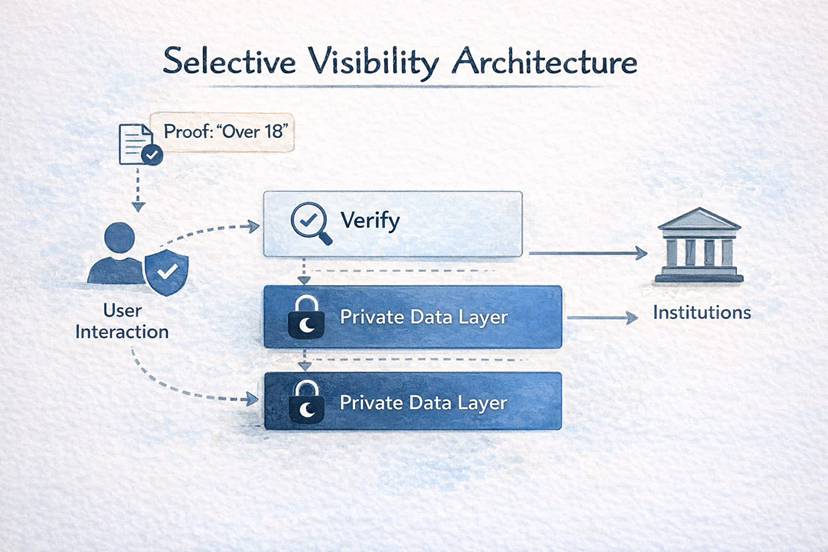
Think about a safe deposit box at a bank. The bank doesn’t need to know what’s inside. They just need to know it’s yours, and that you’re allowed to open it. That’s it. The contents are none of their business. They verify the right not the content.
That one distinction changes everything.
Midnight doesn’t try to hide everything. It redraws what needs to be seen.
One layer handles verification the part the world needs to see. The other holds the actual sensitive data — the part that should never leave your control. They communicate, but only through proofs. Not raw data. Not your history. Just proof.
Not the secret. Just the answer to the question.
It sounds almost too simple. But that simplicity is exactly what’s been missing. Most blockchain systems were built on the assumption that visibility equals trust. Put everything on the ledger. Let everyone inspect it. Call that accountability. And for certain things, that works. But real institutions banks, hospitals, regulators don’t actually operate that way. They work in layers. Permissions. Boundaries. They verify what they need and leave the rest alone.
Midnight is asking: why should digital systems be any different?
Too much transparency turns people into data. Too much privacy turns systems into black boxes. Midnight sits in between and that middle ground is harder to build than it sounds. Most projects avoid it entirely because it’s uncomfortable. It requires precision. It requires deciding, deliberately, what gets shown and what doesn’t. That’s not a technical problem. It’s a design philosophy.
Now, I’m not easily impressed. I’ve watched too many projects dress up old ideas in new language and call it innovation. Same concept, cleaner graphics, louder community. Most of it falls apart the moment you press on the details.
But what keeps me coming back to Midnight is that it isn’t trying to be revolutionary. It’s trying to be correct.
Most projects pick a side. Full exposure or full opacity. Midnight is asking whether that was ever the right choice to begin with. And in a market this exhausted where people have seen too many promises disappear into their own abstractions that kind of focused, specific thinking stands out more than it used to.
Will it work in practice? That question still hangs over it. Good design doesn’t guarantee adoption. People are stubborn. Systems are slow to change. Institutions are slower. And this market punishes anything that asks for patience.
But the idea itself is not complicated. It’s not trying to be.
What if systems only took what they actually needed?
It’s a small question. But if the answer is right, it doesn’t just fix privacy it fixes how systems behave.
And maybe that’s what makes it worth watching.