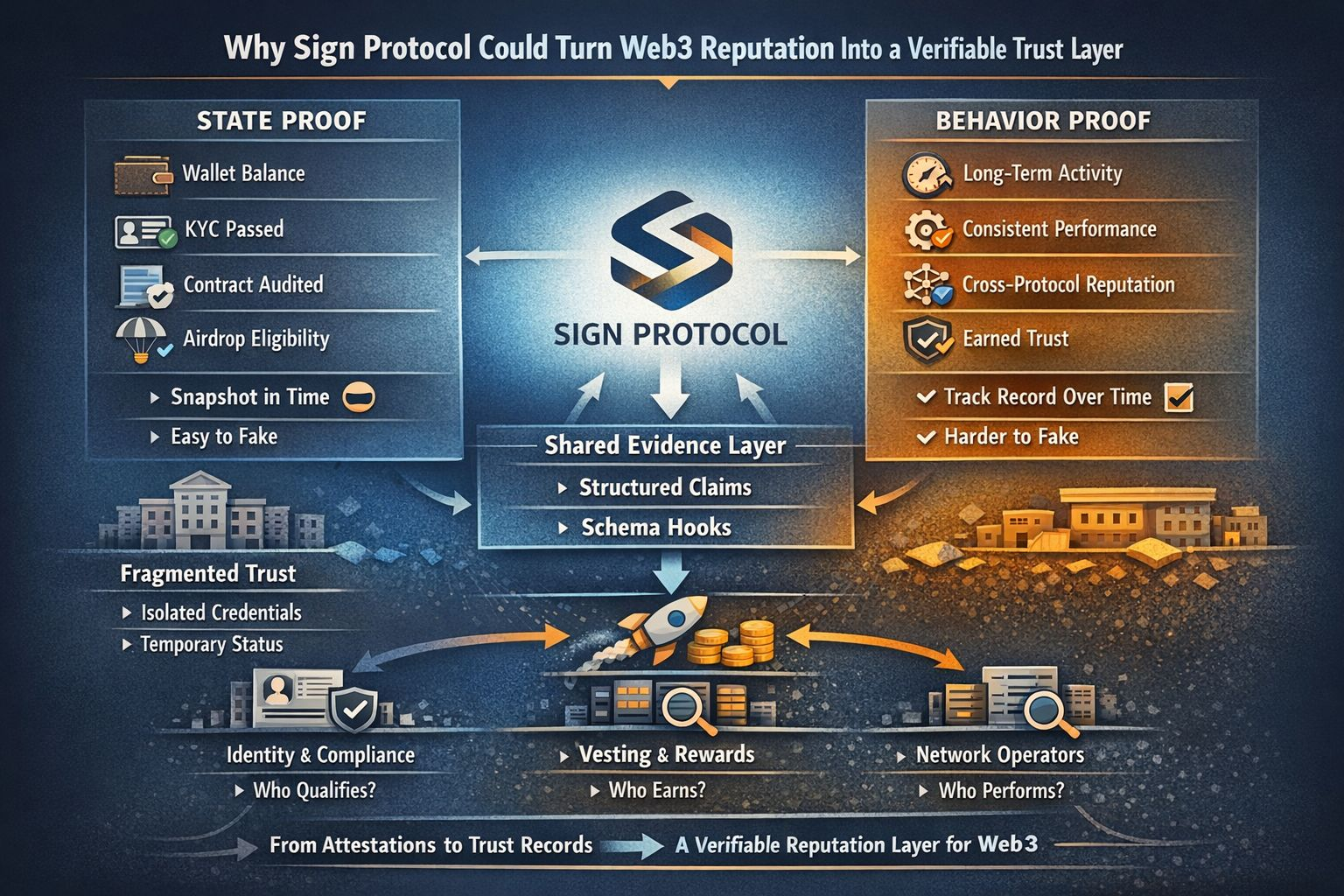
Sign separates proof for state and proof for behavior.
The more I thought about that, the more it felt like one of the most meaningful ideas in the whole protocol.
Because those two forms of proof may sound similar, but they are not the same at all.
State proof is the easier one to understand. It tells you something is true at a particular moment. A wallet holds a certain balance. A user passed KYC. A contract was audited. A person qualifies for an airdrop.
All of that can be true, but it is still just a snapshot.
It captures a single moment in time, not the full story.
That is where the weakness begins.
A wallet can borrow tokens, satisfy a requirement, and move them out right after. KYC can go stale. An audit can lose value once a contract changes. A snapshot can be technically correct and still tell you very little about whether that person, wallet, or protocol is actually trustworthy over time.
That is why behavior proof feels so much more valuable.
Behavior proof is not about one isolated moment. It is about a pattern. It is about what someone has actually done over time.
There is a big difference between saying a validator exists and saying that validator has operated for two years without being slashed.
There is a big difference between saying someone contributed once and saying they have kept showing up and shipping across multiple protocols for a year.
One is a condition.
The other is a track record.
And in a trustless environment, track record is far harder to fake than condition.
You can borrow capital. You can game a snapshot. You can buy access.
But you cannot easily fake a long history of real performance.
You cannot cheaply manufacture consistency.
And that is why behavior proof, if it can actually be done well, carries far more weight than a one-time credential ever could.
That is where Sign starts to become genuinely interesting to me.
Because the protocol does not feel like it is only trying to store attestations. It feels like it is trying to build a shared system for how Web3 defines and verifies claims in general.
That matters because so much of crypto still runs on fragmented trust.
Every protocol creates its own rules, its own eligibility system, its own badges, its own internal reputation logic.
Nothing carries over cleanly.
Proof stays trapped inside separate ecosystems.
What Sign seems to be pushing toward is a common structure for claims.
A claim can be many things. It can be an identity check, a compliance result, an eligibility condition, a contribution record, a credential, or a proof that a certain statement is true.
But the bigger idea is that these claims should not remain as disconnected one-off pieces of data.
They should be structured, signed, readable, and reusable across different systems.
That is a much bigger ambition than simply being an attestation tool.
And I think that is exactly why schema hooks matter so much.
Without hooks, an attestation is mostly just a record. Useful, yes, but still static.
With hooks, it becomes much more active.
It can enforce conditions. It can validate inputs. It can decide whether something should be issued in the first place.
That changes the nature of the system.
Imagine an operator joining a network.
At first, there may only be a simple proof showing they passed onboarding. That is useful, but it says almost nothing about how they will perform.
Then imagine that over time the system keeps updating that record based on actual outcomes, completed tasks, verified performance, missed obligations, and sustained reliability.
At that point, the attestation stops being a frozen credential and starts becoming something much closer to living reputation.
That is where the idea starts to feel powerful.
Because once trust reflects ongoing behavior instead of one-time status, it becomes useful in a deeper way.
Other systems can read it.
Other protocols can build on it.
Capital can be allocated based on it.
Access can depend on it.
Coordination can improve because the network is no longer forced to make decisions from thin snapshots alone.
At that point, Sign is not just helping systems prove things.
It is helping them remember things.
And honestly, that may be the deeper infrastructure play here.
But this is also where the hardest question appears.
How do you know the recorded behavior is real?
That is the part I do not think should be skipped over.
Because behavior proof sounds incredibly compelling in theory, but the moment you start talking about tracking real-world or off-chain behavior over time, the oracle problem shows up immediately.
Who feeds the data into the system?
Who verifies that a task really happened?
Who confirms that a contribution was genuine?
Who decides whether a performance score reflects reality rather than manipulated input?
This is not some minor technical issue at the edge.
It is the center of the whole trust model.
If schema hooks automatically update an attestation but the data feeding those updates is weak, biased, or compromised, then the entire behavior-proof layer becomes shaky.
In that case, the protocol may still be organizing information elegantly, but it could still be organizing unreliable information.
And that distinction matters a lot.
I do not think Sign magically solves truth.
No protocol really can.
What it can do is make claims more structured, more portable, more inspectable, and easier to verify across systems.
That is already extremely valuable.
But it is still different from solving whether the original source of the data is trustworthy.
That is why I think Sign’s real promise is not that it removes trust problems altogether, but that it gives Web3 a better framework for handling them.
It gives claims a shared language.
It gives evidence a clearer structure.
It gives systems a way to carry trust signals from one context into another without having to rebuild everything from scratch every single time.
And when I look at Sign through that lens, the wider ecosystem around it starts making a lot more sense.
Products tied to token distribution, vesting, identity, and digital agreements are not random extensions.
They are environments where claims actually matter in a practical way.
Who is eligible, who met a milestone, who should receive an allocation, who completed the right steps, who has the right credentials, who has earned an unlock.
These are all different forms of claims.
So the protocol is not interesting because attestations sound impressive.
It is interesting because claims sit underneath so many forms of coordination, especially once identity, money, and reputation begin to overlap.
That is why the distinction between state proof and behavior proof keeps pulling me back.
A lot of crypto still leans too heavily on state.
Token balances, NFT ownership, one-time badges, temporary conditions, isolated actions.
These are easy to measure and easy to display, but they often do not tell you very much about actual reliability.
Behavior is slower, messier, and harder to capture.
But it tells you much more.
It tells you whether someone keeps showing up.
It tells you whether performance holds over time.
It tells you whether trust has really been earned instead of briefly rented.
That is why, to me, the long-term value of Sign is probably not in proving what is true once.
It is in helping prove what has remained true long enough to matter.
That is where my view becomes both optimistic and careful at the same time.
I do think Sign is trying to standardize how Web3 defines a claim.
I think that part is real.
The protocol clearly seems to be building toward a shared evidence layer that different systems can use.
But I also think the strongest version of that thesis still depends on something deeper being proven in practice.
It is not enough to have elegant schemas.
It is not enough to say behavior proof matters more.
The real test is whether Sign can support actual production systems where trust records are updated by genuine behavior, where the source of that behavior is credible, and where other protocols begin to rely on those records in meaningful ways.
That is the part I still want to see more clearly.
Because if Sign gets that right, then it stops being just another attestation tool.
It becomes something much bigger than that.
It becomes infrastructure for memory, trust, and reputation across Web3.
And honestly, that is a far more important opportunity than most people realize.
#SignDigitalSovereignInfra @SignOfficial $SIGN