

I remember the point where I stopped treating Sign Protocol like just another crypto middleware story and started looking at it as a market habit problem. It was after watching one more launch cycle where the chain, the token, the dashboard, and the community all looked busy, but the actual thing being rebuilt was the same old question: how do strangers trust a claim online without trusting the person who posted it? Crypto keeps rebuilding that layer in different costumes. A bridge score here, a badge there, an allowlist somewhere else. Sign makes more sense when you realize it is trying to standardize the evidence itself, not just the app sitting on top of it. That matters. But it also creates a brutal retention test, because traders do not get paid for admiring architecture. They get paid when usage persists after the first distribution, first exchange listing, and first round of attention cools off.
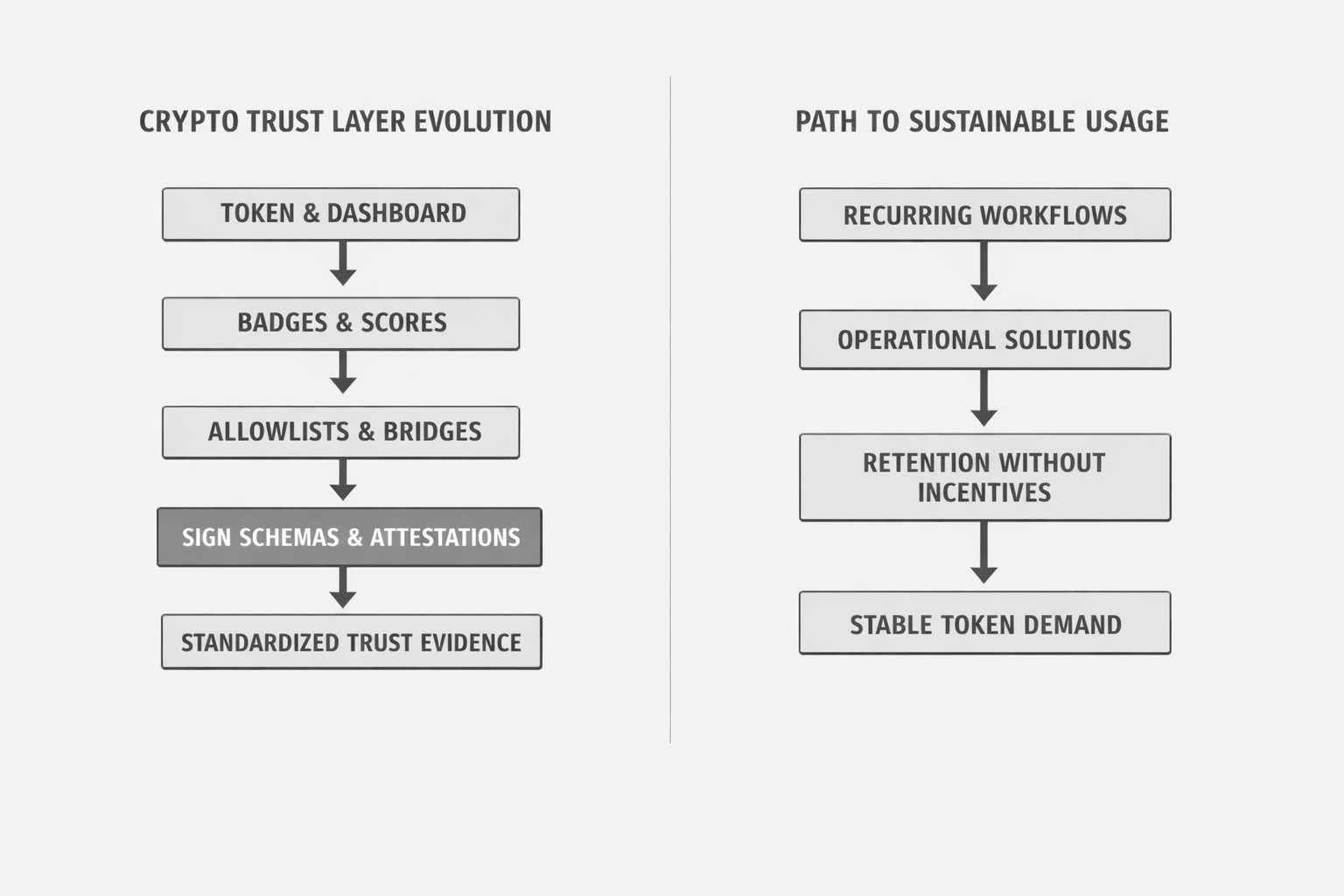
The practical idea is stronger than the token story people usually lead with. Sign Protocol organizes claims into schemas and attestations, then lets builders store them onchain, offchain, or in hybrid form while keeping them queryable and verifiable. Their own docs are pretty clear that verification is not just “did someone sign this.” It includes schema checks, signer and signing domain checks, authority checks, status checks like revocation or expiration, and even evidence checks when supporting proof is required. That is the part of crypto we keep underpricing. Not signatures. Context. Anyone can slap a signature on data. The harder problem is whether that data still means the same thing six months later when money, access, compliance, or reputation depends on it. If you are trading around this, the risk shows up fast. An evidence layer sounds important, but importance does not automatically become stickiness. Sign has multiple live surfaces around that core. EthSign says it has more than 2 million users and 800 thousand contracts signed, which gives the ecosystem a real footprint. SignScan also shows that at least some schemas are generating large attestation counts, including one public profile with more than 3.3 million attestations attached to 19 schemas. That tells me the system can handle repeated issuance, not just one-off demos. Still, that is not the same as broad, recurring, fee-generating demand across many independent apps. One busy issuer can make a protocol look healthier than it is. I have seen that movie too many times in crypto. This is where the retention problem matters more than the headline. Sign is no longer just talking about attestations as an abstract developer primitive. The stack now includes TokenTable for rules-based distributions and vesting, plus an OBI program for SIGN holders that is explicitly framed around staying aligned over time. That is a smart move, because it tries to turn passive holding into an ongoing relationship. But here is my hesitation: retention built on incentives is always suspect until it survives reduced incentives. If users, builders, or holders return only because a campaign is live, then the protocol is renting attention, not owning a workflow. What I am watching is whether attestations keep getting created because they solve an operational bottleneck, like eligibility, auditability, or signer authority, not because people are farming the next reason to click. That also ties directly into price. As of now, SIGN is trading around five cents, up roughly 11 percent on the day according to Binance, with a circulating supply around 1.64 billion and 24 hour trading volume that has recently been in the tens of millions of dollars. On paper, that kind of move can pull in momentum traders. In practice, it forces a better question: is price leading real usage, or just rediscovering an old narrative? I do not mind trading narrative when the tape is clean. I do mind pretending that narrative and retention are the same thing. They are not. A token can squeeze hard while the underlying habit loop is still unproven. What would change my mind decisively on the bullish side is pretty simple. I want to see repeated evidence that builders use Sign because recreating trust logic themselves is slower, messier, and more expensive. I want more visible distribution programs, more attestation-heavy applications, and more proof that the protocol is becoming boring infrastructure instead of a featured campaign. Boring is good here. The best trust layers disappear into workflow. If that happens, retention improves, token demand becomes easier to defend, and price moves start to mean more than temporary attention. If it does not, then SIGN risks becoming another token attached to a valid idea that the market only rents for a season. That is the trade. Not whether verifiable claims matter. They do. The real trade is whether Sign becomes the default place where crypto stops rebuilding trust from scratch every cycle, or whether it remains one more well-designed layer that traders visit, trade, and leave behind. If you are eyeing this, stop asking whether the concept sounds smart and start asking whether the behavior is becoming routine. Watch the workflows. Watch the repeat usage. Watch who comes back when there is nothing new to announce. Then take the trade with your eyes open, not your hopes up. $SIGN is moving because the market is starting to price the idea that trust infrastructure might matter more than another short-lived app narrative. But the real question is whether that move can survive once attention cools. Sign already has live attestation rails, TokenTable distribution logic, and ecosystem scale through products like EthSign. Now traders need proof of repeat usage, not just visibility. My trade idea is simple: stay constructive only while usage signals keep catching up to price. What do you think?