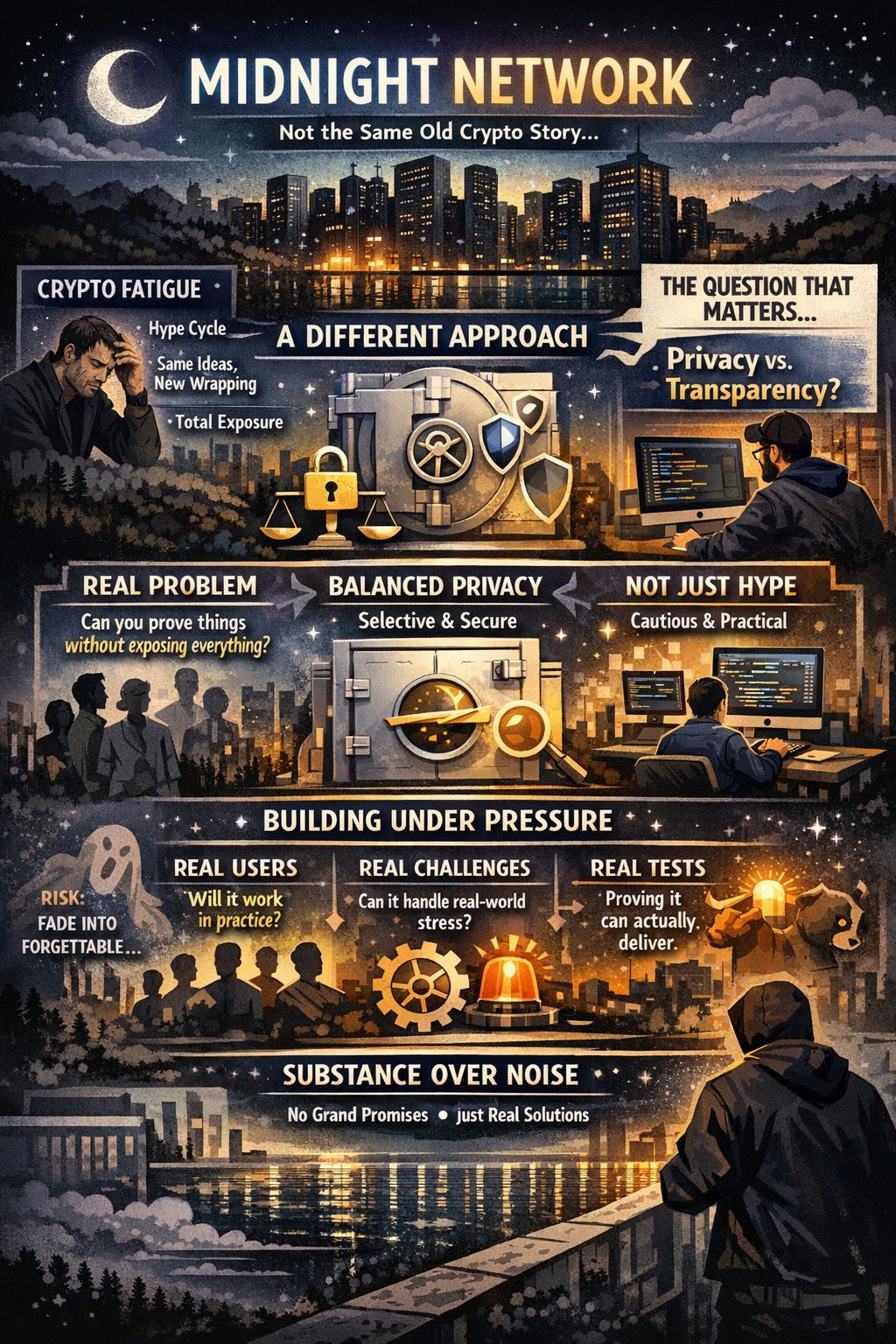
I did not expect to care about Midnight Network.
That is probably the most honest place to start.
After being in crypto long enough, you lose patience in a very specific way. Not dramatically. Not loudly. You just get tired. Tired of seeing the same ideas recycled with new branding. Tired of watching projects act like they are breaking new ground when really they are just rearranging old language into a fresher-looking pitch. Tired of hearing every cycle talk like it has finally figured everything out, only for most of it to end the same way it always does.
So when Midnight first landed on my radar, my reaction was not excitement. It was more like, alright, here we go again.
And yet, I kept coming back to it.
Not because I think it is guaranteed to work. I do not. Crypto has a way of making things look convincing right up until the moment they meet reality. I have seen enough projects sound serious, look polished, and still fall apart once they had to deal with actual users, actual incentives, actual pressure. So I am not looking at Midnight through that kind of naive optimism.
What makes it harder for me to dismiss is something much simpler.
It feels like it is trying to solve a real problem.
That alone already puts it ahead of a lot of this market.
For a long time, crypto treated transparency like it was automatically a virtue. Everything public. Everything visible. Everything on-chain. The culture started acting like exposure was the same thing as trust. And sure, at first, that made sense. Public verifiability was one of the things that made blockchains feel new and important.
But over time, that idea got pushed so far that it started to feel strange.
Because in real life, nobody wants every financial move, every agreement, every personal interaction, every sensitive transaction permanently out in the open by default.
That is not normal.
That is not elegant.
That is not even especially practical.
It is just something crypto got used to and then pretended was a principle.
And Midnight seems to begin exactly where that story starts to crack.
That is what caught my attention.
It does not feel like it is approaching privacy as a slogan or some dramatic ideology. It feels more grounded than that. More practical. More like it is asking a simple question that most of the industry has avoided for too long:
Can a blockchain prove what it needs to prove without exposing everything all the time?
Can you build something that still has trust and verification without turning every detail into public property forever?
That question feels real to me.
And real questions are rarer in this space than they should be.
A lot of projects do not start with tension. They start with ambition. They start with scale, disruption, transformation, some giant promise that sounds impressive until you realize nobody has clearly explained what pain point they are actually dealing with.
Midnight feels different because the tension is already there from the beginning.
It is not saying privacy is cool.
It is saying public-by-default might not be enough.
That is a much more interesting place to start.
What also makes Midnight stand out is that it does not seem to be selling fantasy in the usual crypto way. It is not really offering some cartoon version of freedom where technology magically solves human complexity. It is not pretending code eliminates law, politics, regulation, institutions, or trade-offs. I have heard that version of crypto enough times. It always sounds clean at the start, and ridiculous by the end.
Midnight feels narrower.
And I think that helps it.
Because narrow projects dealing with real friction are usually more interesting than huge projects built on vague promises. Midnight seems to understand that the useful version of privacy is not theatrical. It is structural. It is selective. It is built into the system itself, not tacked on afterward because everyone eventually realized the original design was too exposed to live with.
That distinction is doing a lot of work here.
The hard part is not making privacy sound appealing. Of course it sounds appealing. The hard part is building a system where privacy does not destroy trust, and where trust does not require total exposure. That middle ground is ugly. It is difficult. It is much harder to explain than the loud, simple stories crypto usually prefers.
Which is probably why Midnight still feels alive to me.
It has not been flattened into something too polished yet.
There is still some tension in it. Some uncertainty. Some actual risk. It still feels like a project that has something to prove.
And I trust that more than I trust confidence.
Because this is the phase that matters. Not the announcement phase. Not the branding phase. Not the stage where everyone is still in love with the idea of what something could become.
The part that matters is when the concept starts running into real conditions.
Real builders.
Real users.
Real pressure.
That is where most projects begin to show what they are actually made of.
That is what I am watching for with Midnight.
I want to see whether the architecture still holds once real usage begins. I want to see whether the developer experience becomes a headache. I want to see whether the privacy model stays meaningful under pressure or slowly gets softened into something safer and less important. I want to see whether this becomes a network people genuinely build on, or just one of those technically respectable projects everyone politely praises while nobody really commits to it.
That kind of failure happens more often than people admit.
Some projects do not collapse.
They just fade into being well-mannered and forgettable.
That is one of the risks here too.
But even with that, I still cannot tune Midnight out.
Maybe because it feels like one of the few crypto projects reacting to the right kind of exhaustion. Not just market exhaustion, though that is part of it. I mean the deeper kind. The exhaustion of pretending the first version of crypto got everything right. The exhaustion of acting like transparency is always a virtue, even when it starts looking more like permanent overexposure. The exhaustion of watching the same assumptions recycled so many times that people forget they were assumptions to begin with.
Midnight seems to be pushing against that.
Quietly, too.
And honestly, that might be part of why it sticks with me. It does not feel desperate for approval. It does not feel like it is trying to overpower people with noise. In a market that constantly confuses volume with substance, that restraint stands out.
Not in some dramatic way.
Just enough to notice.
So I keep watching it.
Not because I am sold. Not because I think it is beyond criticism. And definitely not because I trust crypto narratives on first contact anymore.
I keep watching because Midnight still feels unfinished in the right way.
It still feels like a project standing in front of a real problem, trying to solve it without pretending the problem is easier than it is.
And after years of watching this industry package the same nonsense in prettier language, that alone is enough to make me pay attention a little longer.
#night @MidnightNetwork $NIGHT