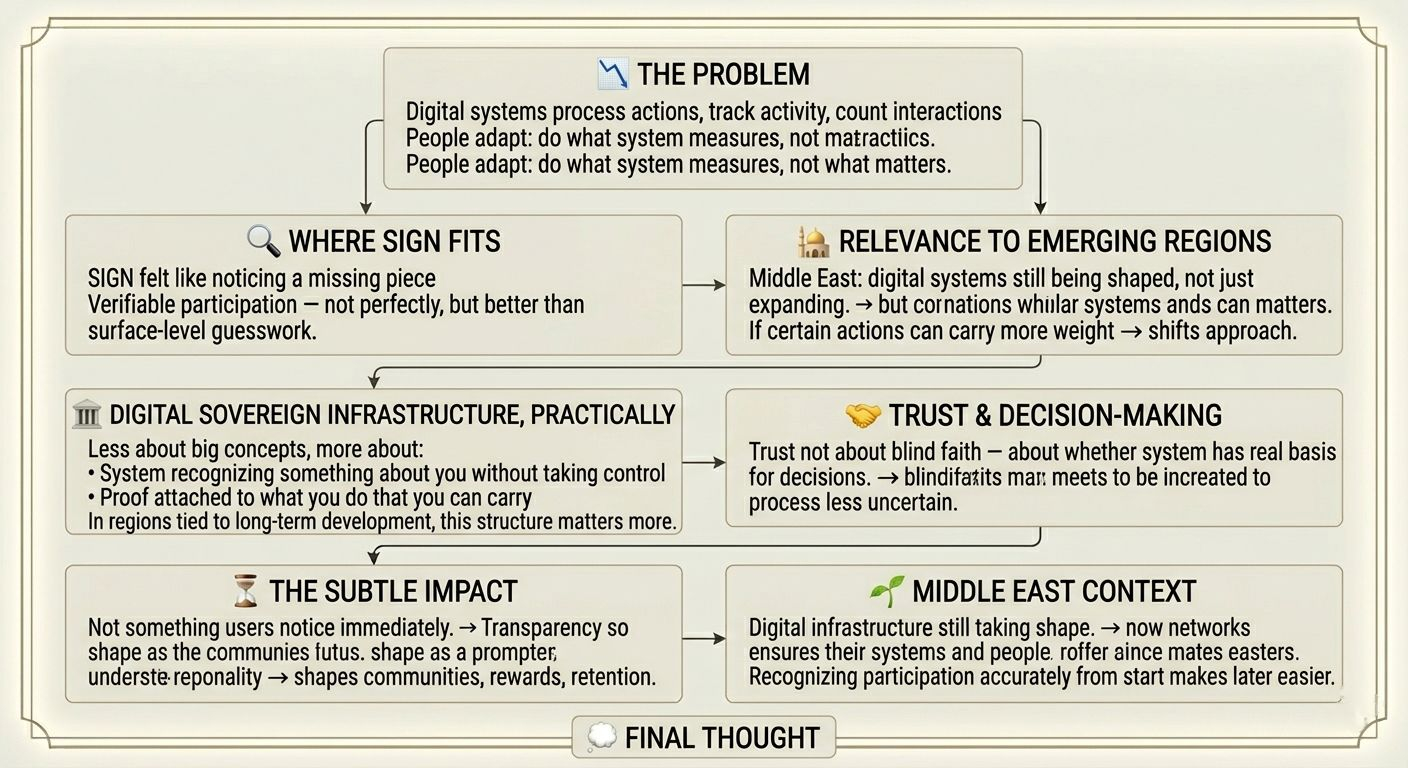
Something I’ve been thinking about lately is how most digital systems don’t really “understand” the people using them. They process actions, track activity, record transactions, count interactions. But that’s not the same as understanding what someone actually did or why they did it. Everything gets flattened into signals that are easy to read, and once that happens, a lot of the context just disappears. I didn’t pay much attention to this before, but the more I look at how different projects work, the more it feels like this is one of those gaps that keeps showing up in different ways.
You can see it in small things. Someone might spend time helping others in a community, consistently show up early in a project, or just stay involved longer than most people. But when it comes to recognition or rewards, those things don’t always show up clearly. The system just sees activity, not intent. And since it can’t really tell the difference, it treats everything more or less the same. Over time, people adapt. They start doing what the system can measure, not necessarily what actually matters. Most of the time, people don’t even think about it they just end up interacting that way.
When I started looking into SIGN, it didn’t immediately feel like something big or disruptive. It felt more like noticing a missing piece that had been there for a while. The idea that some parts of participation could be verified in a more meaningful way not perfectly, but better than just guessing based on surface-level activity changes how you think about these systems. It’s not about tracking more data, it’s about making certain things count in a way that doesn’t get lost as soon as they happen.
This becomes more relevant when you think about places where digital systems aren’t just expanding, but still being shaped. The Middle East is a good example. There’s a lot of movement there right now new platforms, infrastructure, and initiatives developing at the same time. And when things are still at that stage, the way systems interpret participation isn’t just a detail, it ends up influencing how people behave inside them. If everything gets reduced to simple signals, that’s what people optimize for. But if certain actions can carry more weight, even slightly, it can shift how people approach participation.
This is where the idea of digital sovereign infrastructure starts to make more sense in practice. It’s less about big concepts and more about whether the system can recognize something about you without taking control away from you. Whether what you do has some form of proof attached to it that you can carry, instead of it just disappearing into a record somewhere. In regions where digital growth is tied to longer-term development, like parts of the Middle East, that kind of structure likely matters more.
Another thing that stands out is how this affects trust, but not in the usual sense. It’s less about trusting the system blindly, and more about whether the system has something real to base its decisions on. Right now, a lot of outcomes are shaped by patterns that can be repeated or adjusted pretty easily. That doesn’t always break things, but it can make results feel inconsistent. If some of those decisions are tied to something more verifiable, even in a limited way, it makes the whole process feel less uncertain.
I don’t think this is something people will notice immediately and maybe that’s the point. It’s not a feature you interact with directly. It sits underneath, influencing how systems interpret what’s happening. But over time, those small differences show up in how communities form, how rewards are distributed, and how people choose to stay involved or move on.
In a region like the Middle East, where a lot of digital infrastructure is still taking shape, this kind of layer doesn’t feel optional. It feels like something that could shape how these systems behave as they grow. Because once patterns are set, they tend to stick, even if they’re not perfect. So having a way to recognize participation a bit more accurately from the beginning could make things easier later on.
I’m not saying SIGN solves everything around this, because it doesn’t. But it does touch on something that most systems haven’t really handled well yet. And sometimes, improving even one part of how systems understand people can change more than expected over time.