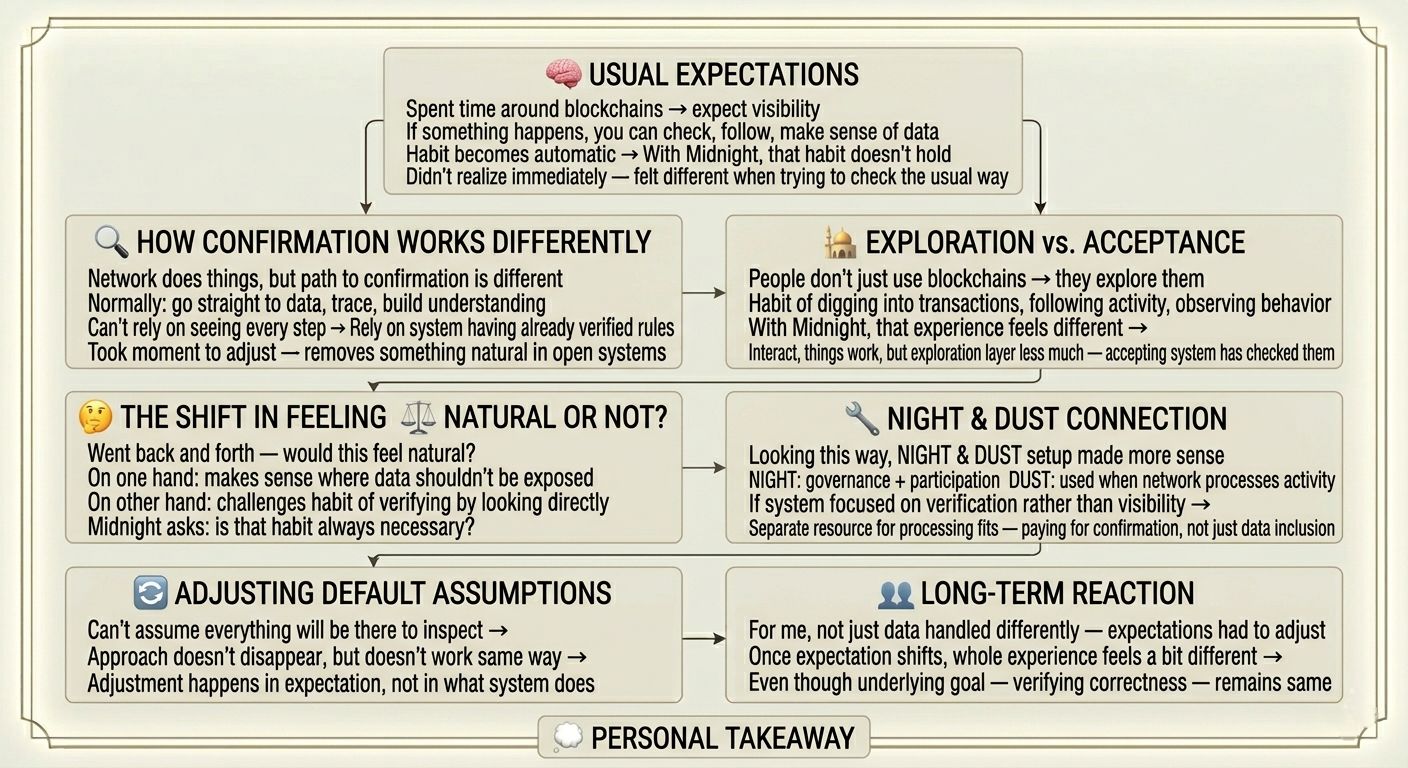
While going through Midnight, I noticed something that took me a bit longer to understand, and it wasn’t even about the technical side at first. It was more about expectations. When you’ve spent enough time around blockchains, you get used to certain patterns. You expect things to be visible. You expect that if something happens, you’ll be able to check it, follow it, and make sense of it by looking at the data. That expectation becomes almost automatic. You don’t really question it anymore. But with Midnight, that habit doesn’t hold up in the same way, and I didn’t realize it immediately. It only started to feel different when I caught myself trying to “check” something the usual way and realizing that the system doesn’t really give you that same path.
It’s not that the network isn’t doing anything or that things are unclear. It’s more that the way you confirm things is different from what you’re used to. Normally, if you want to understand what’s happening, you go straight to the data. You look at it, you trace it, and you build your understanding from there. Here, that instinct doesn’t always help. You can’t rely on seeing everything step by step. Instead, you’re relying on the fact that the system has already verified that things follow the rules. That took me a moment to adjust to, because it removes something that feels very natural when you’re used to open systems.
I also found myself thinking about how often people don’t just use blockchains they explore them. There’s this habit of digging into transactions, following activity, and trying to understand behavior just by observing what’s happening. It’s almost part of the experience. With Midnight, that experience doesn’t feel the same. You can still interact with the network, things still work, but that layer of exploration isn’t as available in the same way. You’re not building understanding from visible details as much as you’re accepting that the system has already checked them.
At first, it kind of felt like something was missing.
But after thinking about it for a bit, it didn’t really feel like a limitation anymore just different.
The system isn’t removing verification or anything like that. It just handles it in its own way.
You’re not really checking everything yourself all the time. It’s more like you’re relying on the system to have already checked it.
Another thing that stood out to me is how this affects the way you think about interactions over time. On most blockchains, the more activity there is, the more there is to observe. More transactions, more data, more patterns. With Midnight, increased activity doesn’t necessarily mean increased visibility in the same way. Things are still happening, but they don’t all translate into something you can easily analyze from the outside. That creates a different kind of environment, especially for people who are used to learning by watching the network itself.
I kept going back and forth on whether this would feel natural or not. On one hand, it makes sense in situations where data shouldn’t be exposed in the first place. Not everything needs to be visible to everyone. On the other hand, it does challenge a habit that a lot of people have built over time the habit of verifying things by looking at them directly. Midnight seems to be asking a different question, which is whether that habit is always necessary.
When I looked at it this way, the NIGHT and DUST setup made a bit more sense.NIGHT is tied to governance and participation, while DUST is used when the network processes activity. If the system is focused more on verification than visibility, then having a separate resource tied to processing makes more sense. It’s not just about paying to include data, it’s about paying for the network to confirm that everything is valid. I didn’t think much of it at first, but it fits better once you look at how the system actually behaves.
What I kept coming back to, though, is how this changes your default assumptions. You can’t just assume that everything will be there to inspect. You can’t rely on the usual approach of “I’ll just check it myself.” That approach doesn’t disappear completely, but it doesn’t work in the same way either. And that’s where the adjustment happens. Not in what the system does, but in how you expect it to behave.
I’m still not completely sure how people will react to that shift over time.Not everyone will notice it right away, I think.
If you’re just using apps, it might feel normal. But if you’re used to digging into things and checking everything yourself, the difference is easier to notice.
It really depends on how you interact with the system.
And for me, it didn’t just feel like data is handled differently. It felt like my expectations had to adjust a bit.And once that expectation shifts, the whole experience starts to feel a bit different, even if the underlying goal verifying that things are correct is still the same.