I’ll be honest, most conversations around privacy in crypto still feel a bit surface-level to me. It’s usually framed as a feature something optional, something you turn on when you need it. But the more I think about it, the more it feels like that framing misses the bigger picture. Privacy isn’t just about hiding information, it’s about how systems function when not everything is exposed by default. And that’s exactly where something like Midnight starts to shift the conversation.
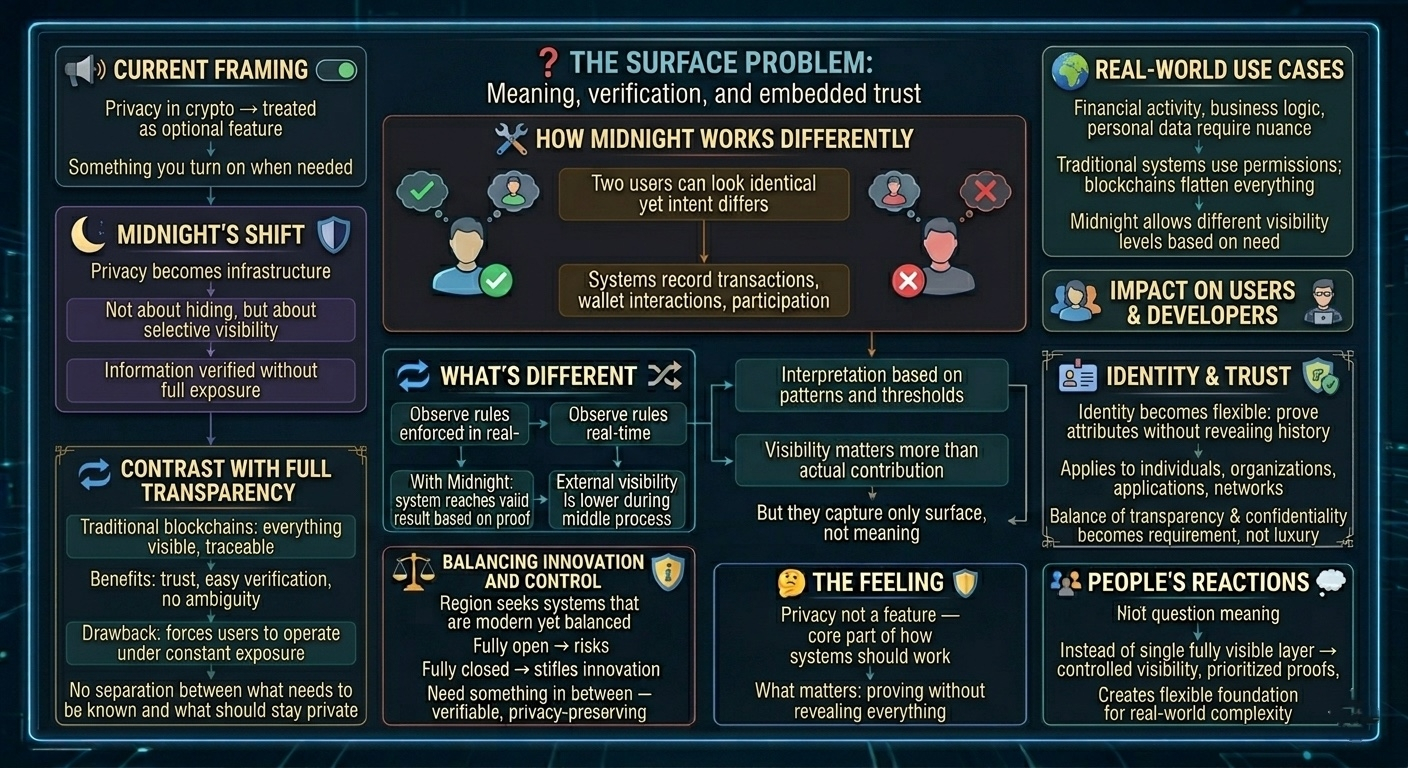
Right now, most blockchain systems operate on full transparency. Every transaction, every interaction, every movement is visible and traceable. That transparency has its advantages it builds trust, it makes verification easy, and it removes ambiguity. But it also creates a kind of rigidity. When everything is visible, users are forced to operate in a way that assumes constant exposure. There’s no separation between what needs to be known and what should remain private. Over time, that affects behavior more than people realize.
What Midnight introduces isn’t just “more privacy,” it introduces selective visibility. And that distinction matters. Instead of choosing between full transparency and complete opacity, it creates a structure where information can be verified without being fully revealed. That changes how systems can operate at a fundamental level. It means actions can still be trusted, but they don’t have to be publicly exposed in their entirety.
This becomes especially important when you consider how real-world use cases interact with blockchain systems. Not everything should be public. Financial activity, business logic, personal data these are things that require nuance. Traditional systems handle this through layers of permission and access control, but most blockchains flatten everything into a shared, visible state. Midnight moves away from that model by allowing different levels of visibility depending on what’s actually needed.
What stands out to me is how this impacts usability. A lot of people assume privacy makes systems more complicated, but in many cases, it actually makes them more practical. When users don’t have to constantly think about what they’re exposing, interactions become more natural. You’re not adjusting your behavior to fit the system the system adapts to the reality that not everything should be public.
Another angle that feels important is how this affects developers. Building on fully transparent systems comes with limitations. Certain applications simply don’t make sense when all data is exposed. That’s why we’ve seen entire categories of use cases struggle to move on-chain. With Midnight, that barrier starts to shift. Developers can design applications where sensitive logic or data doesn’t have to be revealed, while still maintaining verifiability through zero-knowledge proofs.
That balance between privacy and verification is where things get interesting. Because the goal isn’t to hide everything it’s to prove what needs to be proven without unnecessary exposure. That’s a very different approach from traditional models, where verification often depends on visibility. Midnight flips that by making proof independent from exposure, which opens up a different design space for digital systems.
There’s also a broader implication here around user identity. In most current systems, identity is either fully exposed or fragmented across different platforms. There’s very little middle ground. With privacy-preserving infrastructure, identity can become more flexible. You can prove certain attributes or actions without revealing your entire history. That doesn’t just improve privacy it changes how trust is built and maintained over time.
What I find interesting is that this isn’t just about individuals. It applies to organizations, applications, and entire networks. Any entity that needs to operate with a mix of transparency and confidentiality can benefit from this kind of structure. And as blockchain technology moves into more complex use cases, that balance becomes less of a luxury and more of a requirement.
At the same time, this doesn’t mean transparency disappears. Public verification still exists where it’s needed. The difference is that it becomes intentional instead of default. Systems can choose what to reveal and what to keep private, rather than exposing everything and trying to work around it later. That shift might seem subtle, but it has long-term implications for how systems are designed.
If you step back, what Midnight is really doing is redefining how information flows within blockchain environments. It’s not removing transparency, it’s restructuring it. Instead of a single, fully visible layer, you get a system where visibility is controlled, proofs are prioritized, and exposure is minimized. That creates a more flexible foundation for building applications that reflect real-world complexity.
And honestly, that’s what makes it feel different. It’s not just solving for privacy as a feature it’s treating privacy as a core part of how systems should work. Because in reality, not everything needs to be seen to be trusted. Sometimes, what matters more is whether something can be proven without revealing everything behind it.