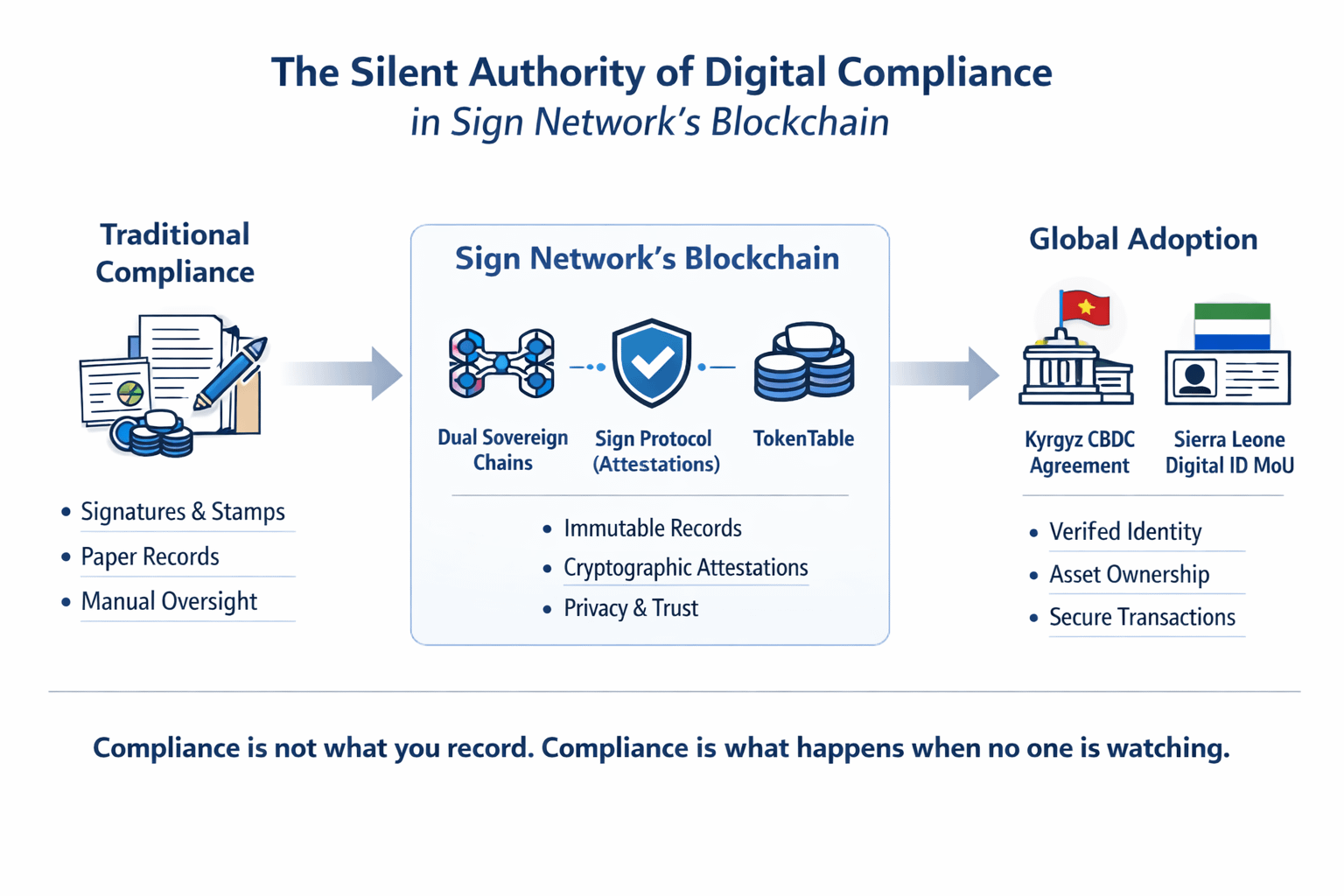
I walked into the office one morning and picked up a file that looked perfectly assembled. Every signature was in place, every stamp correctly positioned, every date aligned. On paper, it was flawless. But then I looked out the window — watching the actual people those documents represented, the contracts being honored or quietly ignored, the promises written in ink but lived out in something far messier — and I understood something that no audit trail had ever told me before. Compliance is not what you record. Compliance is what happens when no one is watching.
That realization stayed with me when I started paying closer attention to Sign Network. Not because it's another blockchain project making grand promises, but because it seems to be asking a question that most projects deliberately avoid: what does it actually mean to verify something?
Most of the crypto world has built its credibility around performance — transaction speeds, yield rates, token prices. Sign has chosen a quieter lane. Its architecture is structured around what it calls the SIGN Stack, comprising a dual sovereign chain design, the Sign Protocol for attestation, and TokenTable for digital asset distribution. (TheStreet) That description, taken alone, sounds like every other technical whitepaper. But the context around it is harder to dismiss.
Sign has already signed agreements with the national bank of the Kyrgyz Republic for CBDC development and formalized an MoU with Sierra Leone's Ministry of Communication, Technology, and Innovation for blockchain-based digital identity infrastructure. (TheStreet) These are not partnerships announced for marketing purposes. Governments don't sign sovereign infrastructure agreements to generate Twitter impressions.
Here's what I find genuinely interesting — and also worth interrogating. The idea that compliance can be "silent" is both Sign's greatest strength and its most serious design challenge. Sign's framework creates cryptographic attestations that preserve authenticity, allowing a publicly auditable yet privacy-respecting system of record. (Medium) In theory, this means a passport credential stored on chain carries the same authority as the physical document — without exposing private data to unauthorized parties. The silence isn't emptiness. It's a kind of institutional weight encoded into code.
But I've watched enough blockchain cycles to know that cryptographic elegance doesn't automatically translate into institutional trust. The hardest part isn't building the protocol. It's convincing a ministry, a national bank, or a rural government office to actually feed their real data into a system they don't fully control. Sign's vision is to move demand scenarios that need to be globally verifiable — from identity to asset ownership — onto a unified blockchain standard, so that individuals, businesses, and governments can collaborate without friction. (Panews) The vision is coherent. Whether the humans on the other end are ready for it is a different question entirely.
Think of it this way: imagine a land registry office in a country where titles have been disputed for decades. The data exists — scattered across paper files, local court records, municipal databases — but none of it speaks to the other. Sign's proposition is essentially: let us be the connective tissue. Let us become the system that each of those separate records points to. That's not a technology pitch. That's a political ask. And political asks take time, trust, and often, a crisis that makes the old way unworkable.
Sign has raised $25.5 million in a round led by YZi Labs and IDG Capital, with the stated goal of bridging traditional financial systems with decentralized infrastructure at national scale. (Crypto Briefing) The funding reflects a conviction, not just in the technology, but in the timeline. Someone believes this moment — where governments are actively seeking digital infrastructure solutions — is the window. I'm inclined to think they're right about the moment, even if the execution will be slower and more complicated than any roadmap suggests.
What draws me back to Sign isn't its tokenomics or its partnerships list. It's the question embedded in its design: can a blockchain become the place where a government's word becomes provably true? Not just recorded — but verified, in a way that requires no further trust in the institution making the claim.
Without reliable identity systems, nations cannot achieve financial inclusion, digital service delivery, or economic development at scale. (Sign) That sentence reads like a governance report. But it also reads like the premise of everything Sign is building toward.
The real test of digital compliance has never been what gets filed. It's what holds when pressure is applied from outside the system. Sign is betting that its blockchain can carry that weight silently — the way the best infrastructure always does. Invisible until you need it. Irreplaceable once you do.
Whether that bet lands depends less on the protocol and more on whether the people inside those government offices are ready to trust something they cannot see.