
Honestly I have been in this space long enough to know when I am getting sold a story versus when something is actually real. And for a while SIGN felt like it could go either way. The identity angle is compelling. The sovereign infrastructure narrative is the kind of thing that sounds important enough that nobody really questions it. But I have watched too many projects with great narratives quietly disappear once the hype cycle moved on. So before I get into any of that the first thing I always want to know is simple. Is anyone actually paying for this thing?
With TokenTable the answer is yes and the numbers are not close. Which honestly caught me off guard because I had been reading about SIGN for a few weeks and kept skipping past the TokenTable section to get to the more interesting sounding parts. That was a mistake. Because TokenTable is where the actual proof lives.
Most people look at the SIGN story and their eyes go straight to attestations and digital identity. That is where the exciting language is. The sovereign infrastructure narrative. The government partnerships. The whitepapers about programmable money. And then somewhere near the bottom there is a mention of TokenTable and most articles give it one sentence before moving on. But TokenTable is the only piece of this entire stack that was already making money before any of this became a public conversation.
Before the $SIGN token launched in April 2025. Before the Sierra Leone agreement. Before the Kyrgyzstan CBDC deal made headlines. TokenTable had already distributed over four billion dollars in tokens across more than forty million wallet addresses for over two hundred projects and was pulling in fifteen million dollars in annual revenue doing it.
Sit with that number for a second. Fifteen million dollars. Annual. Real revenue from real teams who found the product useful enough to pay for it. In an industry where most protocols are burning runway and hoping the ecosystem catches up before the money runs out, TokenTable had already closed the loop.
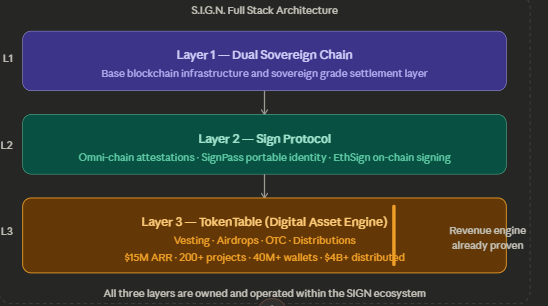
That diagram is the piece most people gloss over. Three layers. All owned by the same ecosystem. The attention goes to Layer 1 and Layer 2 because those are the big picture pieces. But Layer 3 is the one that was already generating real revenue while the rest of the story was still being written.
So the question worth asking is why did it win? Because the problem TokenTable solves sounds almost deliberately boring on the surface. Every project that launches a token needs to get those tokens to people. Investors have vesting schedules. Team members have lockup periods. Community members need airdrops. Ecosystem partners need allocations. On paper that sounds like a simple logistics problem. In practice it turns into an operational nightmare very quickly.
You have investors spread across multiple chains on different unlock dates. You have gas costs that spiral when you are distributing to two million addresses in a single campaign. You have team members who want some liquidity before their cliff hits. You have compliance pressure to make vesting enforcement happen on-chain so nobody can dispute the timeline later. None of that has a clean default solution in the crypto toolkit.
TokenTable built the answer to all of it.
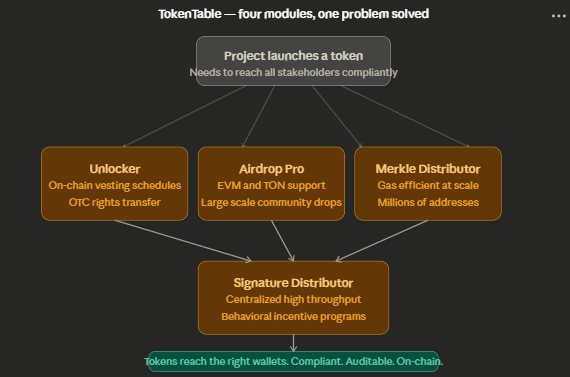
The Unlocker module handles vesting enforcement on-chain, meaning the schedule lives in code, not in anyone's word. The Merkle Distributor handles massive drops at gas-efficient rates even when you are talking about millions of recipient addresses. The Signature Distributor handles centralized, high-volume distributions for behavioral reward programs. And for locked holders who need liquidity before their cliff date, the OTC module lets them transfer withdrawal rights before the tokens actually unlock. That last one is essentially a secondary market for future token claims, and it solves a problem that comes up for large holders in almost every significant project.
None of that sounds revolutionary on paper. That is actually why it worked.
What made TokenTable stick was not that it did something magical. It was that it solved a real operational headache cleanly enough that teams stopped looking for alternatives. Starknet used it. ZetaChain used it. Notcoin used it. DOGS on TON used it. Kaito used it to distribute to over a hundred thousand users in a single campaign. Word moves fast in this space when something works without creating problems. Projects talk to each other. Investors sit on multiple boards and make recommendations. Once TokenTable became the default answer to "what are you using for distribution" the inertia started compounding naturally. That kind of stickiness does not come from a good marketing campaign. It comes from solving a problem that every single team faces the moment they launch a token.
The part that I think most analysis gets completely wrong is treating TokenTable as a standalone product that SIGN happens to own. That framing misses everything. TokenTable is Layer 3 in a three-layer architecture and when you understand what the other two layers do the whole picture looks completely different.
Layer 2 is Sign Protocol which handles omni-chain attestations and runs SignPass, a portable verifiable digital identity that a user can carry across any chain. Layer 1 is the Dual Sovereign Chain providing the settlement infrastructure underneath. And Layer 3, TokenTable, handles the actual movement of value to verified, eligible recipients at scale.
Put all three of those together and you have something that genuinely does not exist anywhere else in the market right now.
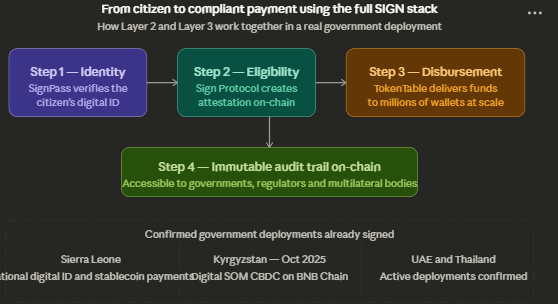
A government running a social protection program needs to verify identities, confirm eligibility, push funds to potentially millions of beneficiaries, and keep audit trails that regulators can inspect years later. Right now that entire process runs through layers of intermediaries and each one adds cost, friction, delay, and risk of leakage or fraud. The SIGN whitepaper references ten trillion dollars in annual global social protection spending as the eventual addressable market. That number is not there for decoration. It is pointing at the actual scale of the problem they are building toward.
In October 2025 SIGN signed an agreement with Kyrgyzstan for the Digital SOM CBDC built on BNB Chain. CZ attended the signing in person. That is not a vague letter of intent. That is a government committing to infrastructure. The Sierra Leone agreement covers national digital ID, stablecoin payments, and asset tokenization as a full-stack national rollout. UAE and Thailand deployments have been confirmed as well. The team raised $54 million across multiple rounds from YZi Labs, IDG Capital, Sequoia Capital, Circle, and Altos Ventures. The Sign Foundation also executed a $4 million token buyback in August 2025.
These are real signals. But I want to stay honest here because I think intellectual honesty matters more than a clean narrative.
Fifteen million dollars in annual revenue from crypto-native distribution projects is not the same thing as winning government contracts. Those two things should not be conflated. Government procurement is slow, compliance-heavy, and politically complex in ways that are completely different from selling a SaaS tool to a blockchain project. The fact that DOGS on TON used TokenTable does not automatically mean a national finance ministry will. Early partnership agreements and full national rollouts are separated by a lot of ground that still needs to be covered, and anyone skipping over that gap is not being straight with you.
What I keep coming back to though is the starting point. SIGN came into this cycle with working infrastructure, paying customers, confirmed government agreements, and a coherent architectural story for why those paying customers represent the first version of something much bigger. Most projects at this stage of narrative development are asking you to trust a roadmap. SIGN is pointing at a product that already generates fifteen million dollars a year and asking you to extrapolate from there.
TokenTable is not the headline of this story. It rarely gets mentioned in the same breath as sovereign infrastructure or zero-knowledge identity. But it is the part of this story that already proved the team knows how to build something real people pay for. In a market full of ambitious ideas that never turn into products, that matters more than most people are giving it credit for.
Most people are still treating it like a footnote. I genuinely think it is the main argument.
@SignOfficial $SIGN #SignDigitalSovereignInfra