
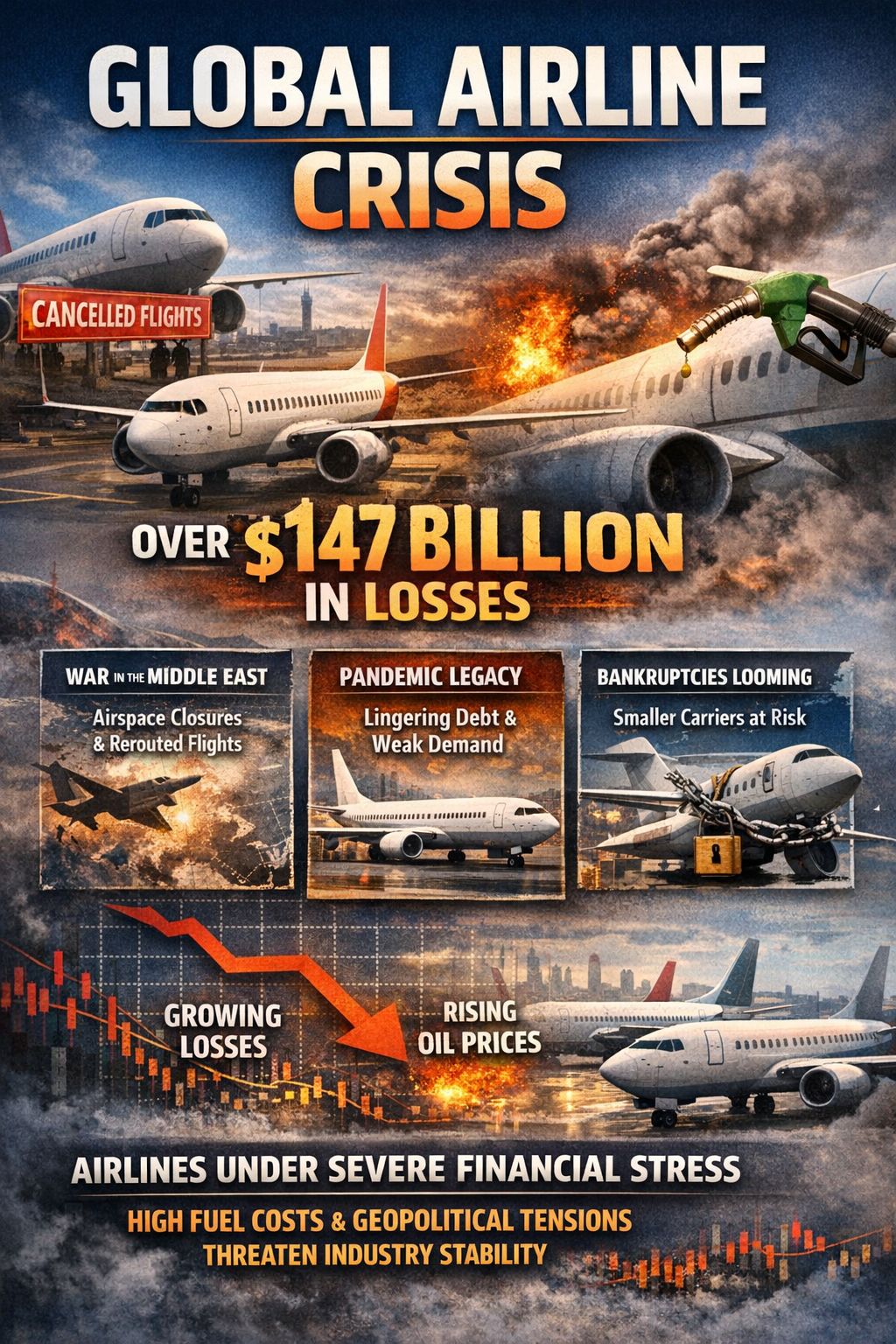
The global aviation sector is currently experiencing one of its toughest financial periods in recent years, with reports indicating that the world’s top airlines have collectively suffered massive financial losses running into tens of billions of dollars due to rising fuel costs, geopolitical instability, and operational disruptions. The crisis has been intensified by escalating tensions in the Middle East, which have led to airspace closures, flight cancellations, and sharp increases in jet fuel prices—one of the biggest expenses for airlines.
📉 Why Airlines Are Losing Billions
Jet fuel prices, which typically account for 25–35% of an airline’s operating costs, have surged dramatically due to supply risks and oil market volatility. This has forced airlines worldwide to increase ticket prices, cut routes, and reduce flight capacity to manage mounting expenses. Several major carriers, including those in the United States and Europe, have already scaled back less profitable routes and delayed expansion plans to contain losses.
At the same time, the aviation industry is still recovering from the financial damage caused by the COVID-19 pandemic, which left many airlines burdened with heavy debt. Even though passenger demand has returned strongly in 2026, thin profit margins mean that any sudden rise in fuel costs or geopolitical shock quickly pushes airlines back into losses.
🌍 Impact of War and Airspace Closures
The Middle East plays a crucial role in global aviation as a major transit hub connecting Europe, Asia, and Africa. Military tensions and missile threats in the region have forced airlines to reroute flights, increasing flight times, fuel consumption, and operational complexity. Some countries have even temporarily closed their airspace as a precaution, leading to widespread disruptions across international travel networks.
These disruptions not only increase costs but also reduce efficiency, which directly affects airline profitability and global logistics chains, including cargo transport and international trade.
💸 Long-Term Consequences for the Industry
If high fuel prices and geopolitical tensions persist, analysts warn that the aviation industry could face its worst financial stress since the pandemic. Smaller and low-cost carriers are particularly vulnerable because they operate on thinner margins and often lack fuel hedging strategies to protect against price spikes. Some airlines have already entered restructuring or bankruptcy proceedings as they struggle to remain financially stable.
🔮 Future Outlook and Forecast
Despite current losses, industry bodies such as the International Air Transport Association (IATA) still expect global airline revenues to exceed $1 trillion in 2026, with only modest profitability due to rising operating costs. However, this forecast is highly sensitive to oil prices and geopolitical stability.
If crude oil prices continue rising or airspace disruptions worsen, ticket prices will likely increase further, global tourism may slow, and airlines could be forced into deeper cost-cutting measures, including layoffs, fleet reductions, and route closures.
📋 SUMMARY
In summary, the airline industry is once again under severe pressure from external shocks—this time driven by war-related fuel inflation and airspace risks. The coming months will be critical in determining whether the sector stabilizes or enters another prolonged financial crisis.


