
$SIGN operates in a part of the system most people don’t pay attention to, the moment where an action is either allowed or blocked. SIGN doesn’t try to speed up transactions or attract attention at the surface level, it sits underneath, shaping how permission is granted across different environments without forcing everything into the same structure.
The way this usually works today is quite rigid. Each platform or system decides independently who is valid and who isn’t, and those decisions rarely travel well. Even when the same information already exists, it often has to be reprocessed again just to fit a new context. Over time, this creates a pattern where participation feels segmented instead of continuous.
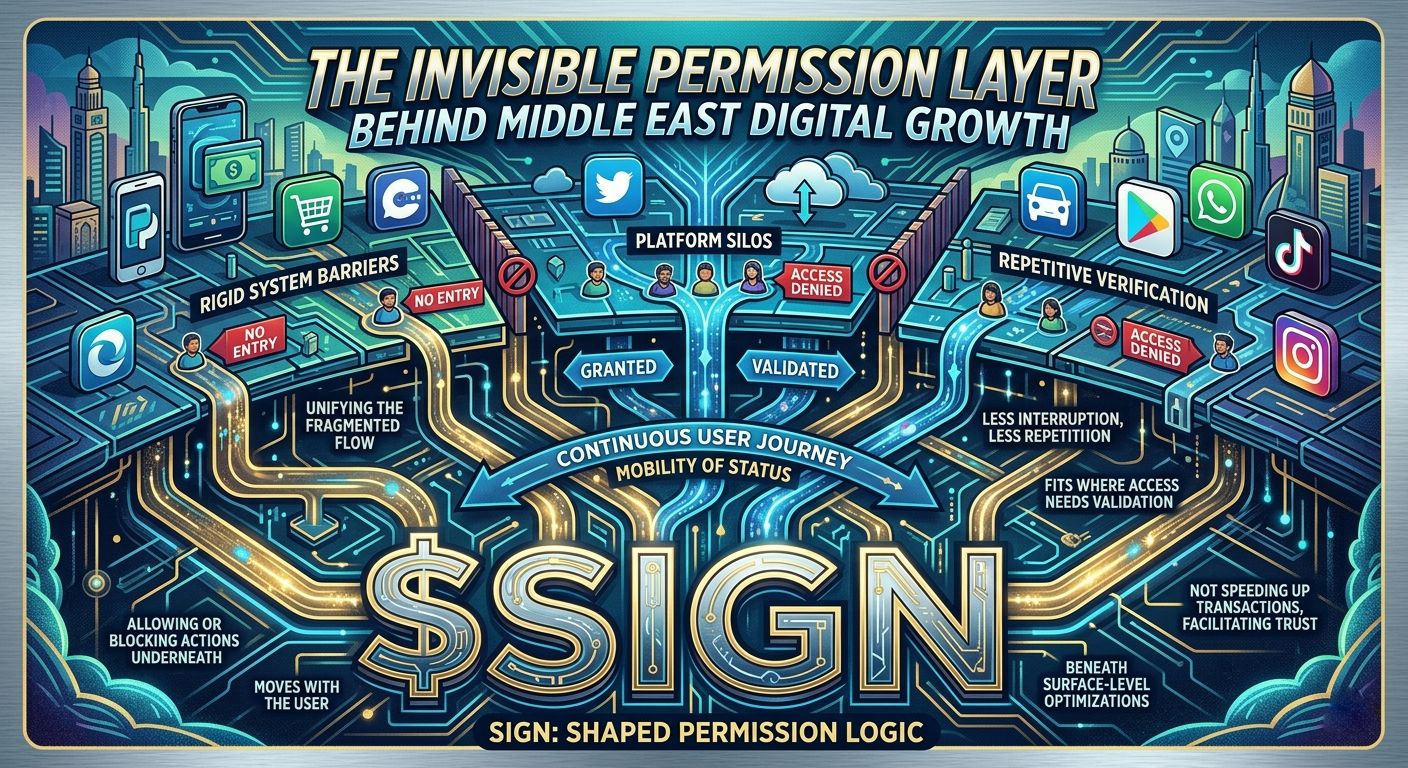
I ran into this in a pretty ordinary situation, nothing major. Accessing a feature on a new platform that required a status I had already proven elsewhere. The process didn’t fail, it just slowed down in a way that felt unnecessary. Same type of check, same type of requirement, but no connection between the two. It’s the kind of friction that doesn’t break anything, but keeps stacking quietly.
In a region like the Middle East, where multiple digital systems are expanding side by side, that fragmentation becomes more noticeable. Growth is not limited by activity, but by how smoothly different layers can recognize each other without forcing users to restart from zero. A shared permission logic, even if minimal, starts to matter more than isolated optimizations.
$SIGN fits into that exact layer. Not visible enough to be called a headline feature, but present in every interaction where access needs to be validated. When permission becomes something that can move with the user instead of stopping them, the entire flow of activity changes in a quiet way, less interruption, less repetition, more continuity.