
i have been thinking about this from the perspective of a Trader who Trade on BITCOIN and XAG regularly. imagine you want to build an application on midnight. your users dont hold night. they dont know what night is. they just want to use your app
how does that actually work at launch - and what does midnight have in place to make it possible?
the answer is more complicated than i expected, and honestly the gap between what the whitepaper describes and what exists at mainnet is the part that kept me reading 😂
what this design gets right:
the whitepaper describes capacity marketplace as a concept covering different solution designs that offer non-midnight users frictionless access to midnight network capacity. the core insight is elegant. dust is what you need to transact on midnight. but most end users wont hold night and wont generate dust. someone has to bridge that gap.
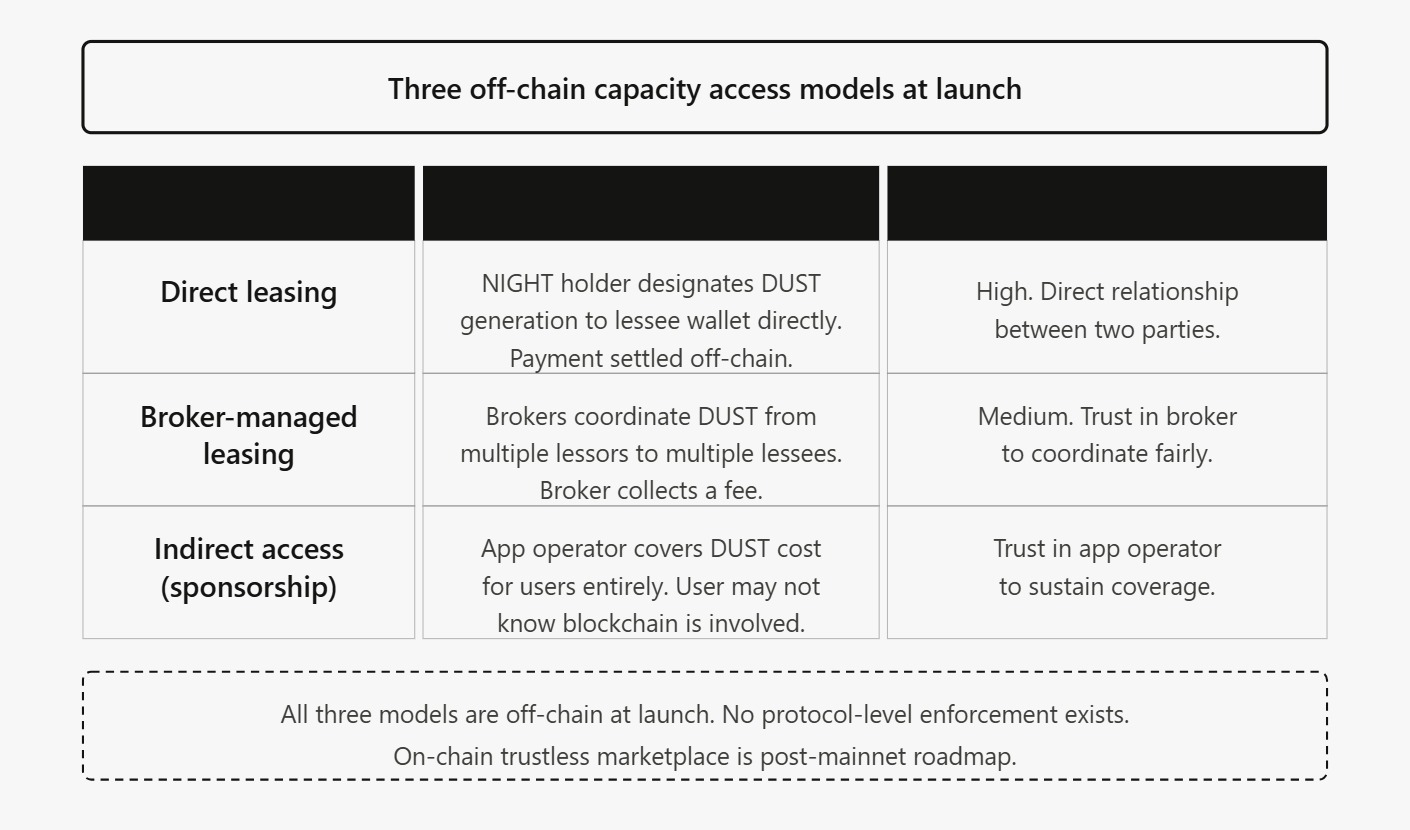
midnight describes three off-chain models that can do this.
the first is direct dust generation leasing. a night holder designates their dust generation to a lessee's dust wallet directly. the lessee gets to use dust however they want for as long as the lease holds. payments and arrangements between parties are settled off-chain
simple
flexible
requires trust between parties
the second is broker-managed leasing. night holders lease their dust via specialized brokers who coordinate generation from multiple lessors to multiple lessees. brokers collect a fee and handle the logistics. more scalable than direct leasing, still off-chain, introduces a coordinating intermediary.
the third is indirect access. app operators sponsor their users entirely. users submit transactions, the app operator covers the dust cost. the end user never touches night, never sees dust, may not even know a blockchain is involved
this is the model that enables genuinely blockchain-abstracted consumer applications.
what keeps nagging me:
all three of these models are off-chain. they depend on trust, coordination, and arrangements between parties settled outside the protocol. there is no on-chain enforcement, no trustless settlement, no protocol-level guarantee.
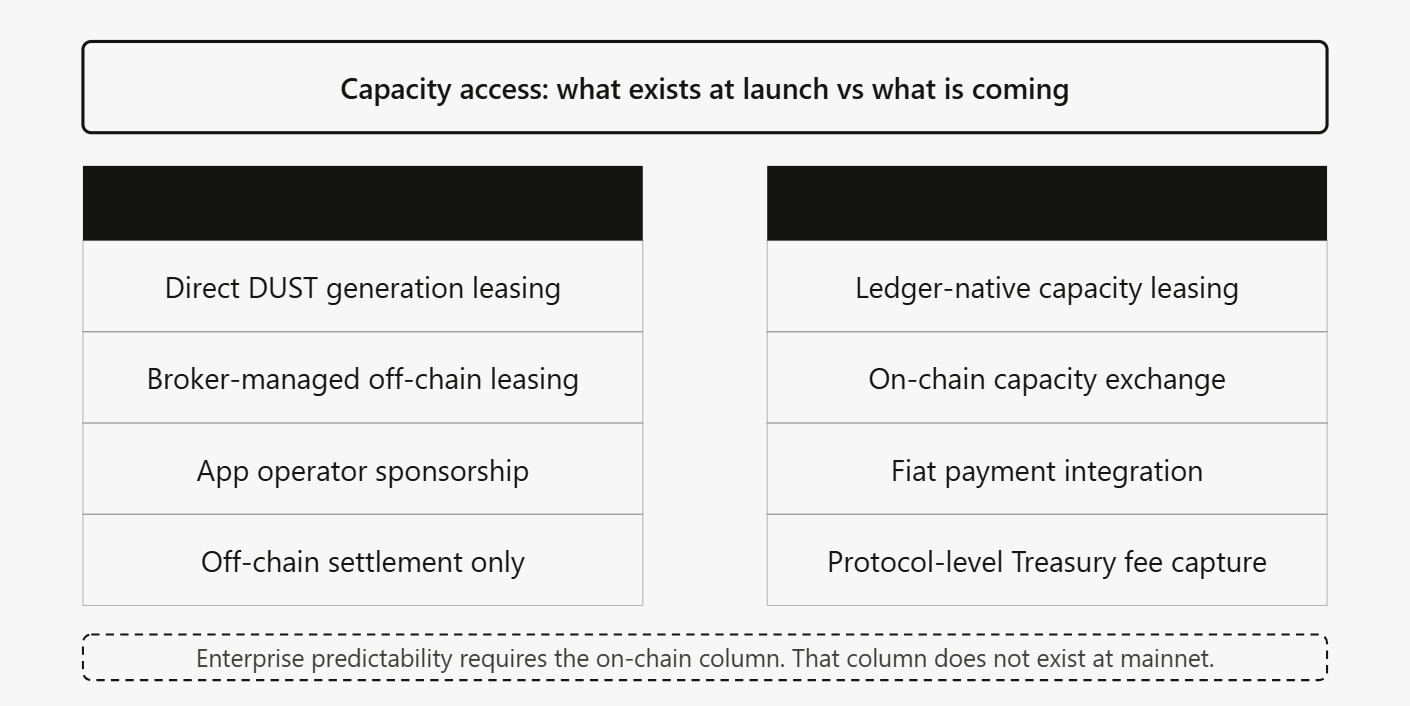
the whitepaper is explicit that future protocol upgrades could enable a larger trustless on-chain capacity marketplace. ledger-native capacity leasing, on-chain capacity exchange, protocol-level mechanisms with built-in fees flowing to the Treasury. that is where the model becomes truly composable and trustless.
but that is post-mainnet roadmap
at launch, every capacity access model outside of direct night ownership depends on off-chain arrangements. a business building on midnight today that doesnt hold night is dependent on the existence and reliability of brokers, lessors, and operators who have voluntarily built these arrangements.
my concern though:
the framing of capacity marketplace as an available solution and the reality that all accessible versions of it require off-chain trust relationships is a gap that compounds for enterprise adoption specifically. the whitepaper positions midnight as infrastructure for businesses that need predictable operating costs
but predictable operating costs through off-chain leasing arrangements inherit the counterparty risk of whoever you are leasing from.
honestly dont know if the off-chain capacity models described are a sufficient bridge that gets midnight to genuine enterprise adoption while the on-chain marketplace matures or a dependency stack that makes the accessibility promise harder to deliver on than the whitepaper framing suggests?? 🤔
#night @MidnightNetwork $NIGHT
