

I have been following blockchain voting projects for years, and one thing keeps repeating: most systems promise transparency but fail on privacy. Voters either compromise anonymity or rely on complex tools that rarely scale. I expect Midnight to tackle this differently, and what excites me is how thoughtfully it approaches confidential voting from the ground up.
I have observed how organizations and DAOs try to balance accountability with secrecy. In most setups, either votes are public (hurting voter privacy) or verification requires third-party intermediaries (adding trust risks). Midnight’s programmable privacy framework solves this by separating vote proof from voter identity, leveraging zero-knowledge proofs so each vote is verifiable without revealing the voter or their choice. That is not just a theoretical benefit, it’s the kind of solution that can make digital voting reliable at scale.
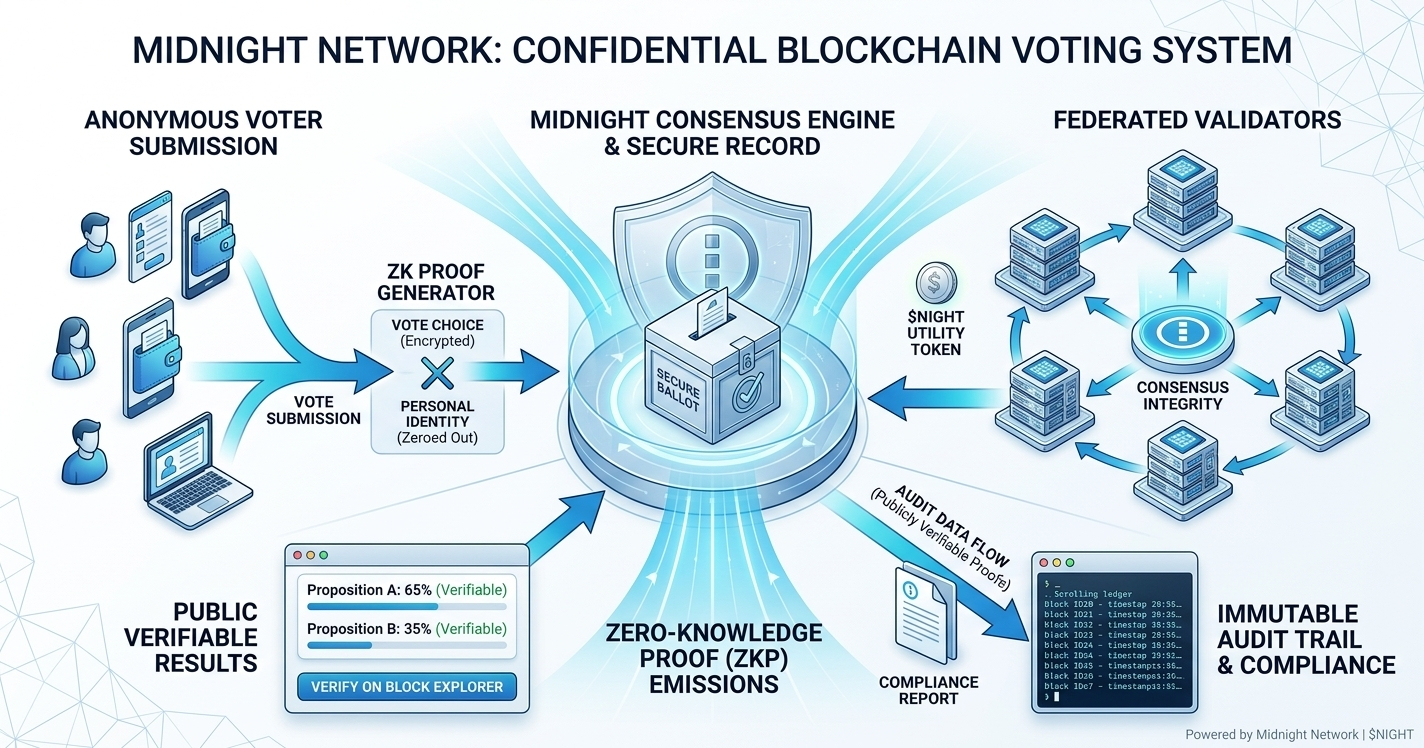
I have seen pilot DAOs struggle with participation because users fear their vote might be traceable. I expect Midnight to remove that friction. By issuing verifiable credentials and using its federated validator model, votes are submitted, verified, and counted without exposing personal data. This allows organizations to confidently run elections while maintaining integrity and confidentiality.
I have noticed that most blockchains treat voting as an add-on feature, which often breaks when applied in real-world governance. I expect Midnight’s design to make confidential voting a core utility, not a hack. Every vote interacts with the network’s ZK infrastructure, ensuring scalability and auditability. Compliance teams can validate results without accessing sensitive voter information, which is crucial for enterprises, governments, and privacy-focused DAOs alike.
I have personally watched how fragmented voting ecosystems create distrust. I expect Midnight’s cross-institution verification and programmable rules to standardize governance. Whether it’s DAO treasury decisions, board elections, or national pilot programs, the system ensures votes are counted, proofs are auditable, and identities remain protected.
I have realized that adoption comes from usability. Midnight doesn’t just make confidential voting secure; it makes it practical for day-to-day governance. Users can vote directly from their wallets, developers can integrate rules programmatically, and institutions can rely on the results without intermediaries. That’s a rare combination of security, privacy, and operational simplicity.
I have also noticed a larger implication: confidential voting is more than privacy; it’s trust infrastructure. I expect that as Midnight continues to scale, its model could define the standard for digital governance, where participation is verifiable, decisions are binding, and personal data never leaves the user’s control.
If you were designing a governance system, would you prioritize public transparency or confidential verifiability, and how would you ensure both in practice?