


I was looking at an attestation this morning that kept passing.
Every check.
Valid.
Issuer active.
Schema resolved.
Nothing wrong with it.
But something felt off.
So I followed where it was being used.
Or where I expected it to be.
Nothing.
No downstream checks referencing it.
No eligibility flows depending on it.
No system reading it.
It existed.
But nothing was touching it.
At first I assumed I was missing the connection.
Wrong query.
Wrong endpoint.
So I checked again.
Different path.
Same result.
The credential was there.
Fully valid.
Fully verifiable.
Just… unused.
That’s where it started to feel strange.
Because SIGN is built around reuse.
An attestation is supposed to move.
Be read.
Be depended on.
Be consumed by other systems.
This one wasn’t.
So I checked the structure more closely.
The dataLocation pointed off-chain.
The reference was there.
But nothing had ever fetched it.
No reads.
No interactions.
No downstream traces.
The credential existed in the evidence layer.
But outside of verification, it had never been touched.
I ran a second one.
Different issuer.
Different schema.
Same pattern.
Valid credential.
No consumption.
And another.
Same result.
That’s when it shifted.
Because nothing was broken.
The credentials were correct.
They just weren’t doing anything.
I had to go back and check I wasn’t missing something obvious.
So I stopped looking at attestations
and started looking at what the system actually tracks.
Verification is visible.
Resolution is visible.
Structure is visible.
Usage isn’t.
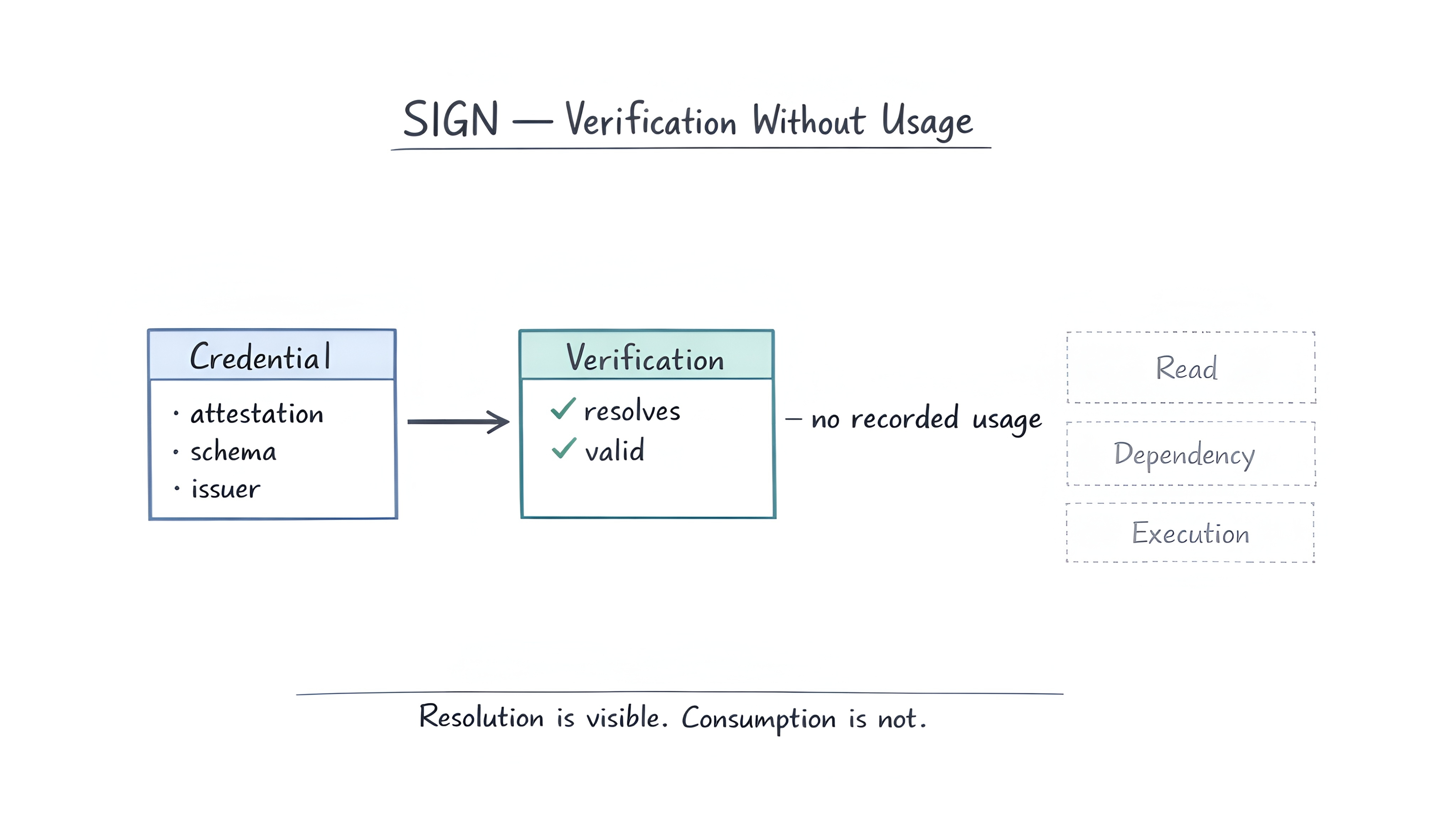
SIGN proves that a credential exists
and that it resolves correctly.
But it doesn’t show whether anything has ever depended on it.
From the system’s perspective, these credentials are complete.
They pass verification.
They exist in the evidence layer.
They can be queried.
That’s enough.
Whether anything actually reads them
isn’t part of what gets recorded.
That part stayed with me.
Because it means a credential can be perfectly valid
and completely irrelevant at the same time.
No failure.
No warning.
No signal that nothing is using it.
Just a clean record sitting in the system.
Nothing flagged it. Nothing would.
I keep coming back to this as unused truth.
A claim that exists, verifies, and persists
without ever being consumed.
And the system treats it the same
as one that drives decisions everywhere.
That’s where it gets uncomfortable.
Because once you stop assuming usage,
verification starts to feel incomplete.
Not incorrect.
Just… insufficient.
$SIGN only matters if the evidence layer can distinguish between a credential that has been consumed by downstream systems and one that has never been read outside its own verification.
Because right now both resolve the same way.
And if a credential can exist indefinitely without ever being used, what exactly is the system optimizing for?
#SignDigitalSovereignInfra #Sign
