

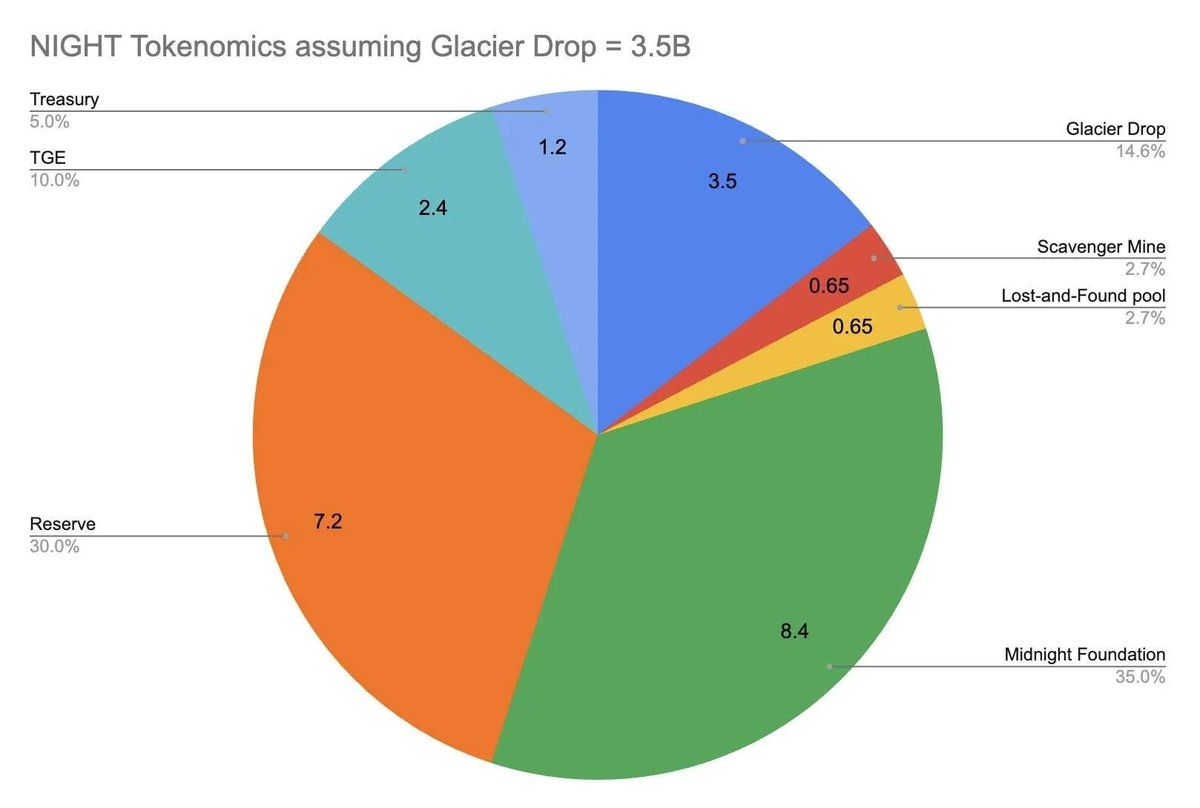
Yesterday just a few hours after a quiet snapshot window closed for early @MidnightNetwork participants I found myself still tracing through Compact contracts and simulation logs. The urgency wasn’t drivan by price action or hype cycles, but by something deeper an architectural tension that did not quite resolve itself the more I explored. Midnight is not smply positioning itself as another smart contract platform it’s attempting to reframe how developers interact with confidential computation altogether. Wat initially pulled me in was the promise that any developer familiar with TypeScript could begin building zero-knowledge applications without wrestling with the underlying cryptography. But the longer I sat with that idea, the more it began to feel like both a breakthrough and a potential blind spot.
Even in its early state, the network’s behavior reveals subtle but important differences from traditional systems. In environments like the Ethereum Virtual Mchine, excution revolves around shared, transparent state changes that anyone can inspect. Midnight flips that model on its head. The traces I followed addresses resembling fragments were not interacting with state in the conventional sense. Instead they were submitting profs, with computational weight shifting toward generation rather than execution. Gas patterns, even in simulation, appeared to spike around proof construction rather than transaction finality. It creates a system where what matters is not what you do on-chain, but what you can convincingly prove without revealing.
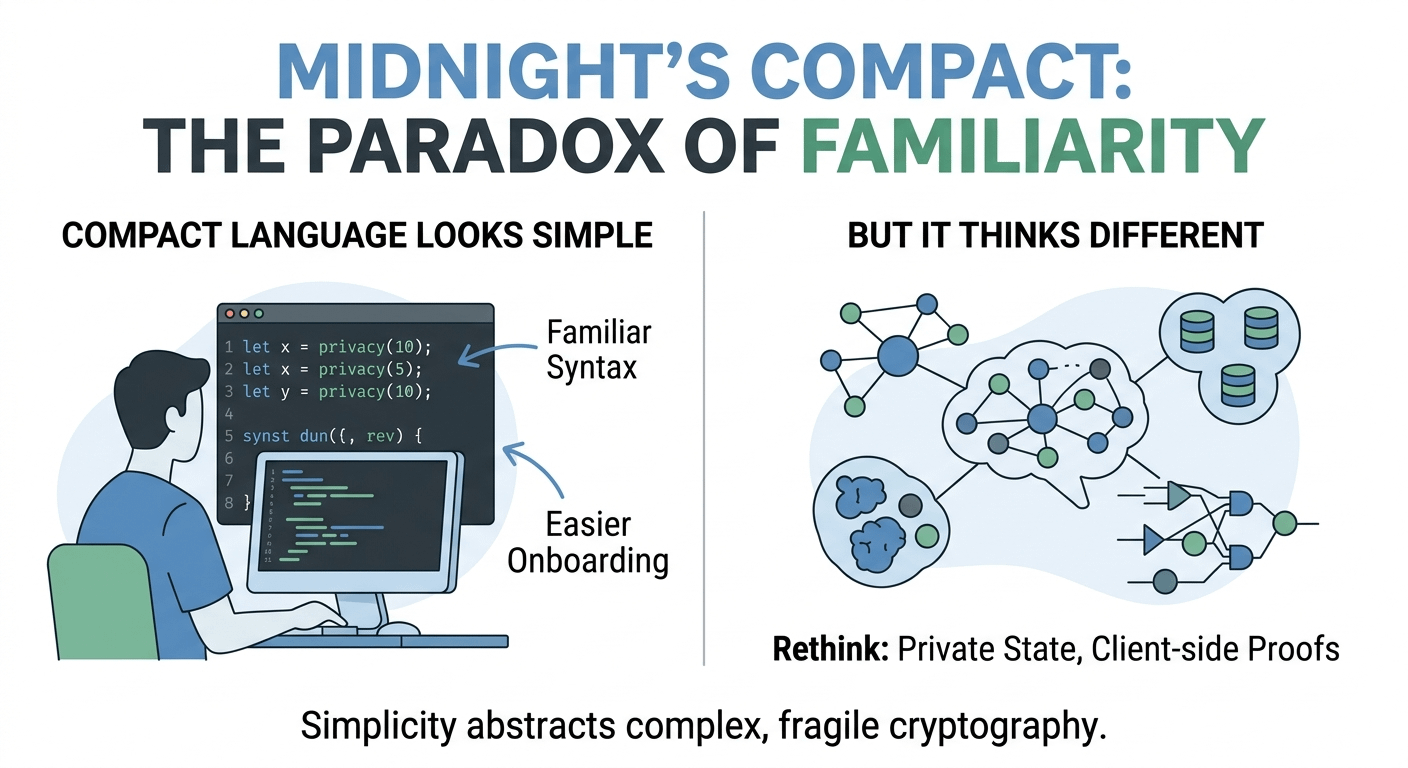
There was a moment during one of my mental simulations where everything slowed down. I tried to map out a basic decentralized exchange order flaw, something that would normally feel trivial. But I kept running into an invisible wall. Every assumption I made about shared variables or synchronized state started to collapse under scrutiny. I realized I was designing logic that depended on information that shouldn’t exist publicly in the first place. That pause forced a shift in perspective. Compact, Midnight’s programming language, doesn’t just simplify cryptography it relocates the burden of understanding. It gives the impression of familiarity while quietly demanding a completely different mental model. And that’s where the real friction begins.
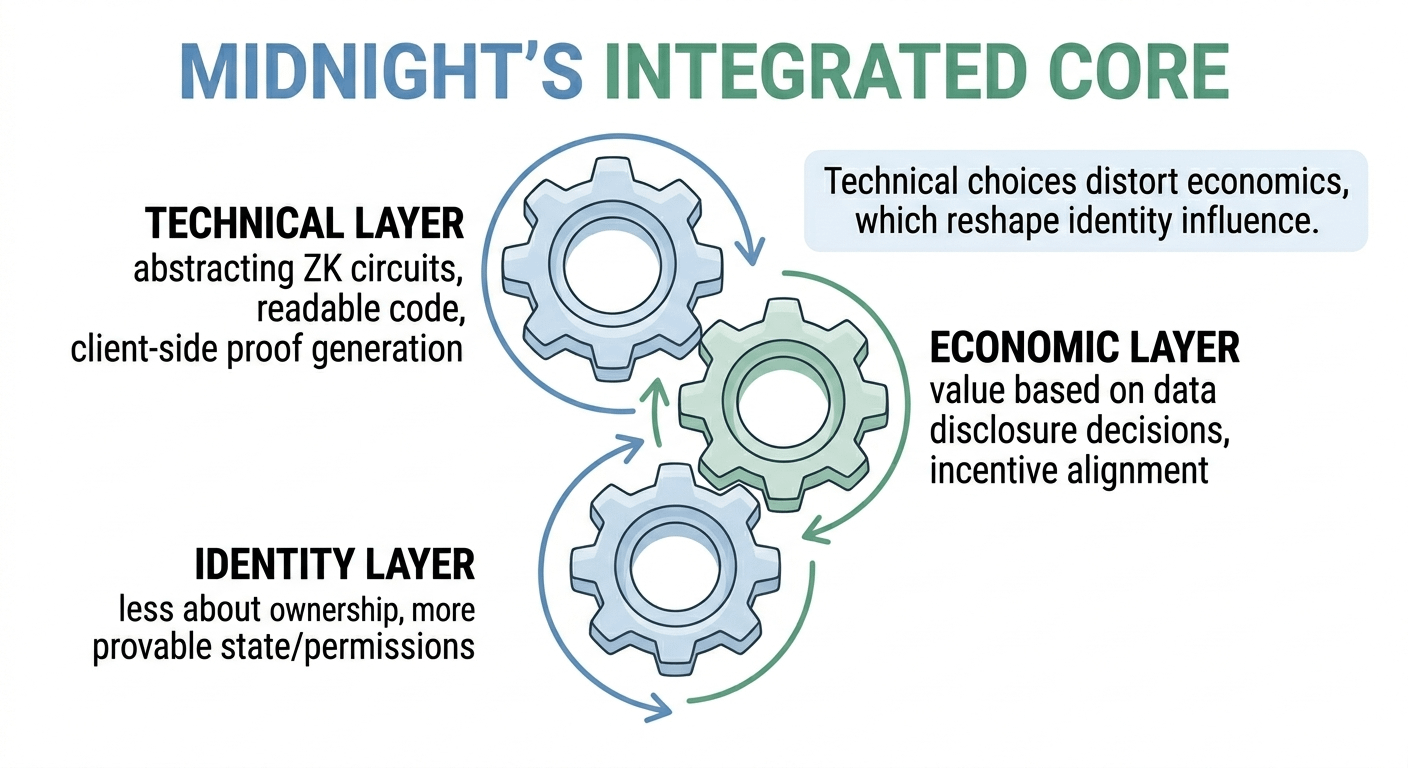
What I keep circling back to is how tightly coupled the system’s economic, technical, and identity layers actually are, even if they do not present themselves that way at first glance. Economic value in Midnight seems to emerge from decisions about data disclosure rather than pure transaction flow. The technical layer abstracts zero-knowledge circuits into something readable, but the actual execution still depends on client-side proof generation interacting with a shared verification layer. Then there is identity, which becomes less about explicit ownership and more about what can be proven at any given moment. These layers do not operate independently they loop into each other. A small misunderstanding at the technical level can distort incentives, which can then reshape how influence accumulates across the network.
When I briefly compare this to systems like Fetch.ai or Bittensor, the distinction becomes more pronounced. Those platforms abstract complexity in ways that still allow developers to reason about outcomes relatively intuitively. Midnight on the other hand, is abstracting something far more fragile the nature of truth and verification itself. And that kind of abstraction carries a different category of risk. In traditional smart contract systems, errors tend to surface loudly and quickly. In zero-knowledge environments, failures can remain mathematically valid while being logically flawed, which is a much harder problem to detect.
The honest part I keep returning to is the possibility that making cryptographic systems feel familiar might unintentionally encourage overconfidence. If developers begin to trust the abstraction without fully understanding what sits beneath it, the risks don’t disappear they just become harder to see. We’ve already experienced the consequences of misunderstood smart contracts in public and irreversible ways. But here, the failure modes are quieter. They don’t necessarily drain funds immediately or trigger obvious alarms. They can persist, embedded in circuit logic or flawed assumptions, slowly compounding until they reach a breaking point that’s difficult to trace back.
And that leaves me sitting with a question that feels less technical and more human. If Midnight succeeds in onboarding a new generation of developers into confidential computing, but those developers never fully grasp the systems they are building on are we actually expanding innovation or are we distributing responsibility across a layer that is not fully prepared to carry it?
