
Midnight Network is one of those projects I almost ignored.
Not because it sounded bad just because I’ve seen this story too many times. Crypto has a way of repeating itself. Same ideas, same promises, just dressed differently each cycle. After a while, you stop reacting. Everything starts blending together.

This one didn’t. Not fully.
What caught my attention wasn’t some big vision or bold claim. It was actually the opposite. The problem it’s focused on is pretty narrow and that’s exactly why it feels real.
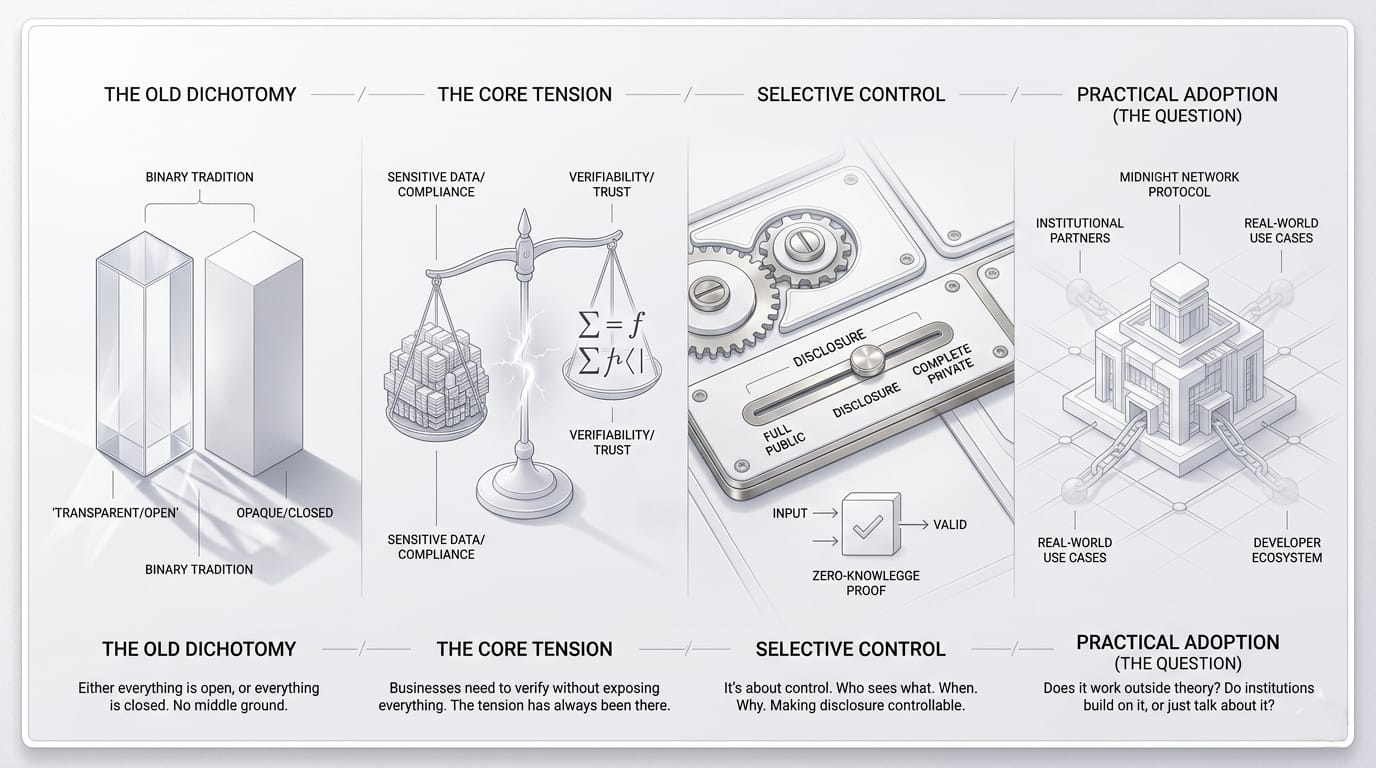
Most serious systems can’t run on infrastructure where everything is exposed by default. That’s just the truth. Businesses, institutions, anyone handling sensitive data they can’t operate like that. They need to verify things without putting everything out in the open every single time.

That tension has always been there.
And crypto, for all its talk, hasn’t really handled it well.
For years, the idea was simple: transparency equals trust. Put everything on-chain, make it all visible, and that solves the problem. And sure, in some cases it worked. But in a lot of situations, it didn’t it just created new problems that people pretended weren’t there.
Midnight seems to come from a different angle.
It doesn’t feel like it’s trying to “sell privacy” in the usual crypto way. It feels more practical than that. Almost like it’s built around an annoyance rather than an ideology. Some things need to be proven. Some things need to stay hidden. And most real systems sit somewhere in between.

That’s the part that made me pause.
Because if you think about it, the real problem isn’t transparency or privacy on their own. It’s control. Who sees what. When they see it. Why they’re allowed to see it.
That’s where things usually get messy.
And that’s what Midnight seems to be trying to deal with making disclosure something you can actually control instead of something that just happens by default.
If that works, it’s a big deal. Not in a flashy way, but in a very practical one.
At the same time, I’m not getting carried away.
I’ve seen too many projects get the idea right and still fail. Execution is where things fall apart. Adoption is where things fall apart. Reality is where things fall apart. It doesn’t matter how clean something looks on paper if no one ends up using it.
So that’s the real question here.
Does this actually work outside of theory? Do institutions build on it, or just talk about it? Does it make things easier, or just more complicated in a different way?
Because that’s usually where you find out what’s real and what isn’t.
One thing I will say though Midnight doesn’t feel like it’s chasing attention. It doesn’t read like something designed just to fit the current cycle. It feels more like it came from frustration. Like it’s trying to fix something that’s actually broken.
And that changes how I look at it.
There’s also something slightly uncomfortable about the idea behind it. If it’s right, then a lot of blockchain thinking over the years was based on a false choice either everything is open, or everything is closed.
No middle ground.
Midnight is basically questioning that whole assumption.
And maybe that’s why it sticks.
Not because it’s loud. Not because it’s revolutionary. But because it’s working on a problem that’s been sitting there for a long time just ignored or oversimplified.
It’s not exciting work. It’s not the kind of thing that creates hype overnight.
But it’s the kind of thing that matters if it actually works.
So yeah, I’m watching it. Not hyped. Not dismissive. Just paying attention.
Because I’ve seen enough to know spotting the right problem is only the beginning.
What matters is whether anyone actually uses the solution when things get quiet.
#night #FTXCreditorPayouts #AsiaStocksPlunge #MarchFedMeeting
