
The Problem: The Era of Fragmented Liquidity
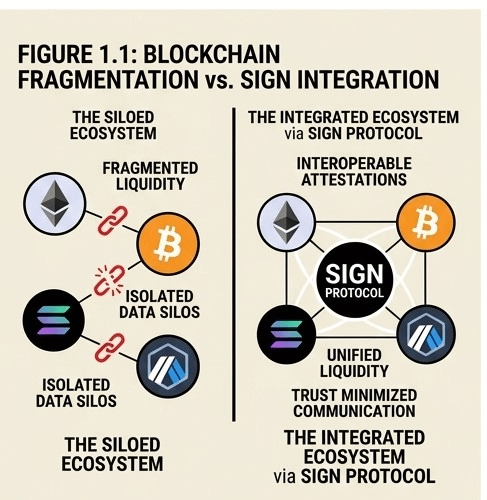
The current state of the blockchain industry is often described as a collection of "Silos." While ecosystems like Ethereum, Solana, and Bitcoin are thriving individually, they remain largely disconnected. Data and identity on one chain are invisible to another. This fragmentation is the single biggest hurdle to mass adoption. For crypto to scale, we need more than just bridges; we need a universal "Source of Truth" that all networks can recognize.
This is where Sign Protocol enters the frame. It isn't just another dApp; it is a foundational "Omni-chain" layer designed to make digital trust portable across every corner of the crypto-verse.
The Solution: Verifiable Attestations as a Universal Language
How does Sign actually connect these different worlds? It uses a concept called Verifiable Attestations.
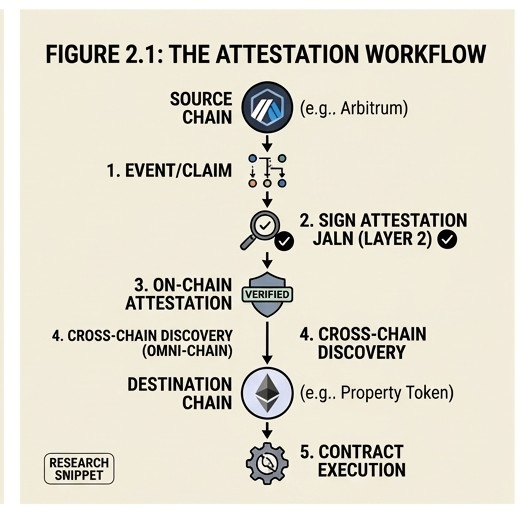
Think of an attestation as a "digital seal of approval." Whether it’s a KYC check, a social media reputation score, or a professional certification, Sign allows these claims to be recorded on-chain in a way that is tamper-proof and instantly verifiable by any other blockchain. By using a standardized Schema, Sign ensures that a smart contract on Arbitrum can "understand" and trust a piece of data that originated on Ethereum or even a private government database.
DeFi 2.0: Moving Beyond Risky Bridges
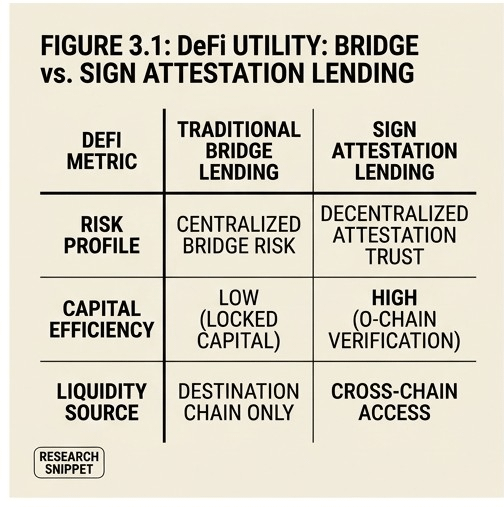
Traditional DeFi has relied heavily on "Bridges" to move assets. However, bridges are often centralized and have been the target of some of the largest hacks in crypto history.
Sign Protocol introduces a safer alternative: Attestation-Based Lending. Instead of physically moving your assets and risking them in a bridge, you can simply provide an "Attestation" of your collateral or your creditworthiness. This allows for "Zero-Knowledge" interactions where you can prove you have the funds without moving them, unlocking high capital efficiency and cross-chain access without the traditional risks.
The Grand Finale: Real-World Assets (RWA) and Sovereignty
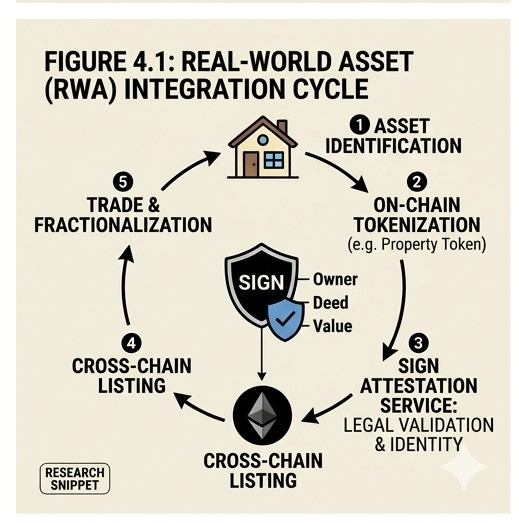
The true "Holy Grail" of blockchain is the tokenization of Real-World Assets (RWAs)—like real estate, gold, or intellectual property. But a token on a screen is meaningless unless it is legally tied to the physical asset.
Sign Protocol provides the "Legal-to-Digital" bridge. By issuing on-chain attestations for property deeds, legal valuations, and identity verification, Sign ensures that RWA tokens are backed by verifiable facts. This level of transparency is exactly what institutional investors and sovereign nations (especially in regions like the Middle East) require to integrate blockchain into their national digital infrastructure.
Conclusion: The Future is Integrated
The next phase of the digital economy won't be won by the fastest chain, but by the most connected one. Sign Protocol is positioning itself as the "Connective Tissue" of the crypto world. By moving identity and trust out of isolated silos and into a universal attestation layer, Sign is not just scaling technology—it is scaling the very foundation of global economic activity.#Sign #SignDigitalSovereignInfra $SIGN @SignOfficial #ominichain #SignProtocol #defi