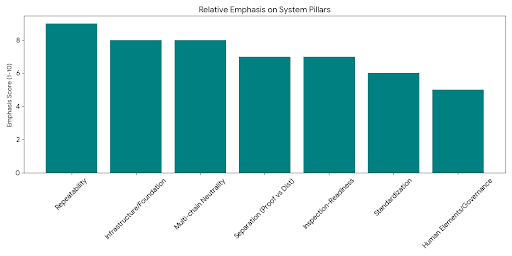
I’ve been sitting with SIGN for a while now, and what keeps coming back to me is how quiet it feels compared to most systems I’ve looked at. It doesn’t try to grab attention or push a big narrative. It feels more like something that wants to sit underneath other things and just… work. That idea of infrastructure for verification sounds simple at first, but the more I sit with it, the more I realize how foundational it actually is.
What stood out early on was this idea of repeatability. Not just proving something once, but being able to prove it again later, in a different context, without things falling apart. That feels very close to real life. Trust isn’t built in a single moment it’s tested over time. And I keep wondering whether a system like this can really hold up when it’s used over and over in unpredictable ways.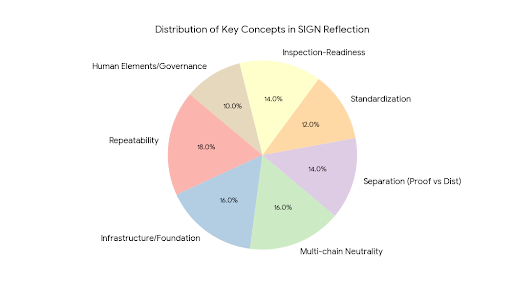
I also keep thinking about how it separates proof from distribution. On the surface, that might not seem like a big deal, but the more I think about it, the more sense it makes. Proving something and deciding how value moves are not the same thing. When those two are mixed together, things can get messy very quickly. Keeping them apart feels cleaner, but also like something that might be hard to maintain as the system grows.
Another thing I noticed is that it doesn’t lock itself into one chain or one environment. That gave me a bit of relief, honestly. Systems that depend too much on a single foundation tend to feel fragile over time. But at the same time, I wonder what it really takes to stay flexible like that. Because in practice, different environments pull in different directions, and staying neutral isn’t always easy.
I found myself appreciating how it leans on existing standards instead of trying to reinvent everything from scratch. It doesn’t feel like it’s trying to be flashy or completely new just for the sake of it. It feels more grounded than that. Still, I’m not sure how smooth that compatibility actually is in the real world. Standards are one thing on paper, but they can behave differently when different systems start interacting.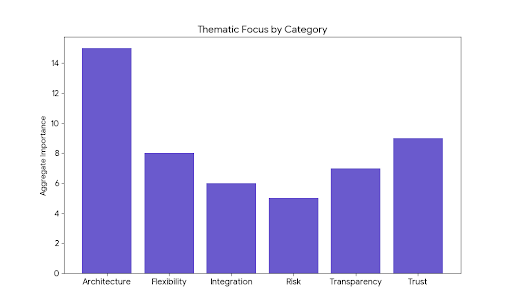
At the same time, I don’t feel fully settled in my understanding of it. There’s a part of me that’s still cautious. Systems like this often look strong in controlled environments, but the real test comes when they deal with messy, human situations. Privacy, misuse, governance those are the kinds of things that really show what a system is made of. I haven’t seen enough yet to know how SIGN handles those.
There’s also this idea of being “inspection-ready,” which keeps sticking in my mind. It feels like the system is expecting people to look closely at it, question it, maybe even challenge it. I like that mindset. But I also know that being open to inspection and actually standing up under that level of scrutiny are two different things. That gap is something I’m still thinking about.
So for now, I’m not trying to decide what SIGN is or where it’s going. I’m just paying attention. Some of the design choices feel thoughtful and grounded in real problems. Other parts still feel like open questions to me. And maybe that’s why I haven’t moved on from it yet because I don’t fully understand it, and I’m not ready to ignore it either.