DO You Know About Whats Problems You Are Facing Because It's Not A Small Problems But Other Side Sign Foundation Will Be Trying To Solve IT. If You Can't Know This Read My Article And Then Your All Points And Thinkings Will Be Clear
Governments do not need disruption.
That word gets thrown around constantly in crypto circles. Disrupt the banks. Disrupt the state. Disrupt the financial system. And underneath all of it, the same assumption — that the existing infrastructure is the enemy.
I have never found that framing particularly useful. Most governments are not looking to be disrupted. They are looking for infrastructure that works. Infrastructure that does not break. Infrastructure that they can actually control.
That is a different problem. And it is the one Sign Foundation seems to be trying to solve.
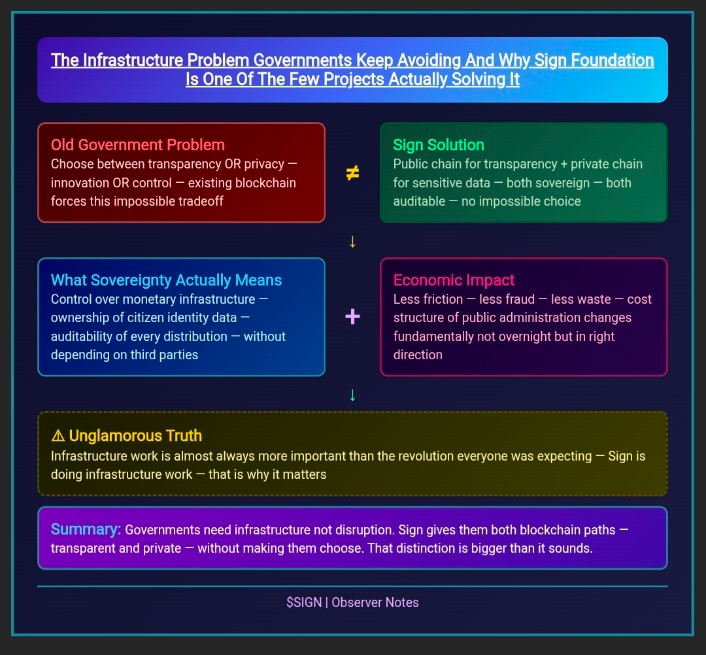
The whitepaper opens with something I keep returning to. Blockchain technology offers immense transformative potential for modernizing governance and financial systems — yet its adoption by sovereign nations remains limited. Not because governments are slow. Because the existing blockchain implementations force them to choose between transparency and privacy, between innovation and control.
That is not a small problem. That is the entire problem.
A government that cannot control its own monetary infrastructure is not sovereign in any meaningful sense. A government that cannot protect citizen data while delivering digital services is not serving its citizens. A government that has to choose between being transparent and being private is being asked to make a choice that no well-designed system should require.
Sign's architecture does not ask governments to make that choice. The SIGN Stack provides two complementary sovereign blockchain approaches — a public Layer 2 or Layer 1 for transparent operations, and a private Hyperledger Fabric X network for privacy-sensitive financial operations. Both maintain complete government sovereignty. Both leverage the security benefits of blockchain. Neither requires the government to abandon control to participate.
The economic implications of this are more significant than they first appear. When governments can issue digital currencies they actually control, verify citizen identities they actually own, and distribute benefits through systems they actually audit — the cost structure of public administration changes fundamentally. Not dramatically. Not overnight. But in the direction of less friction, less fraud, less waste.
The unglamorous truth about sovereign blockchain is that it is not reshaping national economies through disruption. It is reshaping them through the slow replacement of systems that were expensive, opaque, and difficult to audit with systems that are cheaper, transparent where they need to be, and auditable by design.
That is not a revolution. That is infrastructure work. And infrastructure work is almost always more important than the revolution everyone was expecting.
I am still watching whether governments actually commit to building this — or whether it remains a pilot project that never scales.
What would it take for your government to seriously adopt sovereign blockchain infrastructure — and do you think they have the political will to do it?