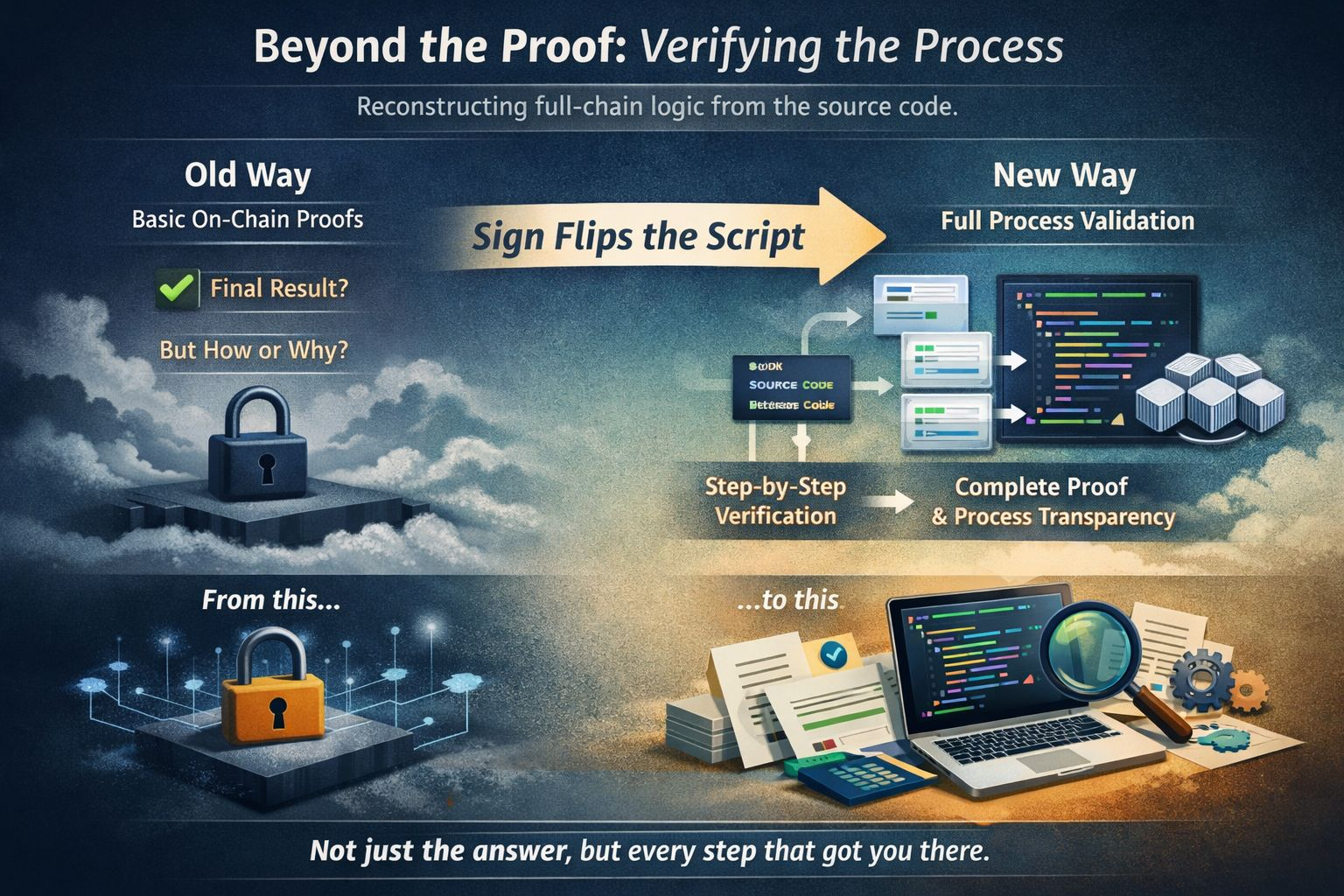
Here’s the thing most people miss about on-chain proof—it was never really “complete.” It showed that something happened, but rarely how or why. And in real-world systems, that gap matters more than we like to admit.
That’s where Sign flips the script.
Instead of relying on simple attestations stored on-chain, Sign rebuilds the entire logic behind those proofs directly from SDK source code. It’s a subtle shift, but a powerful one. You’re no longer just verifying a final result—you’re validating the full process that led there. Think of it like checking not just the answer to a math problem, but every step taken to solve it.
This approach feels closer to how trust actually works in the real world. We don’t just trust outcomes; we trust the methods behind them. By reconstructing full-chain attestation logic, Sign makes verification more transparent and harder to manipulate.
Of course, it’s not magic. It adds complexity, and developers will need to adapt. But it also opens the door to something bigger: proofs that actually mean something beyond a single transaction.
In a space full of shortcuts and surface-level validation, that’s a pretty refreshing direction.
@SignOfficial #sign $SIGN #signdigitalsovereigninfra