
This project enters the Web3 landscape with a proposition that is both timely and structurally relevant: turning trust into something programmable through verifiable attestations. In an ecosystem still dominated by anonymous wallets and fragmented identity layers, this is not a superficial improvement; it addresses a deeply rooted operational gap. Projects today struggle to distinguish genuine users from sybil actors, reward meaningful contributors, and establish credibility without relying on centralized intermediaries.$SIGN
What makes this project stand out is not hype, but positioning. Instead of competing in saturated sectors like DeFi or Layer 1 scalability, it targets a quieter but more foundational layer: on-chain reputation infrastructure. Its focus on attestations, credentials, and proof-of-participation reflects real demand patterns already visible across airdrops, governance mechanisms, and community ecosystems. These are not hypothetical use cases; they are active problems waiting for standardization.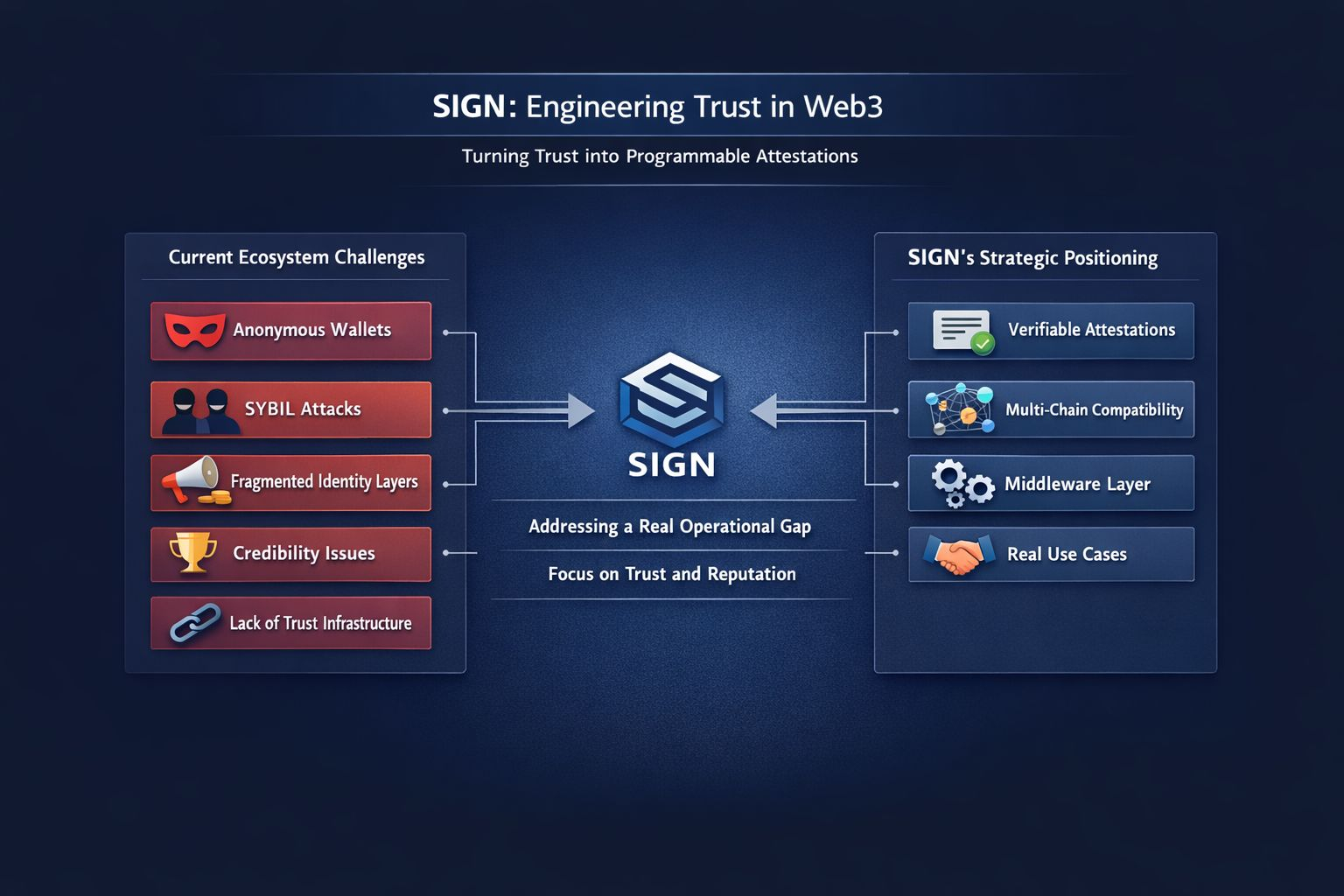
From a strategic standpoint, it demonstrates a clear understanding of where Web3 is heading. Its multi-chain compatibility acknowledges that the ecosystem is expanding across networks rather than consolidating into one. Its role as middleware, operating beneath applications rather than competing with them, positions it as a potential backbone rather than a front-facing product. If executed effectively, it could become an invisible yet essential layer, similar to identity systems in Web2 that quietly power user interactions without drawing attention.
However, beneath this well-structured vision lies a series of deeper tensions that challenge its long-term trajectory.
The first is the inherent paradox of trust. While the system aims to decentralize trust, it ultimately depends on the credibility of those issuing attestations. Over time, certain entities will naturally carry more weight, creating a hierarchy of trust. This introduces the risk of soft centralization, where a limited number of issuers effectively define what is considered credible. In such a scenario, decentralization exists at the protocol level, but influence remains concentrated.
Another critical concern is the lack of a clearly defined economic engine. Unlike protocols with direct revenue mechanisms such as transaction fees or staking incentives, it operates in an abstract layer where value is derived from usage. This raises an important question: what sustains continuous demand? If attestations are not deeply integrated into essential workflows, they risk being perceived as optional rather than necessary. Without strong incentives for both users and developers, adoption may remain inconsistent, limiting long-term impact.$SIGN
The challenge of adoption itself cannot be overlooked. Identity and reputation systems require network effects to become valuable. The project must simultaneously attract issuers, users, and verifiers, a complex coordination problem. Competing decentralized identity frameworks already exist, each attempting to establish itself as the standard. Even with strong technology, success will depend on whether it can achieve critical mass before fragmentation takes hold.
Equally important is the balance between transparency and privacy. Attestations inherently involve data linked to user behavior and participation. Excessive transparency may discourage users concerned about exposure, while excessive privacy can undermine the reliability of the system. Navigating this balance is not merely a technical issue; it involves regulatory considerations and user trust at a fundamental level.
From a broader perspective, this project reflects both the strength and fragility of infrastructure initiatives. Its strength lies in addressing a real and increasingly important problem within Web3. Its fragility stems from its dependence on widespread adoption and ecosystem alignment. Infrastructure only becomes powerful when it is universally integrated; otherwise, it risks remaining underutilized despite its potential.
Ultimately, the key question is not whether it can function as intended, but whether it can become a standard rather than an option. In a fragmented ecosystem, multiple solutions can coexist, but only a few achieve dominance.
The project is building toward a future where reputation is portable, trust is verifiable, and identity is embedded into the fabric of blockchain interactions. Yet that future is still evolving. Until it fully materializes, it exists within a space defined by tension between vision and execution, decentralization and influence, and utility and necessity.
That tension does not weaken the proposition. Instead, it defines the strategic reality it must navigate.