
There was a moment when I was interacting with a contract during a slightly busy period not peak congestion, just enough activity to feel the difference. the transaction went through, but slower than usual. I checked again, refreshed a few times, and started noticing something subtle: it wasn’t just delay, it was variability. some interactions moved smoothly, others felt like they were waiting on something invisible.
after seeing this happen a few times, I stopped thinking about speed and started thinking about conditions. because most systems feel reliable when everything is calm. low load, predictable behavior, clean execution. but that’s not where real networks live long term. they move, they spike, they get messy.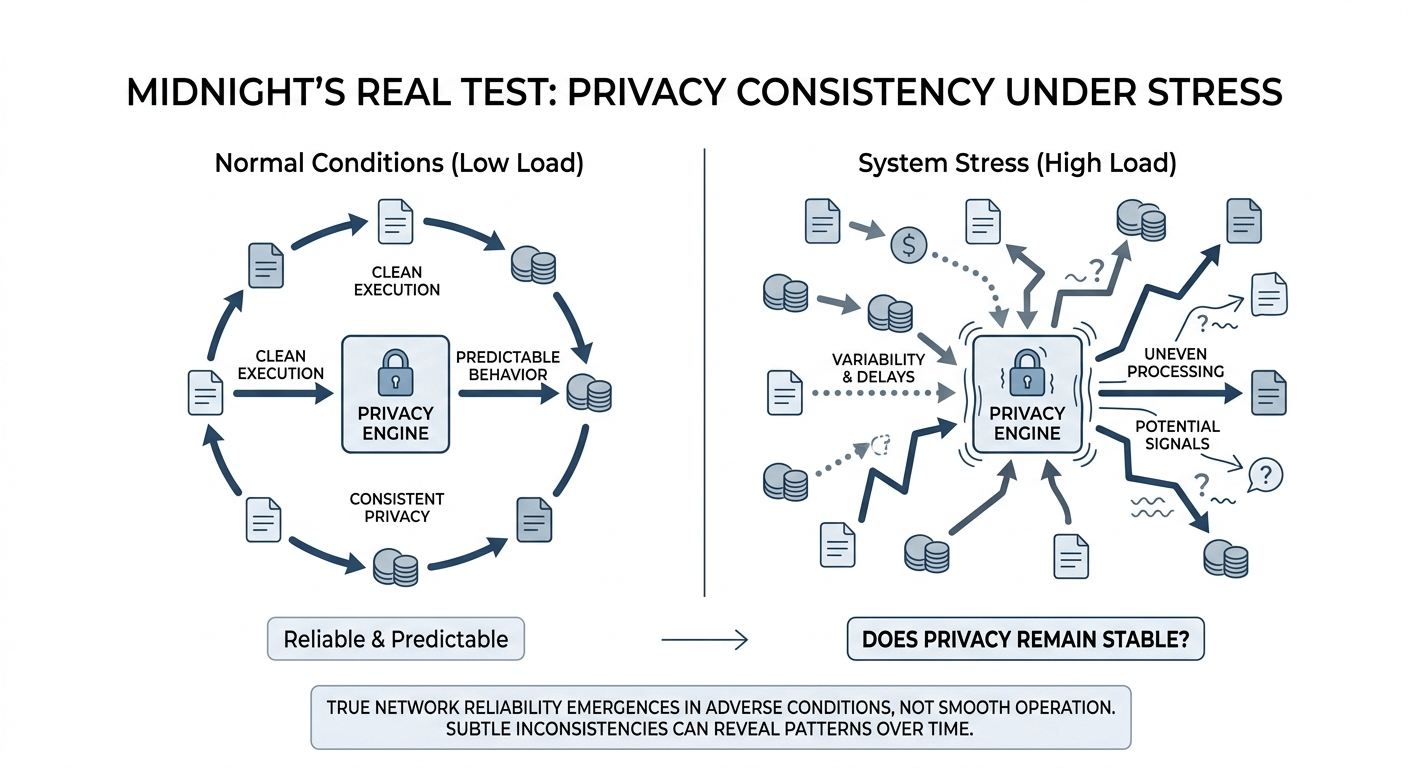
and that’s where design starts to show itself.
from a system perspective, privacy adds another layer to this. it’s not just about processing transactions it’s about doing so while keeping data protected. under normal conditions, that balance is easier to maintain. but as activity increases, the system has to handle more private computations, more coordination between nodes, and more complex state transitions without exposing anything unintended.
the way I think about it is like a quiet room versus a crowded one. in a quiet room, it’s easy to control what’s heard and what isn’t. in a crowded room, the same rules apply, but maintaining them becomes harder. the system doesn’t change the environment does.
when I look at Midnight, what caught my attention is how strongly the design focuses on privacy at the execution level. transactions rely on privacy preserving computation, meaning validation can happen without revealing raw data. selective disclosure ensures only the necessary information is shared. confidential smart contracts run in controlled environments, separating what is executed from what is visible.
on paper, that structure is consistent.
what I noticed though is that the real test isn’t in how this works when activity is low. it’s how it behaves when the network is under pressure. more users, more transactions, more interactions between contracts all happening at once. that increases the load not just on performance, but on coordination between private and public states.
what they get right is minimizing exposure by design. the system doesn’t depend on transparency to maintain correctness, which already reduces unnecessary data visibility.
my concern though is about consistency under stress.
in my experience watching networks, systems rarely fail completely under load. instead, they develop small irregularities. timing differences, uneven processing, slight delays between nodes. in most cases, that just affects performance.
but in a privacy focused system, even small inconsistencies can matter. if certain conditions cause slightly different behavior even unintentionally those differences can become signals over time. not obvious ones, but enough to reveal patterns if someone is paying attention closely.
and that’s the part I keep coming back to.
Midnight’s privacy model makes sense structurally. but what matters in practice is whether that protection remains identical when the system is under stress when coordination becomes harder and edge cases start to appear.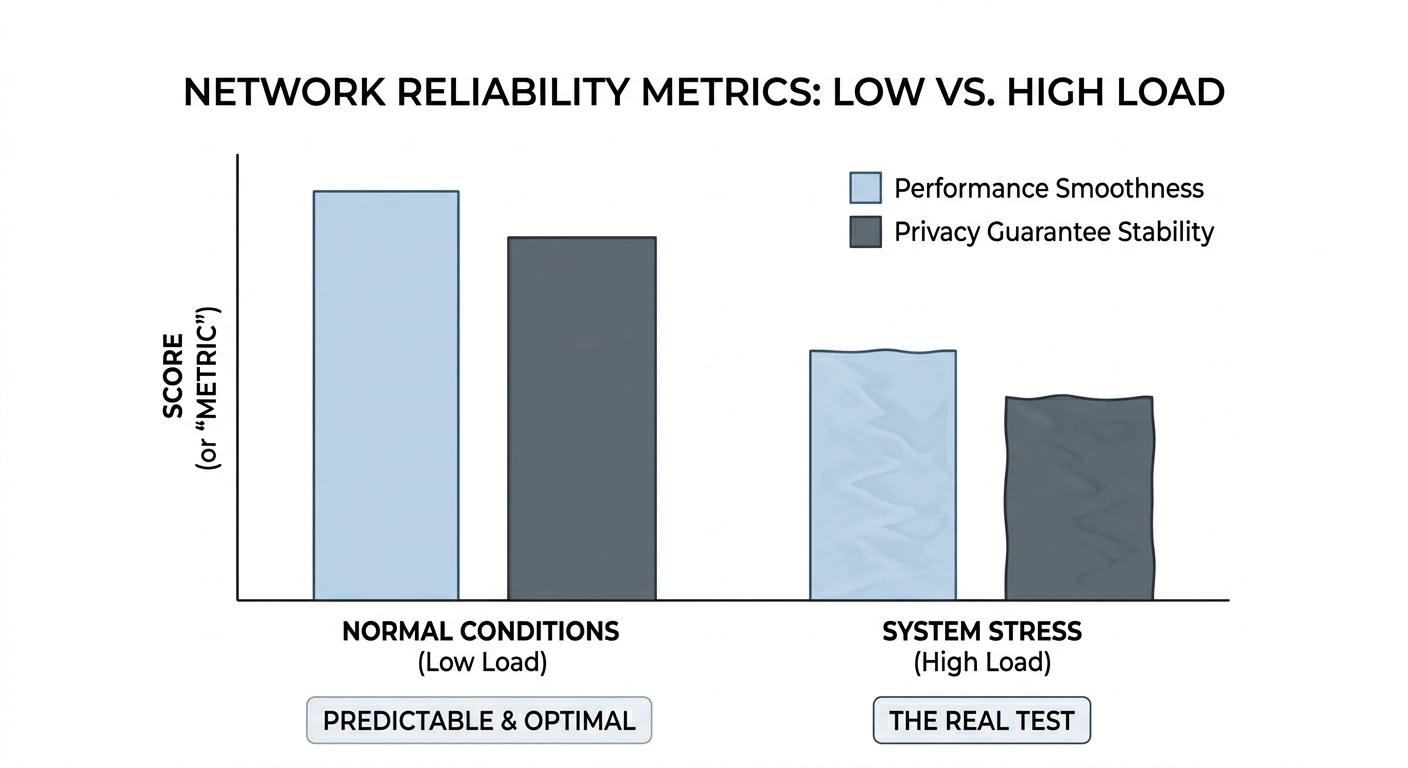
because that’s when infrastructure stops being theory and starts being reality.
what I’m watching now is how the network handles sustained activity. not just peak moments, but continuous load. whether privacy guarantees remain stable, or if subtle variations begin to show.
because a reliable system isn’t defined by how well it works when everything is smooth but by what stays consistent when it isn’t.