@MidnightNetwork #night $NIGHT
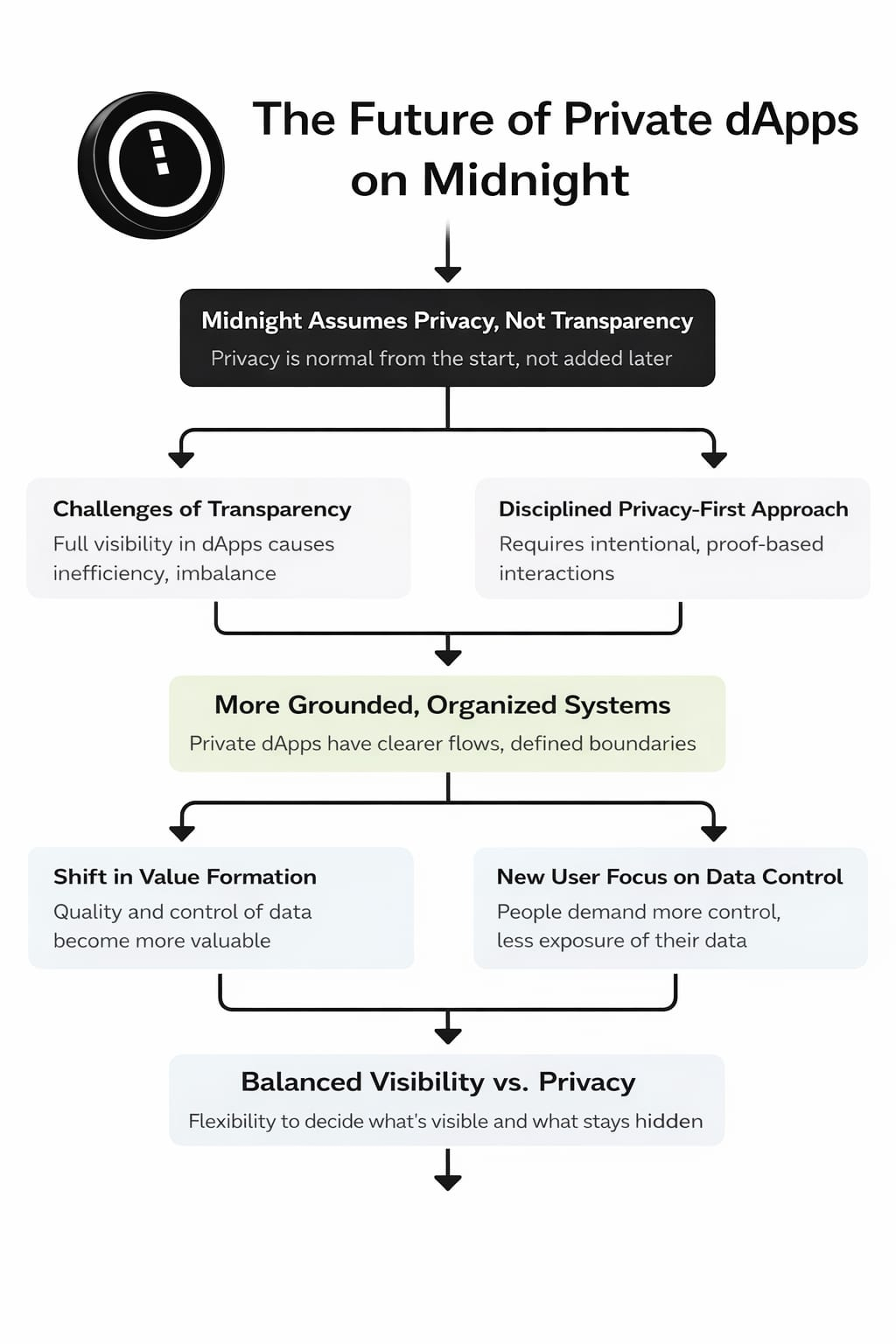
Private dApps never really lacked purpose—they were just trying to exist in systems that weren’t designed for how they needed to function. Most blockchains grew up around the idea that everything should be visible, and for a while, that worked. It made verification simple and trust easier to establish. But outside of that narrow frame, it starts to feel unnatural. Midnight shifts the starting point by assuming privacy is normal, not something that needs to be added later.
That change quietly fixes a problem that has been there from the beginning. Transparency is often treated as fairness, but in practice it doesn’t always play out that way. The people who can process information faster or extract more insight from it tend to benefit the most. What looks open on the surface can still produce imbalance underneath. In more practical environments—finance, business operations, coordination systems—full visibility isn’t just inefficient, it can be a blocker. Midnight removes that tension by letting systems prove that something is correct without exposing how it was done.
Once that restriction is lifted, the way applications are designed starts to feel more grounded. Instead of forcing everything into public view, developers can decide what actually needs to be shared. A system can confirm outcomes, enforce rules, and maintain integrity without turning every internal detail into public data. That alone opens up space for use cases that previously felt awkward or impossible to build on-chain.
At the same time, this isn’t just a free upgrade—it comes with a different kind of discipline. When information isn’t openly available, interactions don’t happen automatically. In transparent systems, contracts connect easily because everything is visible. Here, those connections have to be intentional. Data moves under specific conditions, and every interaction depends on proof rather than assumption. It makes the system more controlled, but also less forgiving if it isn’t thought through properly.
The overall structure starts to shift as a result. Instead of wide, open networks where everything can plug into everything else, you get systems that feel more organized. There are clear entry points, defined flows of information, and boundaries that actually matter. It’s not as loose or spontaneous, but it’s closer to how most real systems are built.
Even the way value forms begins to change. In open environments, a lot of advantage comes from reading public data better than others. In a private setup, that advantage fades. What matters more is the quality of the data itself and how effectively it can be used within the system. That shift mirrors what’s happening beyond crypto, where control over meaningful data is becoming more valuable than simply having access to everything.
There are still challenges that can’t be ignored. Developers need to adjust to a different way of thinking, and that takes time. The tools are still evolving, and building in a privacy-first environment isn’t as straightforward as using familiar patterns. There’s also the question of how these systems are perceived—less visibility can make people uneasy if they’re used to openness as a signal of trust.
What’s changing now is the broader context. People are starting to care more about how their data is used and who gets to see it. In that environment, systems that don’t expose everything by default begin to feel less unusual and more necessary.
The shift isn’t about choosing secrecy over transparency. It’s about having control—deciding what should be visible, what should stay hidden, and when each makes sense. That balance is where the next wave of meaningful applications is likely to come from.