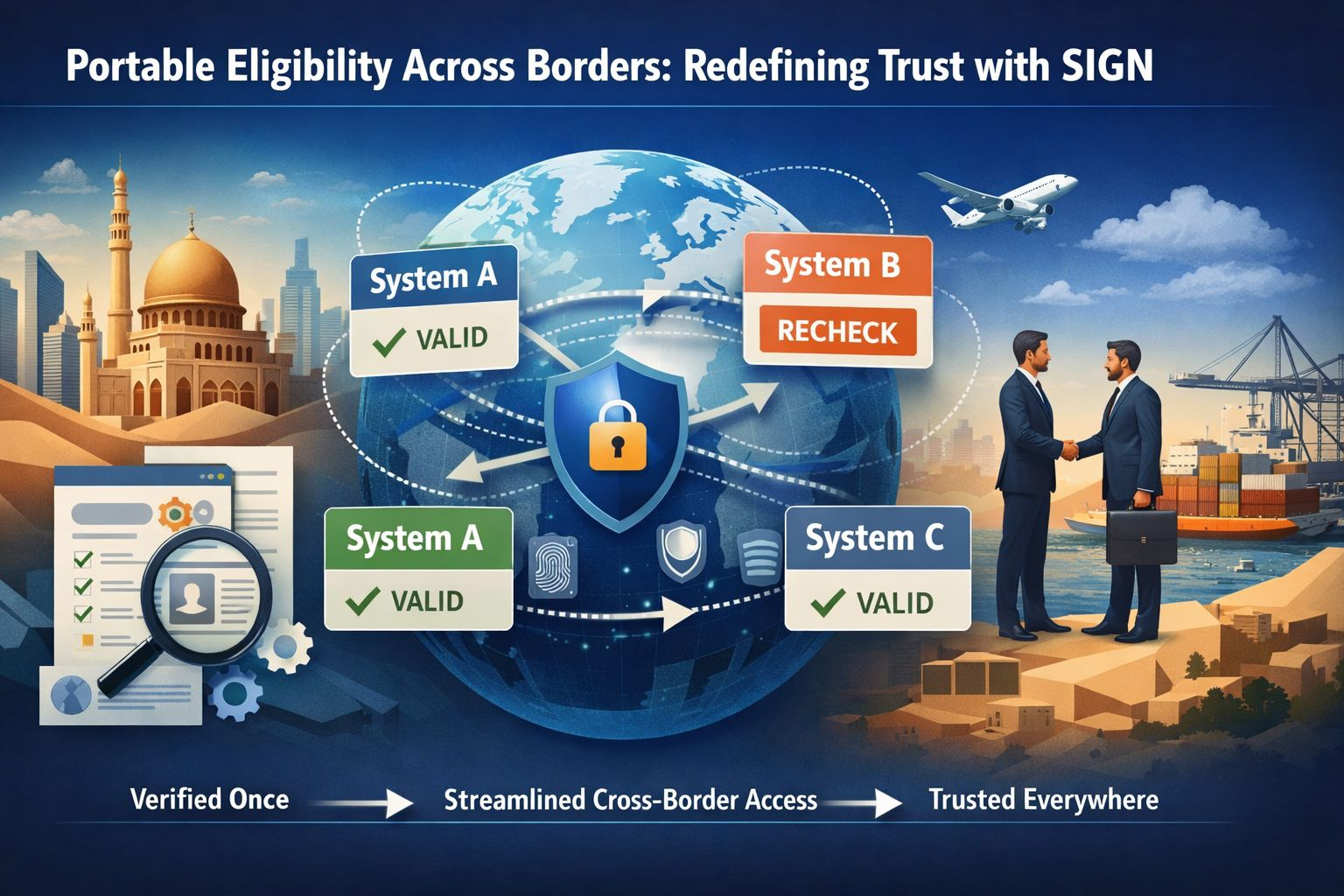
$SIGN only really starts to make sense when viewed through how participation actually works in the Middle East. It is not just about entering a market, it is about being recognized as an entity that is allowed to operate there under conditions multiple sides can trust at the same time. That sounds straightforward, but it is exactly where most of the hidden friction exists.
What becomes noticeable is how different systems still define what is “valid” in slightly different ways. These differences are often small, almost invisible, yet they are enough to trigger rechecks, adjustments, or additional layers before anything can move forward. Nothing breaks completely, but the process keeps getting heavier.
If digital sovereign infrastructure is trying to address this, then $SIGN is less about verification itself and more about eligibility that can move across contexts. It is not just about proving something once, but about whether that proof continues to be accepted when it crosses into a different environment. In a region where cross border activity is expanding quickly, that continuity is the real challenge.
There are situations where everything is already verified, yet still needs to be reshaped to fit another system’s expectations. Not because the original proof failed, but because there is no shared baseline that allows it to be accepted without hesitation. This gap may seem minor at first, but it becomes more visible as it repeats at scale.
So the way to evaluate Sign Official is simple. Does it reduce how often eligibility needs to be re established. Does it make participation feel continuous instead of conditional. And does it allow different systems to rely on the same verified state without second guessing it. If these conditions are met, then $SIGN is not just part of the growth flow, it is influencing who can move through that flow without being slowed down.
@SignOfficial #SignDigitalSovereignInfra