I’ve looked at a lot of blockchain projects, and one thing always becomes obvious to me very quickly: a network only starts proving itself when people begin building on it in a serious way. That’s why, when I think about Midnight after mainnet, I don’t just think about infrastructure, architecture, or launch momentum. I think about applications. I think about the first real products that could show what Midnight is actually meant to do in the wild. And to me, that’s where the conversation gets interesting.
@MidnightNetwork is not trying to be just another chain with a privacy label slapped onto it. That’s the first thing I’d make clear. Its entire purpose points toward something more specific: creating an environment where applications can use privacy as part of their actual function, not just as an optional extra. That matters a lot. I’ve seen many blockchain ecosystems talk about transparency as if more visibility is always better, but that idea falls apart the moment real-world users, businesses, institutions, and regulated activities enter the picture. Most people do not want every action exposed forever. Most businesses definitely don’t. And that’s exactly the gap Midnight is built to address.
What I find especially important about Midnight is that it changes the logic of what an application can be. On a fully transparent chain, developers are always working around exposure. Even when they build something useful, they often have to accept that wallet behavior, transaction patterns, balances, counterparties, or identity-linked activity may become publicly visible. That may work for some categories of crypto-native experimentation, but it becomes a serious limitation when applications need confidentiality. Midnight’s promise after mainnet, at least from how I see it, is that developers won’t have to treat privacy as a workaround anymore. They can treat it as a native design layer.
That changes everything about the first wave of apps that could emerge there. I don’t think the most meaningful Midnight applications will be flashy for the sake of being flashy. I think they’ll be sharp, targeted, and built around situations where public blockchains have always felt too exposed to be practical. Identity is one of the clearest examples. I keep coming back to this because it’s such an obvious pain point. On most systems, proving who you are or proving that you qualify for something usually means giving away more data than necessary. Either the system collects too much, or the blockchain reveals too much, or both. Midnight gives developers a chance to build identity applications around proof instead of exposure.
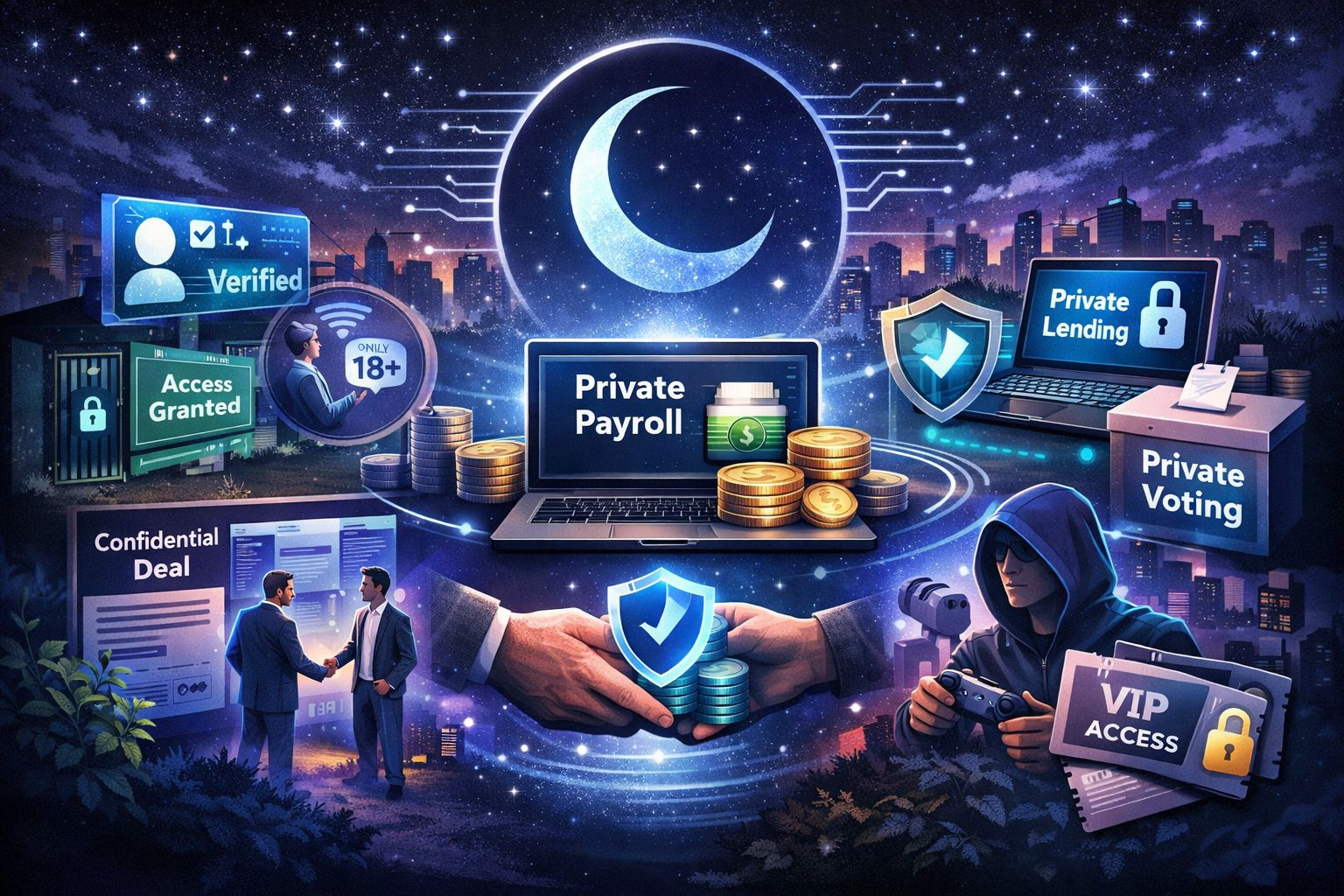
That means a user on a Midnight-based application could prove a fact without disclosing their full personal profile. They could prove age eligibility without revealing a date of birth. They could prove regional qualification without exposing their full identity trail. They could prove they meet access conditions without handing over a complete record of who they are. To me, this is one of the strongest signs of what Midnight could look like after mainnet. Not abstract privacy. Useful privacy. The kind that lets someone participate without feeling stripped open by the system itself.
And once that kind of privacy-preserving identity exists on Midnight, the next step becomes even more powerful. Applications can begin controlling access in ways that are both verifiable and respectful. That’s a huge deal. I’ve noticed that many blockchain projects still struggle with this tension between open participation and real-world compliance. Midnight has the chance to approach it differently. A Midnight application could check whether a user is eligible, verified, or within an approved category, while keeping the user’s underlying data protected. That creates a much more realistic path for applications that need rules but do not want surveillance baked into the user experience.
This is where I think Midnight could stand out very clearly after mainnet. The first successful applications may not be the loudest ones. They may be the ones that solve uncomfortable but very real problems that other chains don’t solve well. For example, regulated access to financial tools. Gated institutional environments. Private verification for enterprise workflows. Credential-based participation in digital ecosystems. These are not random use cases. They line up directly with Midnight’s purpose as a network built for utility without forcing data exposure.
Payments are another major category where I think Midnight could become immediately relevant. Honestly, public payment trails are one of the least natural parts of blockchain when viewed through the lens of real-world use. People need to transact, businesses need to settle, teams need to pay contributors, and organizations need to move value. But they do not need every observer to map those activities in public. A Midnight-based payment application could offer something much more balanced. It could let users transact with privacy while still preserving trust, auditability, and proof when needed.
That part matters to me because Midnight is not just about hiding information. It’s about controlling disclosure. I think that distinction is central to understanding what the first Midnight apps could really look like. A payment on Midnight would not need to become permanent public theater just to be valid. It could remain shielded, while still allowing the right proof to be shown to the right party at the right time. That’s a much stronger model for actual economic life. It protects dignity, strategy, and operational boundaries without breaking verifiability.
I can easily imagine one of the first strong Midnight applications being private payroll or contributor compensation. In fact, I think that would be one of the most practical first-wave builds possible. Public chains are terrible environments for salary visibility. They expose compensation patterns, internal changes, organizational relationships, and timing signals that no serious team wants made public. Midnight gives developers a chance to build payroll systems that are onchain, programmable, and verifiable, but not publicly invasive. Employees or contributors could still prove income when needed, but they would not be forced to publish their compensation life to the world. That feels very Midnight to me because it reflects the exact balance the network appears to be designed for.
I also think Midnight is naturally suited for enterprise-facing applications in a way many other chains simply are not. Businesses do not avoid blockchain because they hate verifiability. They avoid it because transparent environments often reveal too much. Supplier relationships, contract timing, invoice flows, strategic counterparties, internal treasury activity, and operational signals can all leak in ways that make public infrastructure unattractive. On Midnight, the first enterprise applications could finally shift that equation. They could let companies prove that actions were valid, contracts were fulfilled, or obligations were met without exposing the sensitive details around those actions.
That’s a serious opportunity. I’m not saying every enterprise suddenly jumps in the moment mainnet goes live. But I am saying that Midnight’s architecture creates a much more believable foundation for business-grade workflows than standard public-chain logic does. And because of that, I’d expect the first wave of Midnight applications to include things like confidential settlement tools, private invoice systems, selective-disclosure reporting layers, and coordination apps where the proof matters more than the public display of data.
Then there’s DeFi, which I think becomes much more interesting on Midnight when it stops copying the assumptions of transparent DeFi. I’ve seen too many blockchain ecosystems assume that financial openness should always mean total visibility. But users do not naturally want their positions, strategies, balances, or order intentions exposed. Midnight creates room for another model. A Midnight-native DeFi application could be designed around confidential positions, shielded transaction logic, private credit conditions, or proof-based collateral verification. That doesn’t mean risk disappears. Of course not. But it does mean financial tools can be built with a better understanding of how privacy works in real markets.
Lending stands out to me here. On many chains, borrowing means exposing your collateral setup and your position status in ways that invite monitoring or exploitation. A Midnight lending app could be fundamentally different. It could allow a user to prove they qualify, prove they are sufficiently backed, or prove that they satisfy the rules of the protocol without disclosing every detail of their broader financial state. That is a much stronger fit for users who want functionality without full exposure. And again, that feels tightly aligned with Midnight’s purpose.
Trading could follow a similar path. One of the biggest weaknesses in open onchain markets is that visible intent can distort execution. If your move is obvious before it lands, then others can position around it, copy it, or interfere with it. Midnight could support applications where order information remains protected until execution conditions are fulfilled. That improves privacy, yes, but I think it also improves fairness. It reduces unnecessary leakage. It gives users more room to act without advertising strategy. That would be a very real demonstration of what Midnight makes possible after mainnet.
Governance is another area where I think Midnight could offer something unusually strong. Public governance sounds noble until you realize how often it turns into signaling, pressure, reputation gaming, and wallet-based social profiling. On Midnight, governance applications could preserve legitimacy without requiring every participant’s exact choice to become public performance. A user could prove voting rights, cast a valid vote, and help produce a verifiable result without turning their personal governance behavior into an open file. I think that matters more than many people admit. Good governance is not only about visibility. It is also about allowing people to act honestly without unnecessary pressure.
Consumer applications on Midnight could be just as important, even if they appear simpler on the surface. I’ve noticed that regular users understand privacy fastest when it affects something immediate. Membership access. Tickets. Loyalty systems. Creator platforms. Premium communities. Digital services. In all these areas, Midnight could allow applications to verify access or ownership without exposing every related activity. That is powerful because it makes privacy feel normal, not theoretical. A user does not need to care about the technical stack in order to appreciate that an application does not overexpose them.
I think gaming could become a particularly interesting fit. A Midnight-based game or gaming economy could allow ownership, rewards, progression, or in-game achievements to remain verifiable without making the player’s full profile permanently public. Same with fan communities, paid content, membership ecosystems, and tokenized digital experiences. These may seem lighter than enterprise settlement or private DeFi, but they matter because they show how Midnight can serve ordinary interaction, not just high-level infrastructure needs.
The deeper pattern I keep seeing is that Midnight’s first apps will probably succeed when they focus less on secrecy and more on precision. That’s the word I’d use. Precision. Reveal only what is needed. Protect what is not. Make proof portable. Make disclosure optional and contextual. Midnight is most compelling, in my view, when it enables systems that know the difference between verification and overexposure. That difference is where the first strong applications will live.
I also think the best Midnight applications after mainnet will not work as isolated privacy silos. They’ll likely build around reusable proofs and portable credentials. That’s important. A user should not have to start over from scratch in every application. If Midnight becomes a serious ecosystem, then a compliance proof, a membership credential, an eligibility attestation, or a verification status should be reusable across apps in controlled ways. That would make the network feel integrated. It would make privacy composable. And that could become one of Midnight’s biggest strengths over time.
What matters most, though, is the signal the first wave sends. The earliest Midnight applications will shape how people interpret the network itself. If the first products are shallow, vague, or disconnected from real user problems, the project could be seen as clever but distant. But if the first apps clearly demonstrate private identity checks, shielded payments, confidential enterprise workflows, protected governance, and user-controlled access systems, then Midnight will be understood for what it is actually trying to solve. Not privacy as an aesthetic. Privacy as infrastructure for useful participation.
That’s why I think the post-mainnet phase is so important for Midnight. This is the stage where its purpose can become visible through application design. Not through theory. Not through slogans. Through products that make people feel the difference between using a network that exposes everything and using one that understands boundaries. Midnight has a real chance to show that blockchain utility does not need to come at the cost of privacy, and that privacy does not need to weaken trust. In fact, on Midnight, privacy may be the thing that finally makes trust usable at scale.
From my perspective, the first wave of privacy-preserving applications on Midnight could look practical, restrained, and highly intentional. They could center on identity without overcollection, payments without public exposure, business coordination without strategic leakage, finance without forced transparency, and governance without social pressure. If that is the direction Midnight takes after mainnet, then it will not just be another chain with technical ambition. It will be a network that begins proving why privacy-aware applications are not a niche category at all. They are what serious blockchain usage has been missing.