I remember a time when I used to trust systems just because they worked on the surface. Transactions went through, dashboards looked clean, and everything felt smooth. That was enough for me.
At the time, I believed execution was the main thing that mattered.
But after digging deeper into a few projects, I realized something important was missing. When things went wrong, there was no clear way to verify what actually happened. You could see results, but not the reasoning behind them.
That experience changed how I look at infrastructure. Now I don’t just care about whether a system works I care about whether it can prove that it worked correctly.
That’s exactly why S.I.G.N. caught my attention.
Not because it promises better speed or new features.
But because it raises a different kind of question:
What if systems didn’t just execute actions, but also proved them?
So the real question becomes:
Can infrastructure be built in a way where trust is not assumed, but verified every time?
From what I’ve explored in the documentation, S.I.G.N. is built around that idea.
The system connects three major layers:
identity (who is involved)
money (how value moves)
capital (how funds are distributed)
But the real focus is the layer in between the evidence layer.
This is where attestations come in.
Think of it like this: in trading, you don’t just place a trade. There’s always a record entry, margin, execution details. Without that, you can’t audit anything later.
S.I.G.N. applies a similar logic to larger systems.
Every action produces structured evidence:
who approved it
which rules applied
when it happened
And this isn’t just stored randomly. It’s designed to be queried and verified across systems.
That matters because most systems fail not during execution, but during verification.
The architecture also separates public and private rails. Public rails allow transparency, while private rails handle sensitive flows like CBDCs. Identity connects both sides, enabling selective disclosure instead of full exposure.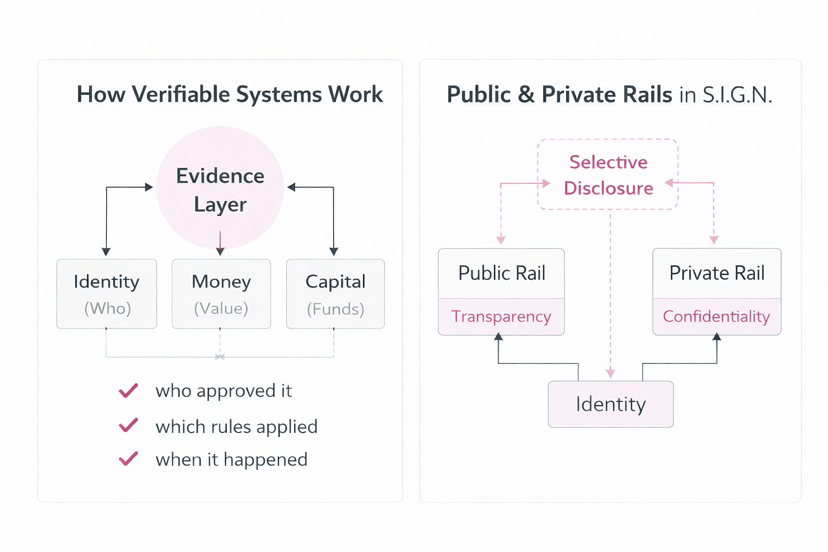
So instead of relying on trust between institutions, the system creates a shared layer of verifiable truth.
The market is slowly starting to explore this direction, but it’s still early.
You don’t really see traditional metrics here like hype-driven volume or quick price spikes tied to retail attention. Instead, adoption looks different.
It’s more about:
how many attestations are being created
how often they are used in real processes
whether systems rely on them for verification
This shifts the focus away from speculation and toward usage quality.
But this is where the real challenge appears.
The biggest issue isn’t whether the technology works.
It’s whether systems actually use the evidence layer consistently.
Because if attestations are not actively used, the entire idea weakens.
For example:
You can build identity systems.
You can build payment rails.
But if actions are not producing verifiable evidence, then you’re back to relying on trust again.
So the key metric here is simple:
evidence usage
Are systems actually generating and verifying attestations in real workflows?
If not, then S.I.G.N. risks becoming another architecture that looks good on paper but isn’t fully applied.
But if it works, the system becomes much stronger over time.
Because once verification becomes standard, it’s hard to go back to blind trust.
So what would make me more confident?
I’d want to see:
consistent use of attestations across identity, payments, and capital flows
real-world scenarios where verification is required, not optional
developers actively building around the evidence layer
On the other hand, I’d be cautious if:
attestations remain underused
systems rely on partial integration
most activity stays experimental
Because that would suggest the core idea isn’t being fully adopted.
So if you’re watching S.I.G.N., don’t just focus on features or narratives.
Watch how often systems actually verify themselves.
In markets like this, the difference between surface-level infrastructure and real infrastructure is simple:
Can the system prove what it does or does it expect you to trust it?
@SignOfficial #SignDigitalSovereignInfra $SIGN