
@SignOfficial $SIGN #SignDigitalSovereignInfra
I have gone through a lot of time observing how markets evolve, but the concept of digital identity only truly "clicked" for me when I looked at the unique economic landscape of the Middle East. In this region, participation isn't just about showing up; it’s about recognition. It’s about being verified as an entity that is permitted to operate under conditions that are trusted by multiple, often competing, stakeholders simultaneously.
On the surface, this sounds like a standard administrative hurdle. In reality, it is where the most significant "hidden friction" in modern business resides.
Beyond Verification: The Concept of "Travelable Eligibility"
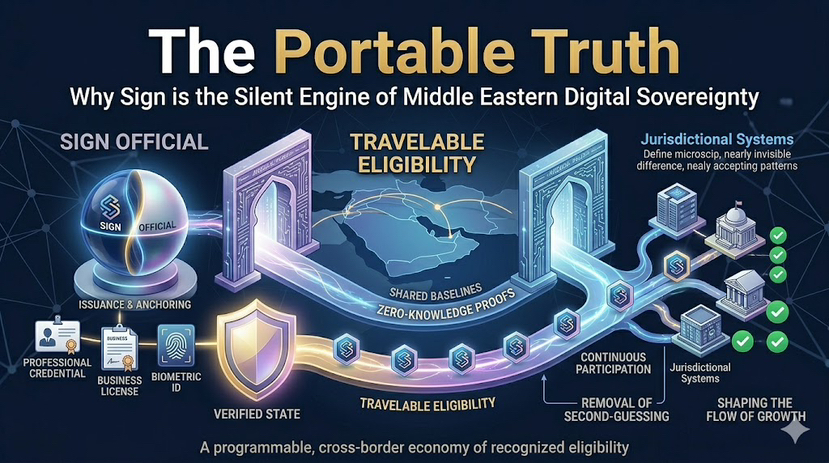
If we look at what digital sovereign infrastructure is actually trying to achieve, the Sign ($SIGN) protocol emerges as something far more sophisticated than a simple verification tool. It isn't just asking, Is this data true? Instead, it asks, Will this truth continue to be accepted when the context changes?
In a region where cross-border activity is accelerating, the challenge isn't proving your legitimacy once. The challenge is ensuring that proof remains meaningful and valid every time you cross a digital or physical border. We are moving toward a world of portable eligibility where your status as a trusted actor travels with you, rather than being anchored to a single siloed database.
The Weight of "Invisible" Differences
One of the most frustrating aspects of current systems is how different jurisdictions define the word "valid." These differences are often microscopic a slight variation in a document format or a different standard for a background check. They don’t necessarily break the process, but they add "weight" to it.
I have seen countless cases where a business was fully cleared in one system, yet had to re-verify, re-frame, and re-submit the exact same data just to satisfy a neighbor’s slightly different expectations. This isn't a failure of the original verification; it’s a failure of shared baselines. When there is no common ground for accepting a proof without hesitation, every interaction becomes a "reset" rather than a "continuation." This gap is easy to ignore in small doses, but at an enterprise or national scale, it becomes a massive drag on GDP.
Defining the Success of Sign Official
When evaluating Sign Official ,the criteria for success are remarkably practical. We have to ask three fundamental questions:
1. Reduction of Redundancy:
Does it decrease the number of times an entity has to re-establish its eligibility?
2. Continuity of Participation:
Does it make participation in a new market feel like a seamless transition instead of a conditional trial?
3. Removal of Second-Guessing: Can different environments rely on the same verified state without needing to "double-check" the work of the previous authority?
Shaping the Flow of Growth
If $SIGN can answer "yes" to these questions, it stops being just another crypto project and starts being a foundational architect of digital trade. It positions itself not just to sit within the flow of economic growth, but to actively shape it.
In the end, the systems that will define the next decade aren't the ones that promise the most speed; they are the ones that remove the most hesitation. A business license or a professional credential that can be verified instantly across borders without second-guessing changes the velocity of an entire economy. Value, in this new era, is found in repeated trust embedded in everyday interactions.