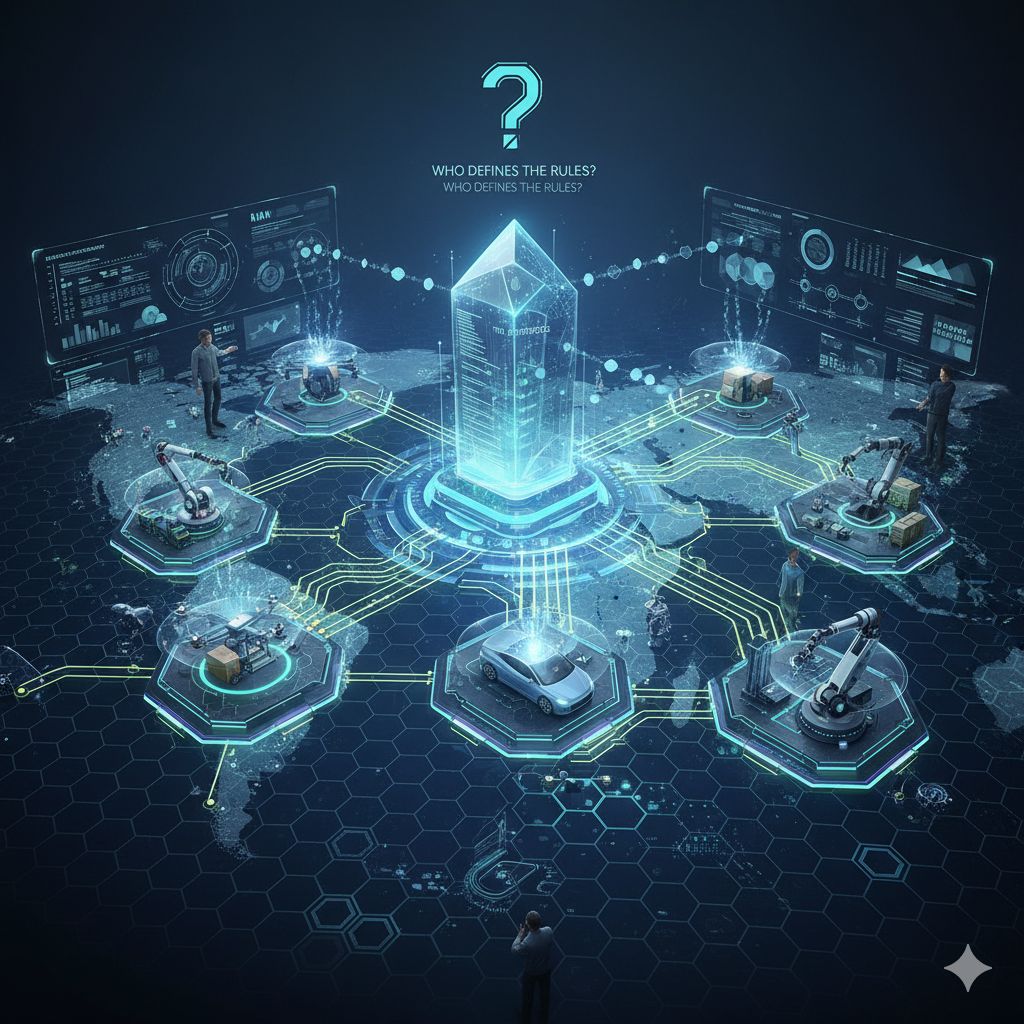
We often assume the hard problem is making machines smarter. In practice, the harder problem is getting different actors human or machine to work together without constant supervision, negotiation, or trust.
Most real-world systems don’t break because participants are incapable. They break because no one can clearly verify what happened, who is responsible, and what the consequences should be. That gap between action and accountability is what institutions have traditionally filled. Licenses, contracts, audits, insurance: all of these exist to make behavior legible and enforceable.
But they don’t scale well. They rely on judgment, paperwork, and centralized control. As systems become more fragmented and tasks become more granular, this model starts to strain.
A different approach is emerging one that doesn’t try to make actors trustworthy, but instead makes their actions verifiable.
In this model, a machine isn’t trusted because of who operates it. It participates because it can meet clearly defined conditions. It can lock up value as a guarantee of performance. It can prove what it did. And if it fails, the cost of that failure is immediate and measurable.
This shifts the focus away from identity and toward execution.
A robot, for example, doesn’t need legal recognition if it can put up collateral. It doesn’t need oversight if its behavior can be checked automatically. It doesn’t need trust if it can’t benefit from cheating without being penalized.
What matters is not how intelligent it is, but how accountable it is.
And accountability scales in a way intelligence doesn. You can coordinate large, complex systems with relatively simple actors as long as their behavior is predictable, verifiable, and economically bounded.
This leads to a deeper change in how work itself is organized.
Today, most work is managed. Tasks are assigned, monitored, adjusted, and reviewed. It’s an ongoing process that depends heavily on supervision and discretion.
But if actions can be clearly defined, measured, and verified, then work can be treated differently. Instead of being managed, it can be settled.
A task is specified. An actor completes it under certain conditions. The outcome is verified. Payment is released. The system moves on.
That might sound like a small shift, but it changes the structure of coordination entirely.
For this to work, physical actions need to be translated into something digital systems can understand. When a machine delivers a package, inspects equipment, or completes a repair, those outcomes must be captured in a way that can be verified through sensors, constraints, or other forms of proof.
Once verified, the action becomes a kind of finalized record. It’s no longer just “something that happened.” It’s a state change the system can rely on. Payment can be triggered. Reputation can be updated. Other processes can build on top of it.
At that point, work becomes modular.
Instead of large, tightly managed operations, you get smaller units of execution that can be combined in different ways. A logistics process, for example, can be broken into pickup, transport, handoff, and delivery each performed by whoever can meet the conditions most efficiently.
These units can be routed dynamically. Tasks are made available. Actors compete or signal readiness. Execution happens under clear rules. Outcomes are verified and settled.
Coordination becomes less about hierarchy and more about flow.
And when coordination becomes the central layer, that’s where value starts to concentrate.
We’ve seen similar patterns before. Traders compete, but exchanges define how trades happen. Businesses create products, but payment networks control how money moves between them. In both cases, the infrastructure that coordinates activity captures a large share of value.
Something similar could happen here.
Machines robots, vehicles, sensors are likely to become more standardized over time. As they do, their individual differences matter less. What matters more is how they connect to a shared system that decides what work is valid, how it’s verified, and how it’s paid for.
That system the coordination protocol begins to look like infrastructure.
It sets the rules. It tracks performance. It determines who can participate and under what conditions. And as more activity flows through it, it becomes harder to replace.
This doesn’t remove complexity. It changes where it lives.
Verification in the physical world is never perfect. Sensors can fail. Edge cases can be exploited. Designing systems that are both strict enough to prevent abuse and flexible enough to handle reality is difficult.
Economic rules introduce trade offs as well. Requiring participants to put up collateral improves accountability, but it can also exclude smaller players. Reputation systems help with trust, but they can make it harder for newcomers to compete.
Even so, the direction is clear.
As more physical actions become measurable and verifiable, and as more of those actions can be tied directly to economic outcomes, coordination starts to move away from institutions and into shared systems of rules.
Work becomes something that can be defined, executed, and settled with minimal interpretation.
And that leads to a more fundamental question.
If participating in the real world increasingly means interacting with systems that decide what counts as valid work systems that verify, route, and settle activity then control doesn’t just belong to those doing the work, or even those owning the machines.
It belongs to whoever defines the rules of the system itself.
When reality is filtered through code, value flows along the paths that code allows.
The question is no longer just who builds or operates the system.
It’s who decides how the system works and who benefits as everything begins to move through it.