
I’ve seen approvals fall apart months after they were made… not because they were wrong, but because no one could explain them anymore.
That’s the part nobody advertises.
Everyone talks about transactions. Movement. Speed. Settlement. The visible stuff. But I’ve had moments usually during audits or messy reconciliations—where the real question wasn’t what happened, it was why was this allowed to happen in the first place?
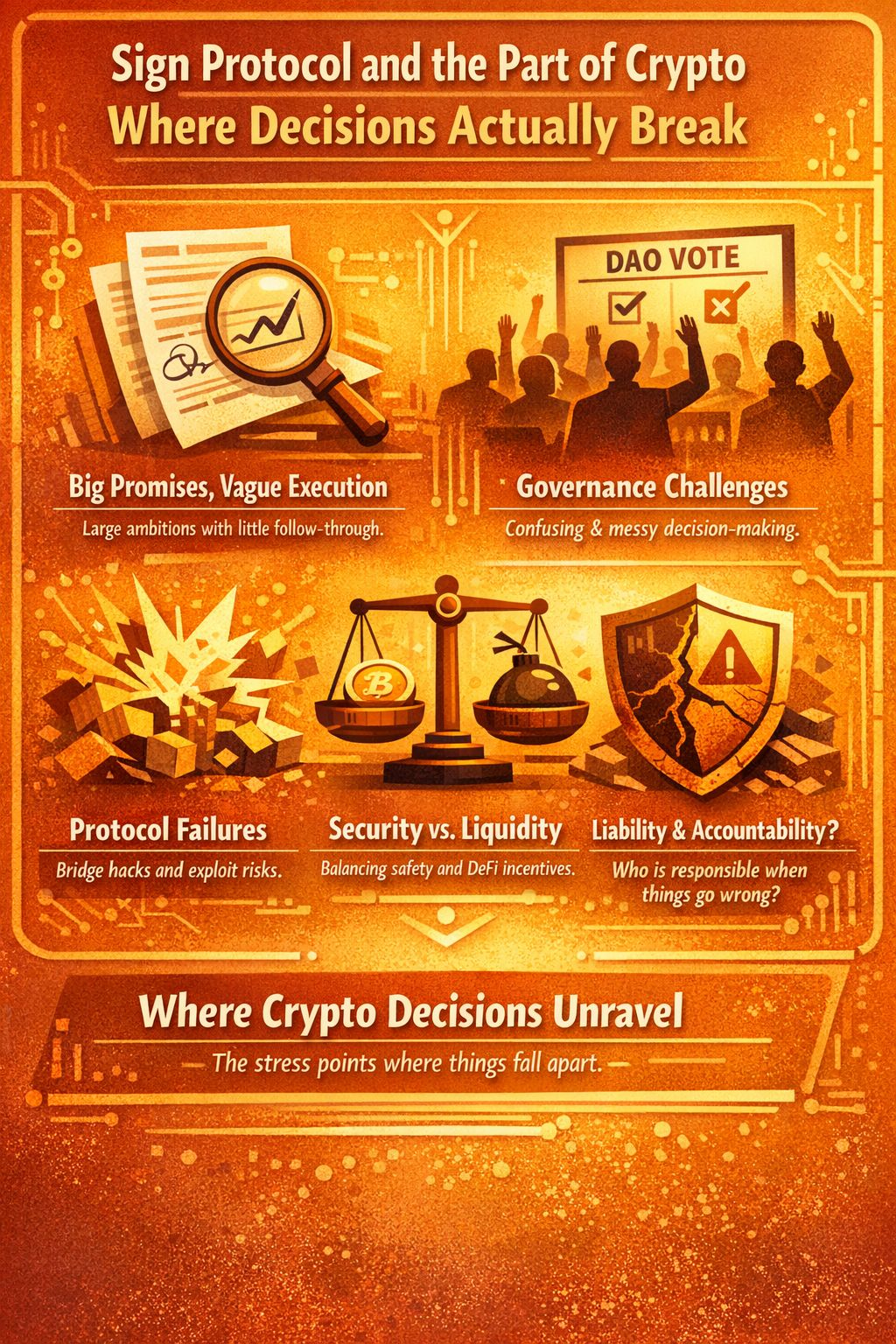
And that’s where things get uncomfortable.
Because most systems don’t break at execution.
They break earlier. Quietly. In the administrative layer where someone decides who gets access, who qualifies, who’s “verified enough”… and who isn’t. It’s dull. Bureaucratic. Easy to ignore. Until it isn’t.
Crypto likes to pretend it solved this.
It didn’t.
It just gave the problem better branding. Identity layers. Credential systems. Trust rails. I’ve read enough of these decks to recognize the pattern.
Same friction, different packaging. And once you dig a little deeper, you usually find the same issues fragmented records, private approvals, scattered logic across systems that don’t quite talk to each other.
Looks clean on the surface.
Underneath? Still a mess.
That’s why Sign Protocol caught my attention. Not because it promises anything revolutionary. It doesn’t feel like that. It feels… more grounded. Almost uncomfortably so.
It’s looking at the part of the system most people avoid.
The evidence behind decisions.
Because in real systems, what matters isn’t just that something happened. It’s whether you can explain it later. Clearly. Defensibly. Without digging through a graveyard of internal tools, emails, spreadsheets, and half-forgotten approvals that only made sense in the moment.
I remember dealing with a case where a company had been fully cleared to participate in a financial process.
Everything looked fine at the time. Then months later, questions came up. Not about the transaction itself but about the approval. Who signed off? Based on what criteria? Where’s the record?
The answer was… complicated.
Not because the decision was wrong. Because the justification didn’t travel with it.
That’s the kind of failure that doesn’t show up in dashboards.
It shows up when things go wrong.
And it’s everywhere.
Finance runs on this kind of fragile memory. Someone gets marked eligible, but the proof is thin.
A business gains access, but that recognition doesn’t carry across systems. Capital gets distributed, but the logic behind inclusion disappears the moment the decision leaves the room.
We like to think digital systems fixed this.
They didn’t.
If anything, they made the paper trail more abstract. Harder to follow. Easier to lose.
Sign Protocol seems to be trying to pin that down. Not in a flashy way. In a very specific, almost stubborn way.
It’s focused on making claims identity, eligibility, authorization hold their shape as they move between systems. Not just exist, but remain interpretable. Verifiable. Intact.
That’s harder than it sounds.
Because most systems don’t agree on context. What counts as “verified” in one environment might mean nothing in another. So the same claim gets rechecked. Revalidated. Reinterpreted. Over and over again.
That repetition? It’s not just annoying.
It’s structural friction.
And it adds up.
So when I look at Sign Protocol, I don’t see a project trying to make crypto faster or louder.
I see something trying to reduce how often the same decision needs to be justified from scratch. Trying to give approvals a kind of durability they usually don’t have.
That matters more than people think.
Because this space still clings to a simplified idea of ownership. Hold the asset. Hold the key. Done.
But that’s never been the full picture not in finance, not in regulated systems, not in anything that involves coordination at scale.
Someone is always deciding who gets in.
Someone is always drawing lines.
Crypto didn’t remove that. It just hid it better.
Sign doesn’t pretend otherwise. And I respect that.
It starts from the messier truth that access is conditional. That participation depends on recognition. And that recognition needs records strong enough to survive scrutiny.
Not exciting. Not headline-worthy.
But real.
Still… I’m not giving it a free pass.
Better infrastructure for proof doesn’t automatically make anything fairer. I’ve seen clean systems enforce bad rules before. If the underlying criteria are flawed, stronger attestations just make exclusion more frictionless. More precise. More scalable.
That’s a real risk.
Maybe the biggest one.
Because a system can become more legible without becoming more just. And crypto doesn’t always like that conversation—it complicates the narrative.
But ignoring the problem doesn’t fix it either.
It just leaves power sitting inside worse systems, with worse visibility, and more room for denial when things break.
So I’d rather see projects engage with the problem directly, even if the outcome isn’t perfect.
That’s where Sign Protocol sits for me.
Not as some heroic solution. Not as a clean break from the past. But as an attempt to deal with something that’s been quietly breaking systems for years how to make a claim hold up after the moment it’s made.
How to stop decisions from dissolving into ambiguity once they leave their original context.
How to give participation a form that doesn’t disappear the second it’s challenged.
It’s a grind.
No glamour. No hype.
Just structure.
And that’s exactly why most teams avoid it.
There’s no adrenaline in saying you’re improving the quality of institutional proof. No easy narrative. No viral hook. It doesn’t feed the usual cycles of attention.
But when systems fail, this is usually where they fail.
Not on execution.
On meaning.
I keep coming back to that.
Because if a user is approved, what does that actually mean outside the system that approved them? If someone qualifies, who made that call—and can anyone verify it later without reconstructing the entire decision from scratch?
If capital moves… what survives after the moment passes?
Not the transaction.
The justification.
That’s the layer Sign Protocol is working on. The evidence layer. The part that gives continuity to decisions that would otherwise collapse into noise.
And yeah… it could still fail.
Adoption is never guaranteed. Systems like this only matter if they’re used repeatedly, embedded deeply enough that people stop thinking about them. If they stay optional just another layer you can ignore they won’t stick.
That’s the real test.
Not whether the idea makes sense. It does.
But whether it becomes necessary.
Because in the end, finance isn’t just about moving value. It’s about recognition who’s allowed to participate, under what conditions, and whether that recognition holds when it’s challenged.
Sign Protocol is trying to give that recognition a stronger form.
The question is… does that actually change anything?
Or does it just make the lines cleaner when they’re drawn?