

I keep coming back to this thought: if a business has valuable intelligence, why does monetizing it so often require exposing the raw material behind it? That is the contradiction I keep seeing in both crypto and enterprise software. The systems that promise transparency often ask firms to reveal too much, while the systems that protect data often make that data harder to use. Midnight caught my attention because it is trying to break that tradeoff instead of pretending it does not exist.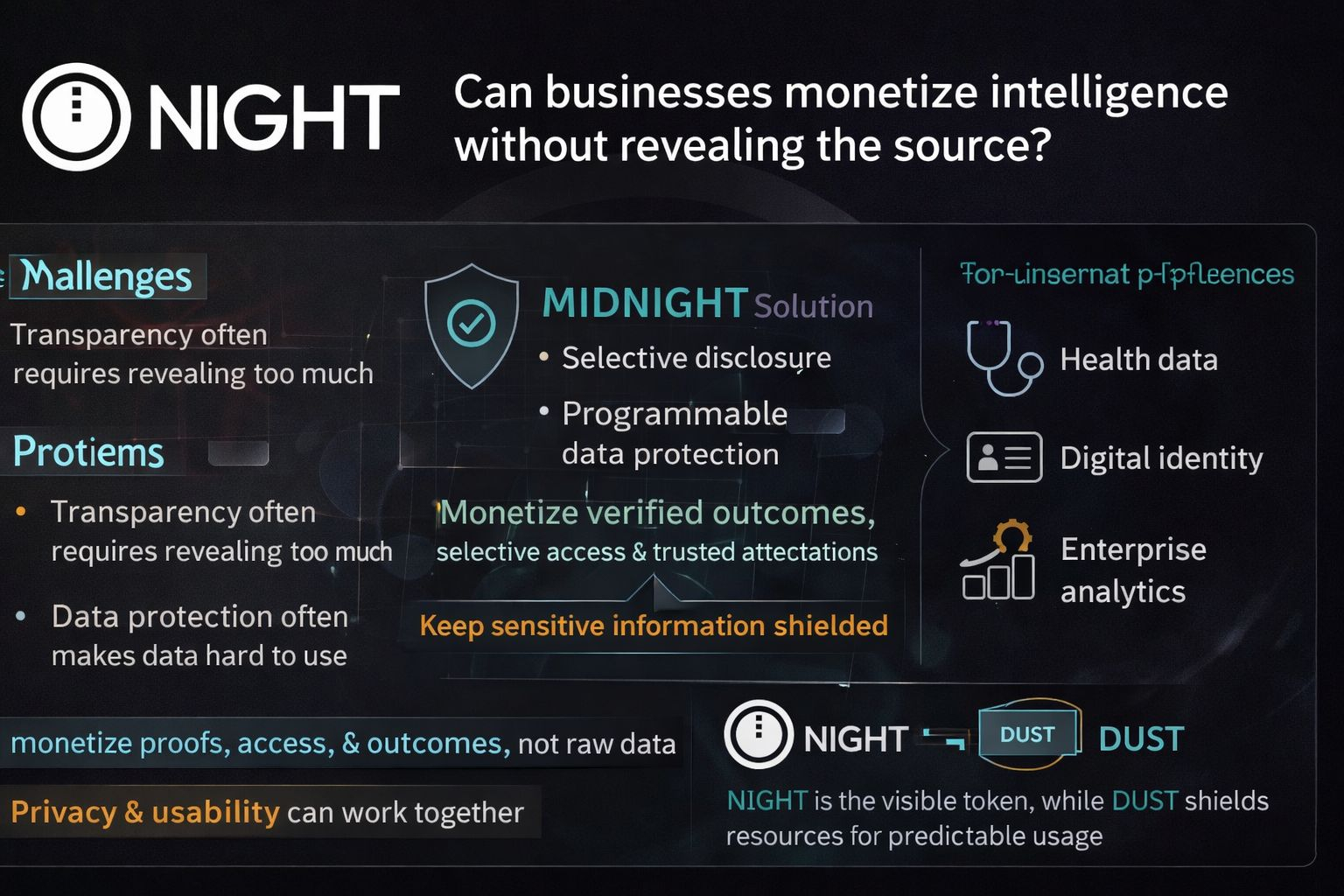
Picture a hospital software provider that has built a strong diagnostic risk model from years of operational data. The model is valuable. The hospital may want to prove that a patient qualifies for a service, or that an internal decision rule was applied correctly, or that a compliance threshold was met. But handing over the raw dataset, the internal logic, or the full metadata trail would create a second risk on top of the first.
That is where so many elegant systems get messy in practice.
The moment intelligence becomes monetizable, the temptation is to extract it, duplicate it, and expose more of it than the business ever intended. In theory, transparency sounds clean. In practice, it often turns commercially valuable knowledge into a leakage point. A company wants to prove something useful. The counterparty wants assurance. Regulators may want something inspectable later. But the more trust the system demands, the more likely it becomes that the source itself gets dragged into view.
That is why Midnight feels more interesting to me as infrastructure than as a simple token story. What stands out is not just the privacy language, but the attempt to connect privacy to actual product design. Midnight is built around programmable data protection, selective disclosure, and the idea that applications can generate utility without forcing users or businesses to surrender ownership of the underlying data. That matters because it shifts the discussion away from hiding everything and toward revealing only what is necessary.
I think that is the deeper commercial point here.
Monetization in this model is not really about selling data. It is about selling verified outcomes, selective access, or trusted attestations. That is a big difference. A lot of digital businesses still behave as if the only way to extract value from intelligence is to centralize it, hoard it, and selectively expose pieces of it whenever trust is needed. Midnight seems to push toward a different logic: keep sensitive information shielded, let public and private state interact through smart contracts, and use proofs to attest that hidden information satisfies certain conditions. In other words, monetize what can be proven, not everything that can be copied.
Could that actually matter in the real world?
I think it could, especially in areas like health data, digital identity, enterprise compliance, and high-value internal analytics. A company may not want to reveal the source data behind a risk score, a behavior model, or a compliance engine. But it may want to prove that the output was generated under valid conditions and that another party can rely on the result. That is a much more useful framing than the usual choice between full disclosure and blind trust. It creates space for privacy and usability to work together instead of canceling each other out.
There is also an economic layer here that seems more practical than people may first notice. Privacy infrastructure only becomes useful to businesses if it can be budgeted, planned, and integrated without constant friction. That is where Midnight’s NIGHT and DUST model becomes more than a tokenomic curiosity. NIGHT remains the visible native token, while DUST functions as the shielded resource used for transaction activity. That separation matters because it tries to make usage more predictable instead of tying every operational cost directly to a volatile visible token. For businesses, predictability is not a side issue. It is part of whether a product is usable at all.
The same applies to user experience.
Midnight’s design suggests that app operators could sponsor users’ transactions, and that end users may not need to understand the underlying fee resource in order to use an application. That sounds like a small detail, but I think it is one of the most important ones. Most people do not want to learn an extra economic model just to use an app. If businesses can absorb the privacy infrastructure while presenting a familiar interface, Midnight starts to look less like a specialized privacy chain and more like a backend for applications that want confidentiality, policy control, and clearer audit boundaries.
Still, I do not think this model is frictionless. The tradeoffs are real. Midnight introduces more conceptual machinery than a normal single-token chain. Businesses and developers may need to understand shielded versus unshielded logic, DUST generation and decay, selective disclosure rules, and the broader capacity design of the network. That may be strong mechanism design, but it also raises the learning burden. Elegant architecture does not automatically become easy architecture.
Adoption is another real question. Businesses do not integrate systems just because the theory is good. They integrate systems when the tooling is usable, the compliance path is credible, and the product fits existing workflows. Midnight seems aware of that burden. Its emphasis on developer tooling, TypeScript-based environments, Compact, and programmable disclosure suggests that it is trying to make privacy operational rather than merely philosophical. That is the right direction. Privacy alone does not close deals. Operational fit does.
So I think the honest answer is not that Midnight guarantees a new market for hidden intelligence. It is that Midnight makes that market more plausible than most blockchain designs do. It treats the source of intelligence as something that may need to stay protected, while the output, proof, or right to act can still become economically useful. That is a meaningful shift from the usual crypto instinct that credibility only comes from putting everything in view.
And that leaves me with the real question behind all of this: if Midnight can let businesses sell proof, access, and verified outcomes instead of exposing raw data, could it become one of the first serious blockchain models where monetizing intelligence no longer means surrendering its source?
@MidnightNetwork #night $NIGHT
